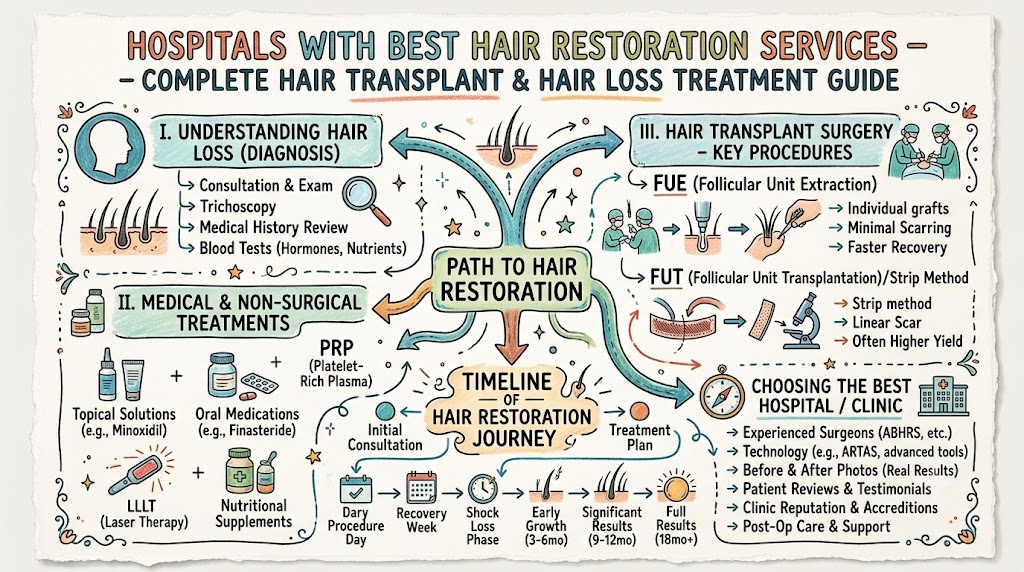
Introduction
Hair loss is far more than a cosmetic concern; for many, it is a deeply emotional journey that impacts self-image, confidence, and professional identity. Whether you are in the early stages of thinning or experiencing advanced balding, the realization that you are losing your hair can be unsettling. However, we live in an era where hair loss is no longer inevitable. Advances in cosmetic surgery and dermatology have revolutionized the field, making it possible to restore not just your hair, but your sense of self.
When you begin searching for “hospitals with best hair restoration services,” you are looking for a unique combination of artistry and medical precision. A successful hair transplant is a blend of clinical expertise, aesthetic judgment, and a patient-centered approach. It is about understanding the geometry of the scalp, the texture of your hair, and your specific goals for the future.Navigating the landscape of available providers can be daunting. You want a facility that prioritizes safety, transparency, and long-term satisfaction. Resources like BESTCOSMETICHOSPITALS are designed to help you cut through the marketing noise and connect with hospitals that adhere to the highest standards of care.
Understanding Hair Loss
To address hair loss effectively, one must first understand why it happens. The human hair growth cycle consists of the anagen (growth), catagen (transition), and telogen (resting) phases. When the balance between these phases is disrupted, hair loss occurs.The most common form of hair loss is Androgenetic Alopecia, or pattern baldness, which affects both men and women. In men, it typically manifests as a receding hairline and thinning at the crown. In women, it is often characterized by diffuse thinning across the scalp, often maintaining the frontal hairline.Genetics remain the primary driver, but other factors contribute significantly. Hormonal changes, particularly fluctuations in dihydrotestosterone (DHT), play a critical role in shrinking hair follicles. High-stress environments can trigger conditions like telogen effluvium, where hair follicles are pushed into the resting phase prematurely. Additionally, nutritional deficiencies, particularly in iron, vitamin D, and protein, can weaken hair structure and lead to excessive shedding.
Table 1: Common Causes of Hair Loss
| Cause | Men | Women |
| Genetics | Common | Common |
| Hormonal Changes | Moderate | Common |
| Stress | Common | Common |
| Nutritional Deficiency | Possible | Possible |
| Medical Conditions | Possible | Possible |
4. What is Hair Restoration?
Hair restoration encompasses a broad range of medical and surgical interventions designed to replenish hair density and restore a natural appearance. It is not a “one-size-fits-all” field; it involves a personalized approach where the surgeon assesses the quality of your donor area, the extent of your hair loss, and your long-term aesthetic goals.Broadly, these treatments are categorized into surgical and non-surgical approaches. Surgical options, like hair transplants, involve moving healthy hair follicles from a donor area (usually the back of the head) to thinning areas. Non-surgical options, such as PRP therapy or medical management, aim to strengthen existing follicles and slow the progression of hair loss.A successful outcome begins with a comprehensive candidate evaluation. Not every patient is a candidate for surgery. An experienced specialist will determine if your donor supply is sufficient and if your scalp health can support the intended procedure.
Types of Hair Restoration Procedures
Modern hair restoration has evolved to prioritize minimally invasive techniques that leave little to no scarring.
FUE (Follicular Unit Extraction)
In FUE, individual hair follicles are harvested one by one from the donor area using a specialized punch tool. This method is highly favored because it avoids a linear scar, making it ideal for patients who prefer shorter hairstyles. The recovery is generally faster, and the results are incredibly natural as the surgeon can strategically place each follicle.
FUT (Follicular Unit Transplantation)
FUT involves removing a thin strip of skin from the donor area, from which individual follicular units are carefully dissected under a microscope. While it involves a linear scar, it is often more efficient for patients requiring a large number of grafts in a single session.
PRP Therapy
Platelet-Rich Plasma (PRP) therapy utilizes your own blood plasma, concentrated with growth factors, to stimulate dormant hair follicles. It is a non-surgical option best suited for individuals in the early stages of hair loss or as a supportive treatment post-transplant.
Scalp Micropigmentation
This is a cosmetic tattoo technique that simulates the appearance of hair follicles, providing the look of a denser, fuller scalp. It is an excellent option for those who want to hide scarring or create the illusion of thickness.
Medical Hair Loss Treatments
These involve topical or oral medications that can inhibit DHT production or encourage blood flow to the scalp, often acting as a bridge to, or a maintenance for, surgical results.
Table 2: Comparison of Hair Restoration Procedures
| Procedure | Surgical | Recovery Time | Suitable For |
| FUE | Yes | Shorter | Mild to Advanced Hair Loss |
| FUT | Yes | Moderate | Larger Graft Needs |
| PRP | No | Minimal | Early Hair Thinning |
| Scalp Micropigmentation | No | Minimal | Cosmetic Enhancement |
Who is a Good Candidate for Hair Restoration?
A good candidate is someone with realistic expectations and a stable enough donor supply to support the desired coverage. Male pattern baldness that has stabilized is a classic indicator, but women with thinning hair are increasingly seeking restoration as well.
The evaluation process includes checking the thickness and caliber of your donor hair. Thick, curly, or coarse hair often provides better coverage than fine, straight hair. Patients should be in good general health, free of uncontrolled medical conditions that might impair healing.
Benefits of Modern Hair Restoration
The primary benefit is, of course, the aesthetic improvement. However, the psychological benefits are equally profound. Patients often report an immediate boost in self-confidence, finding that they no longer feel the need to hide their scalp or avoid social situations.
Modern techniques offer results that are indistinguishable from natural hair. Because the hair is your own, it grows, requires cutting, and can be styled naturally. Advanced hospitals now focus on “hairline design,” where the artistic placement of grafts ensures that the final result frames the face in a way that is age-appropriate and natural.
Risks & Limitations
Like any surgical procedure, hair restoration carries risks, including minor infection, temporary swelling, or inflammation. There is also the possibility of “shock loss,” where existing hair temporarily sheds after the procedure—this is almost always reversible.
It is vital to maintain realistic expectations. A hair transplant creates a full look, but it may not replicate the density you had in your teens. A qualified surgeon will always be transparent about what is achievable, ensuring you are not led toward unrealistic outcomes.
How to Choose the Best Hair Restoration Hospital
Selecting a hospital is the most critical decision in your hair restoration journey.
- Surgeon Expertise: Look for board-certified surgeons with a specific track record in hair restoration.
- Technological Infrastructure: Advanced centers utilize microscopes for dissection and high-precision tools for implantation.
- Before-and-After Portfolio: A reputable hospital should provide a portfolio of their work that shows natural hairlines and consistent results.
- Post-Treatment Support: Hair restoration is a long game. Ensure the hospital provides a clear follow-up plan to manage your scalp health in the months following surgery.
- Patient Education: A great center will spend time educating you on the procedure rather than pushing for a quick sale.
Pre-Procedure Preparation
Preparation involves a detailed medical review. You may be asked to stop certain medications that thin the blood, and you should avoid smoking or alcohol in the days leading up to the procedure to optimize blood circulation to the scalp.
Recovery After Hair Restoration
The first week involves careful scalp management. Most patients return to work within a few days, though strenuous exercise should be avoided for two weeks. The “shedding phase” in the first month is a normal part of the process, and the hair begins to show visible regrowth around 3–6 months.
Table 4: Hair Restoration Recovery Timeline
| Timeline | What to Expect |
| First Week | Healing and scalp care |
| First Month | Temporary shedding |
| 3–6 Months | Early growth |
| 6–12 Months | Visible improvement |
| 12+ Months | Mature results |
Real-Life Patient Success Stories
We frequently hear from patients who describe their procedure as “liberating.” One notable success involved a middle-aged woman who suffered from traction alopecia; through careful graft placement, her hair regained its volume, and she noted that she felt “like herself again.” Another case involved a man who felt his receding hairline aged him by a decade; the FUE procedure helped him regain a youthful appearance that significantly benefited his professional life.
Future of Hair Restoration
The future is incredibly promising. We are moving toward robotic hair transplantation that can extract grafts with unprecedented speed and precision. Furthermore, regenerative medicine—using stem cells to potentially “wake up” dormant follicles without the need for surgery—is a major area of active research.
FAQs
- What is hair restoration?
It is a medical/surgical process to replenish density and restore natural hair coverage. - Is a hair transplant permanent?
Yes, transplanted hair typically lasts a lifetime as it is resistant to DHT. - What is FUE?
Follicular Unit Extraction, a method where individual follicles are harvested without a linear scar. - What is FUT?
Follicular Unit Transplantation, where a strip is harvested and dissected. - Does hair restoration hurt?
Local anesthesia ensures the procedure is largely pain-free. - How long is recovery?
Most return to daily life in a few days. - Can women undergo hair restoration?
Yes, provided they are candidates. - What is PRP therapy?
A non-surgical treatment using your own growth factors. - Are results natural-looking?
Yes, when done by an expert. - How do I choose a hospital?
Look for certification, expertise, and transparency. - What causes hair loss?
Genetics, hormones, stress, and nutrition. - How much donor hair is needed?
It depends on your coverage goals. - Can hair loss return?
The donor area stays, but existing hair may continue to thin. - When will I see results?
Noticeable growth starts at 3–6 months. - Are non-surgical treatments effective?
Yes, especially for early thinning.
Final Conclusion
Choosing to undergo hair restoration is an empowering decision. It is an investment in your confidence and your future. By understanding the causes of hair loss and the sophisticated, safe, and highly effective procedures available, you can approach this journey with clarity and optimism.The path to restoration is personal, and the results can be truly life-changing. We emphasize the importance of choosing hospitals with the best hair restoration services—facilities that combine clinical excellence with a compassionate, patient-first approach. At BestCosmeticHospitals, we believe in providing the education you need to make the right choice. Remember, the best results are not just about hair; they are about the renewed confidence you feel when you look in the mirror. Reach out to specialists, ask your questions, and take the first step toward a more vibrant version of yourself.