Introduction
Many people consider cosmetic treatments to improve their skin. They may want to reduce dark spots, smooth rough skin, or improve skin firmness. Non-invasive cosmetic treatments offer several options for these concerns.
These treatments usually do not need surgical cuts. Some use light, heat, sound waves, or special skin products. However, non-invasive does not mean completely safe. Some treatments can cause burns, irritation, swelling, or changes in skin colour.
Choosing the right hospital or medical facility is an important step. Patients should look beyond advertisements and attractive treatment packages. Qualified practitioners, suitable equipment, clean rooms, and proper aftercare all matter.
The search for top hospitals for non-invasive cosmetic surgery should begin with patient safety. A suitable facility should understand the patient’s needs and explain possible risks. BESTCOSMETICHOSPITALS.COM is an information resource for people researching cosmetic hospitals and treatment options.
Understand Non-Invasive Cosmetic Surgery and Treatments
Non-invasive cosmetic treatments aim to improve appearance without surgical cuts. Many work on the skin surface or deeper skin layers. They may use light, energy, or topical products.
People often use the term cosmetic surgery for many appearance-related treatments. However, not every cosmetic procedure is surgery.
It is important to understand three main categories.
- Non-invasive treatments: These do not involve surgical cuts or injections. Examples include selected laser treatments, light treatments, and some skin peels.
- Minimally invasive treatments: These involve needles, injections, or small skin punctures. Dermal fillers and botulinum toxin injections belong to this group.
- Surgical treatments: These involve cuts or operations. Examples include facelifts and surgical eyelid procedures.
Each category has different risks and recovery needs. A treatment that works well for one person may not suit another.
The right choice depends on the patient’s goals, skin type, health, and medical history. A qualified practitioner should explain which options may be suitable.
Common Non-Invasive Cosmetic Procedures
Cosmetic hospitals and specialist clinics may offer several non-surgical skin treatments. Each treatment targets different concerns.
Laser and Light Treatments
Laser treatments use focused light energy. Different lasers target different skin concerns.
They may help with selected pigmentation, unwanted hair, redness, and skin texture. The device and settings depend on the treatment goal.
Skin type and tone matter when choosing a laser. Some devices may cause burns or dark and light patches if used incorrectly.
Patients should ask which laser will be used and why. The practitioner should also explain the expected number of sessions and possible side effects.
Chemical Peels
Chemical peels use special solutions to remove controlled layers of skin. They may help improve certain types of acne, pigmentation, and uneven texture.
Peels come in different strengths. A mild peel usually affects the outer skin layer. Deeper peels reach further into the skin and may need more recovery time.
The strength must match the patient’s skin and concern. Incorrect use can cause burns, irritation, or lasting colour changes.
Microdermabrasion
Microdermabrasion is a surface treatment. It gently removes some dead skin cells from the outer layer.
It may help with mild roughness and dull-looking skin. It does not treat every type of acne scar or deep wrinkle.
Some people notice temporary redness or sensitivity. Patients should ask whether this treatment is suitable for their skin condition.
Non-Surgical Skin Tightening
Some treatments use radiofrequency or ultrasound energy. These methods aim to improve the appearance of skin firmness.
Radiofrequency uses energy to heat selected skin layers. Ultrasound-based treatments use sound waves to reach targeted tissue.
These procedures do not provide the same results as a surgical lift. Results may vary and can develop gradually.
Patients should ask about the device, expected changes, possible discomfort, and treatment limits.
Intense Pulsed Light (IPL)
Intense pulsed light, or IPL, uses broad-spectrum light. It is different from a laser, which uses a more focused beam of light.
IPL may help with selected pigmentation, redness, and unwanted hair. The device sends light over a wider range of wavelengths.
Not every skin type is suitable for every IPL treatment. A proper skin assessment helps reduce the risk of burns and colour changes.
Eye protection is also important during treatment. Patients should follow the practitioner’s instructions carefully.
Other Device-Based Treatments
Some facilities offer non-surgical body contouring treatments. These may use cooling, radiofrequency, ultrasound, or other technologies.
They aim to change the appearance of selected body areas. They are not a replacement for weight management or surgery.
Evidence and results vary between devices and patients. Ask the practitioner about the treatment’s limits and possible side effects before booking.
Why Choosing the Right Hospital or Medical Facility Matters
The treatment setting can affect patient safety. A suitable facility should have trained staff and equipment for the planned procedure.
A large hospital is not always necessary for every cosmetic treatment. Some procedures may be safely performed in a properly equipped specialist clinic.
The important point is whether the facility meets the needs of the treatment.
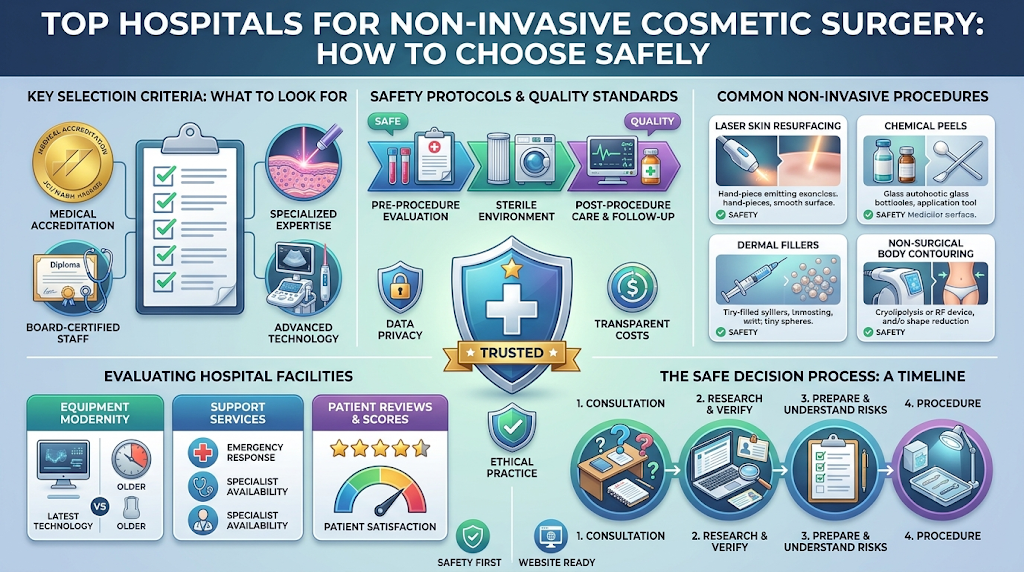
Look for these features:
- Qualified medical professionals.
- Suitable treatment rooms and equipment.
- Clean and hygienic surroundings.
- Proper patient assessment.
- Infection prevention practices.
- Emergency response arrangements.
- Clear treatment and aftercare instructions.
- Follow-up support if a problem occurs.
The facility should explain who will perform the procedure. Patients should also know whom to contact after treatment.
Do not choose a facility based only on its appearance or advertising. Good patient care requires proper medical planning and clear communication.
Qualifications and Experience of Cosmetic Practitioners
The person performing a cosmetic procedure plays a major role in safety. Patients should check their qualifications before treatment.
A practitioner should have relevant medical registration and training. Their experience should match the procedure being offered.
Important points to check include:
- Current medical registration or professional licence.
- Training in dermatology or the relevant cosmetic field.
- Specific training with the planned device or procedure.
- Experience treating similar skin concerns.
- Knowledge of possible side effects.
- Ability to identify unsuitable patients.
- Ability to manage or refer complications.
Patients should verify credentials through the relevant professional or regulatory body. Rules may differ between countries.
Do not rely only on job titles, social media profiles, or advertising claims. Ask for clear information about the practitioner’s training and role.
A trained practitioner should also be willing to explain treatment limits. They should never promise perfect or guaranteed results.
How Hospitals Assess Patient Suitability
A proper assessment helps determine whether a treatment is suitable. It also helps the practitioner choose the right approach.
The assessment may cover:
- Skin type and tone: Skin colour and sensitivity can affect treatment choice.
- Main concern: The practitioner should understand what the patient wants to improve.
- Medical history: Past and current health problems may affect safety.
- Allergies: Skin reactions to products or medicines should be discussed.
- Medicines and supplements: Some may affect healing or skin sensitivity.
- Scarring history: Past scars or pigmentation changes may influence treatment choices.
- Active skin problems: Infection, inflammation, or open wounds may require treatment first.
- Previous cosmetic procedures: Earlier treatments may affect the next procedure.
- Pregnancy: Some treatments may need to be delayed during pregnancy.
Skin tone deserves special attention. Some laser and light treatments can cause pigmentation changes, especially in darker skin tones.
This does not mean that every treatment is unsuitable for darker skin. The practitioner must select suitable devices and settings.
Patients should share complete and honest health information. A facility should never skip assessment just to save time.
Safety Standards and Equipment to Look For
Cosmetic devices need proper handling and regular maintenance. Having modern equipment alone does not prove that a treatment is safe.
Patients should ask how the facility checks and maintains its devices. The practitioner should also understand the equipment’s limits.
Useful safety features include:
- Devices suitable for the intended treatment.
- Proper equipment maintenance.
- Correct eye protection during laser and light procedures.
- Clean treatment surfaces.
- Infection prevention measures.
- Safe product storage and handling.
- Emergency supplies and response plans where relevant.
- Written consent and treatment records.
- Respect for patient privacy.
The facility should explain how it keeps equipment clean. It should also describe how staff prevent infections.
Patients should feel comfortable asking questions about safety. A responsible facility will answer clearly rather than dismissing concerns.
Consultation and Informed Consent Before Treatment
A consultation should happen before a cosmetic procedure. It gives patients time to understand the treatment and decide whether to proceed.
The practitioner should ask about the patient’s goals and medical history. They should explain the proposed treatment in simple language.
A proper consultation should cover:
- What the procedure involves.
- What changes may be possible.
- What results may not be possible.
- Possible side effects and complications.
- Other treatment options.
- The option of having no treatment.
- The likely number of sessions.
- Total costs and possible extra expenses.
- Recovery and aftercare needs.
Informed consent means the patient understands the treatment before agreeing. It should not feel rushed.
Avoid facilities that pressure patients into immediate decisions. Be careful when advertisements promise perfect skin or guaranteed results.
Patients should have enough time to consider the information. They can ask for another consultation if anything remains unclear.
Understand Possible Risks and Side Effects
Non-invasive cosmetic procedures can still cause side effects. The type and level of risk depend on the treatment and the patient.
Possible effects include:
- Temporary redness.
- Swelling.
- Skin irritation.
- Sensitivity or discomfort.
- Burns or blisters with some energy-based treatments.
- Dark or light patches on the skin.
- Infection.
- Scarring in uncommon cases.
- Uneven or unwanted cosmetic results.
Some effects may settle with time. Others may need medical attention or further treatment.
Risk can depend on the device, settings, skin type, practitioner skill, and aftercare. Using the wrong treatment for a patient’s skin may increase the chance of problems.
Patients should ask what side effects are common for their chosen procedure. They should also ask which symptoms need urgent attention.
Aftercare and Follow-Up Support
Aftercare is an important part of cosmetic treatment. The right steps depend on the procedure and the patient’s skin.
A practitioner may recommend:
- Using gentle skin cleansers.
- Applying suitable moisturizers.
- Avoiding strong exfoliating products during recovery.
- Using broad-spectrum sunscreen when advised.
- Limiting direct sun exposure when required.
- Following advice about makeup and skincare products.
- Avoiding certain activities for a recommended period.
- Attending follow-up appointments.
Patients should not copy another person’s aftercare routine. Different procedures can need different care.
Contact the practitioner if redness, pain, or swelling becomes worse. Blistering, signs of infection, or unusual skin changes also need medical review.
Ask for written aftercare instructions before leaving the facility. Make sure you know how to reach the care team if a concern develops.
How to Compare Hospitals for Non-Invasive Cosmetic Treatments
Comparing cosmetic hospitals takes more than checking prices or photos. Patients should look at the quality of care and the suitability of the treatment.
Consider these areas:
1. Practitioner qualifications
Check medical registration, relevant training, and experience with the procedure.
2. Treatment experience
Ask how often the practitioner performs the planned treatment. Their experience should relate to the patient’s specific concern.
3. Equipment and facilities
Check whether the device is suitable and properly maintained. The treatment room should meet hygiene needs.
4. Patient assessment
The facility should review skin type, medical history, and treatment goals before recommending a procedure.
5. Clear treatment information
Patients should receive details about benefits, risks, alternatives, and expected results.
6. Transparent pricing
Ask for the full cost, including consultations and follow-up visits. Be careful with packages that hide extra charges.
7. Aftercare and complication support
Find out who will provide advice after treatment. Ask what happens if a side effect develops.
8. Patient communication
Staff should answer questions clearly and respect patient privacy. Patients should never feel pressured into treatment.
A suitable facility should put medical standards before sales. Compare the care process rather than choosing only by low prices or celebrity endorsements.
Questions to Ask Before Booking a Cosmetic Procedure
A consultation is the right time to ask direct questions. The answers can help patients understand the procedure and the facility.
Consider asking:
- Who will perform the procedure?
- What qualifications and training do they have?
- Is this treatment suitable for my skin type?
- What results can I realistically expect?
- What side effects should I know about?
- Are there safer or more suitable alternatives?
- How many sessions might I need?
- What aftercare will I need?
- What happens if a complication occurs?
- Who can I contact after treatment?
Do not feel you must book immediately. Take time to compare the information and consider your options.
Table 1: Common Non-Invasive Cosmetic Treatments and Their Uses
| Treatment | Common purpose | Important consideration |
|---|---|---|
| Laser treatments | Selected pigmentation, hair reduction, redness, and texture concerns. | Device and settings must suit the patient’s skin. |
| IPL | Selected pigmentation, redness, and unwanted hair. | IPL is not the same as laser treatment. Eye protection is important. |
| Chemical peels | Certain acne, pigmentation, and surface texture concerns. | Peel strength affects skin response and recovery. |
| Microdermabrasion | Mild surface roughness and dull-looking skin. | It mainly works on the outer skin layer. |
| Radiofrequency skin tightening | Improving the appearance of skin firmness. | Results vary and do not match a surgical lift. |
| Ultrasound-based treatments | Selected skin tightening concerns. | Suitability depends on the device and treatment area. |
Note: Dermal fillers and botulinum toxin injections are minimally invasive treatments. They are not included as non-invasive procedures.
Table 2: What to Check When Choosing a Cosmetic Hospital
| Selection factor | What patients should verify | Why it matters |
|---|---|---|
| Practitioner qualifications | Medical registration, relevant training, and experience. | Helps confirm the practitioner’s professional background. |
| Equipment | Suitable devices and proper maintenance. | Supports safe and appropriate treatment use. |
| Hygiene | Clean rooms, infection control, and safe product handling. | Helps reduce the risk of infection. |
| Patient assessment | Review of skin type, health, medicines, and goals. | Helps identify suitable treatments and possible risks. |
| Informed consent | Clear details about benefits, risks, and alternatives. | Helps patients make informed decisions. |
| Transparent pricing | Full treatment costs and possible extra charges. | Reduces confusion about expenses. |
| Follow-up care | Written aftercare and access to medical support. | Helps patients manage recovery and concerns. |
Frequently Asked Questions
1. What are non-invasive cosmetic procedures?
Non-invasive cosmetic procedures aim to improve appearance without surgical cuts or injections. Examples include selected laser treatments, IPL, microdermabrasion, and some chemical peels. They may help with certain skin concerns. However, they can still cause side effects and need proper medical assessment.
2. Which treatments are commonly offered by cosmetic hospitals?
Common options include laser treatments, IPL, chemical peels, microdermabrasion, and energy-based skin tightening. The treatments available depend on the facility and its trained staff. Patients should ask which procedure suits their concern rather than choosing based on popularity.
3. Are non-invasive cosmetic treatments completely safe?
No cosmetic procedure is completely free of risk. Some treatments can cause redness, swelling, burns, pigmentation changes, or infection. Risks depend on the procedure, skin type, device, and practitioner. A proper consultation helps patients understand these risks before treatment.
4. What is the difference between non-invasive and minimally invasive treatments?
Non-invasive treatments do not involve surgical cuts or injections. Laser treatments and selected skin peels are examples. Minimally invasive treatments involve needles or small skin punctures. Dermal fillers and botulinum toxin injections belong to this second group and have different risks.
5. How can I choose a suitable hospital for cosmetic treatment?
Check practitioner qualifications, treatment experience, equipment, hygiene, and patient assessment. Ask about risks, pricing, aftercare, and complication support. A suitable facility should explain the procedure clearly and give you time to decide. Avoid choosing only by advertisements or low prices.
6. Why are practitioner qualifications important for cosmetic procedures?
Qualified practitioners understand skin conditions, treatment methods, and possible complications. They can assess whether a procedure suits the patient. They should also know how to respond to side effects or arrange further medical care. Always verify professional credentials through the relevant regulatory body.
7. Can non-invasive treatments cause skin pigmentation changes?
Yes. Some laser, light, and peel treatments can cause darker or lighter skin patches. The risk may be higher with unsuitable settings or certain skin types. Patients should discuss their skin tone and history of pigmentation changes during consultation.
8. How should I prepare for a cosmetic procedure?
Follow the practitioner’s instructions before treatment. Share your medical history, allergies, medicines, supplements, and previous cosmetic procedures. Ask whether you need to avoid certain skincare products or sun exposure. Do not stop prescribed medicines unless your medical professional tells you to.
9. What aftercare is needed following non-invasive cosmetic treatments?
Aftercare depends on the procedure. It may include gentle cleansing, moisturizer, sunscreen, and avoiding strong skincare products for a period. Some treatments need extra precautions. Follow the written instructions from your practitioner and contact them if symptoms worsen or unusual changes appear.
10. What questions should I ask before booking a cosmetic treatment?
Ask who will perform the procedure and what qualifications they have. Check whether the treatment suits your skin. Discuss expected results, side effects, alternatives, costs, and aftercare. Also ask who will help if a complication develops after you leave the facility.
Final Thoughts
Non-invasive cosmetic treatments may help improve selected skin and appearance concerns. However, results and risks vary between people and procedures.
Safe care starts with qualified practitioners, suitable equipment, careful patient assessment, and informed consent. Clear aftercare and follow-up support also matter.
Choose a medical facility based on its standards and your individual needs. Do not rely only on advertising, low prices, or promises of perfect results. BestCosmeticHospitals.com can help readers explore cosmetic hospital information and prepare questions before making a treatment decision.