Introduction
Significant weight loss—whether achieved through bariatric surgery, dietary changes, or lifestyle modifications—is a major health milestone. However, after substantial weight reduction, the skin and underlying tissues often lack the elasticity needed to shrink back to fit the body’s smaller framework. This frequently results in excess, hanging folds of skin around the abdomen, thighs, buttocks, lower back, chest, and arms.For individuals exploring their options, platforms like BESTCOSMETICHOSPITALS offer educational resources to help patients discover facilities, learn about cosmetic and reconstructive procedures, compare hospital standards, and connect with qualified surgical teams.In this guide, you will learn about the fundamentals of body lift surgery, the various procedures available, candidate evaluation criteria, hospital selection guidelines, and practical steps for a smooth, safe recovery.
What Is a Body Lift Procedure?
Understanding the primary goals of body lift surgery helps set accurate expectations before scheduling consultations.
+-----------------------------------------------------------------------+
|                    GOALS OF BODY LIFT SURGERY                         |
+-----------------------------------------------------------------------+
|  1. Excision of Redundant Skin  : Removes loose, sagging skin folds  |
|  2. Fascial & Muscle Tightening : Restores structural underlying tone |
|  3. Contour Rebalancing        : Reshapes natural body proportions    |
|  4. Relief of Tissue Discomfort : Minimizes friction & skin irritation |
+-----------------------------------------------------------------------+
Definition and Goals
A body lift is a surgical body contouring procedure designed to excise excess, sagging skin and tighten lax underlying supportive tissues. Unlike procedures focused purely on fat reduction, a body lift primary addresses tissue laxity and altered body proportions caused by major weight fluctuations or aging.
While targeted liposuction may be used alongside a body lift to refine specific contours, a body lift itself is not a weight-loss operation. It is a reconstructive and cosmetic procedure intended for individuals who have already achieved and maintained a stable body weight.
Biological Mechanisms of Skin Laxity
Skin elasticity relies on collagen and elastin fibers within the dermis. When skin is stretched significantly over extended periods, these elastic fibers break down. Once broken, the skin loses its natural resilience and ability to contract, even after internal fat mass is lost. Surgical intervention removes this overstretched skin that can no longer contract naturally.
Who May Benefit from Body Lift Surgery?
Body lift surgery is an individualized procedure that requires thorough candidate screening to ensure patient safety and optimal healing.
                  +-----------------------------------+
                  |  IDEAL BODY LIFT CANDIDATE PROFILE|
                  +-----------------+-----------------+
                                    |
        +---------------------------+---------------------------+
        |                                                       |
+-------v-------+                                       +-------v-------+
| WEIGHT STATUS |                                       | GENERAL HEALTH|
+-------+-------+                                       +-------+-------+
| • Stable weight (6+ mos)                              | • Non-smoker  |
| • Near target BMI                                     | • Good nutrition|
| • Post-bariatric stable                               | • Realistic goals|
+---------------+                                       +---------------+
Key Candidate Criteria
- Significant Weight Loss: Individuals who have lost substantial weight through bariatric procedures (such as gastric bypass or sleeve gastrectomy) or lifestyle changes and are left with loose skin folds.
- Weight Stability: Candidates should maintain a stable body weight for at least 3 to 6 months prior to surgery. On-going weight fluctuations can alter surgical outcomes and stretch newly tightened tissues.
- Good General Health: Surgical candidates must be free from uncontrolled chronic medical conditions (such as unmanaged diabetes or severe heart disease) that could impair wound healing or increase anesthesia risks.
- Non-Smoking Status: Smoking severely restricts blood microcirculation, drastically increasing the risks of delayed wound healing, skin necrosis, and infection. Patients must quit smoking well in advance of surgery as advised by their surgical team.
- Realistic Expectations: Understanding that body lift surgery involves extensive incisions, permanent scarring, and a multi-week recovery period is essential for patient satisfaction.
Types of Body Lift Procedures
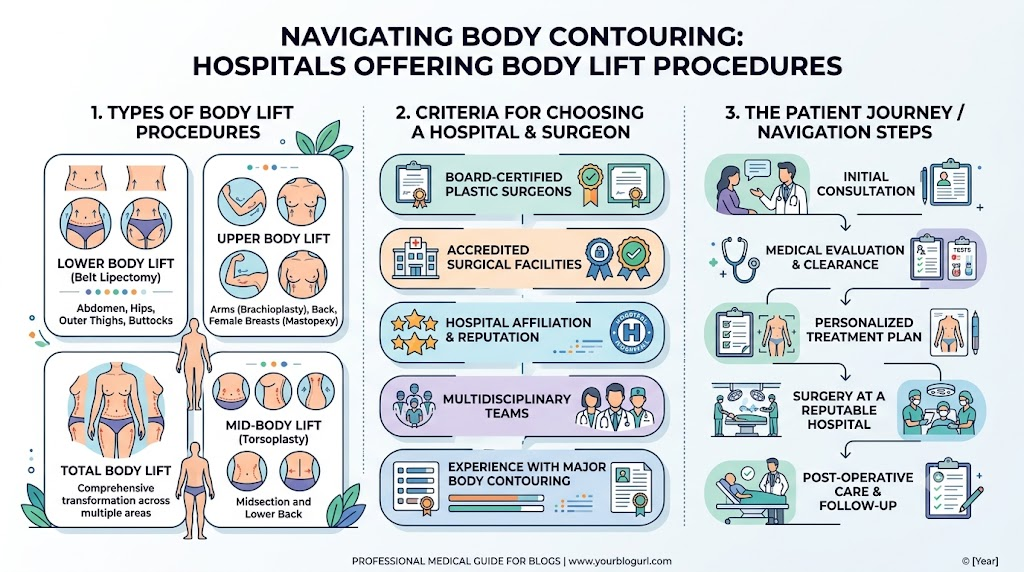
Depending on where excess skin is concentrated, plastic surgeons tailor procedures to focus on specific regions of the body.
+------------------------------------------------------------------------+
|                      TYPES OF BODY LIFT PROCEDURES                     |
+------------------------------------------------------------------------+
|  LOWER BODY LIFT           : Circumferential lower trunk, hips, thighs|
|  UPPER BODY LIFT           : Upper back, chest, lateral breasts, arms  |
|  CIRCUMFERENTIAL LIFT      : Continuous 360-degree belt excision       |
|  BELT LIPECTOMY            : Focused waistline & lower abdomen lift    |
|  STAGED CONTOURING         : Multi-step surgical plans for safety      |
+------------------------------------------------------------------------+
Lower Body Lift
A lower body lift targets tissue laxity across the lower abdomen, outer thighs, hips, and buttocks. By removing a continuous band of excess skin around the lower torso, the surgeon lifts and repositions the buttocks and outer thighs while flattening the abdominal profile.
Upper Body Lift
An upper body lift addresses sagging skin across the upper back, lateral chest walls, bra-line region, and underarm areas. This procedure refines upper body contours and is frequently performed alongside or after arm reduction surgery (brachioplasty).
Circumferential Body Lift & Belt Lipectomy
Often used interchangeably with a lower body lift, a circumferential body lift or belt lipectomy involves a 360-degree incision around the waistline. This technique acts like a supportive belt, lifting the entire lower half of the body simultaneously.
Combined & Staged Contouring Procedures
When excess skin affects multiple body areas, surgeons may divide treatments into staged procedures separated by several months. Staging surgeries prioritizes patient safety by limiting total operating time, blood loss, and recovery demands.
Body Lift Procedures Comparison Table
| Procedure | Primary Area Treated | Primary Goal | Typical Recovery Frame |
| Lower Body Lift | Abdomen, hips, buttocks, outer thighs | Removes redundant lower skin folds and lifts buttocks | 4 to 6 weeks for light activity |
| Upper Body Lift | Upper back, chest wall, lateral bra-line | Smooths upper back contours and tightens chest skin | 3 to 4 weeks for light activity |
| Circumferential Body Lift | Full 360-degree lower torso circumference | Comprehensive lifting and tightening of the lower body | 4 to 6 weeks for light activity |
| Belt Lipectomy | Midsection, waist, and upper buttocks | Focuses on waistline narrowing and abdominal flattening | 4 to 6 weeks for light activity |
| Staged Contouring | Multiple regions (e.g., arms, thighs, torso) | Maximizes safety by dividing major procedures into steps | Phased recovery per stage |
Services Offered by Leading Cosmetic Surgery Hospitals
Top cosmetic and reconstructive surgery centers offer comprehensive support across every phase of treatment.
                   +--------------------------------+
                   |  COMPREHENSIVE HOSPITAL SERVICES|
                   +---------------+----------------+
                                   |
        +--------------------------+--------------------------+
        |                                                     |
+-------v-------+                                     +-------v-------+
|  PREOPERATIVE |                                     |  POSTOPERATIVE|
+-------+-------+                                     +-------+-------+
| • 3D Evaluation|                                    | • Inpatient Care|
| • Anesthesia  |                                     | • Drain Care  |
| • Lab Clearance|                                    | • Scar Therapy|
+---------------+                                     +---------------+
Consultations & Medical Evaluations
Specialized care begins with thorough plastic surgery consultations. Surgeons evaluate skin quality, underlying tissue structure, and surgical goals while medical teams conduct comprehensive lab work to clear patients for major surgery.
Inpatient Facilities & Anesthesia Care
Because extensive body lift procedures can take several hours, leading hospitals utilize modern operating suites staffed by board-certified anesthesiologists. Patients often transition to dedicated inpatient surgical units for 24- to 48-hour monitoring, pain management, and mobility support immediately after surgery.
Postoperative Support & Scar Care
Comprehensive hospitals offer dedicated recovery services, including nursing care for surgical drains, fitted compression garment guidance, wound check visits, and long-term scar management protocols.
Advanced Technologies Used
Modern plastic surgery centers incorporate advanced technologies to improve preoperative planning, intraoperative precision, and patient comfort.
+----------------------------------------------------------------------+
|                     ADVANCED SURGICAL TECHNOLOGIES                   |
+----------------------------------------------------------------------+
|  [3D Body Surface Imaging]    --> Precise incision & volume mapping  |
|  [Energy-Based Hemostasis]    --> Reduced intraoperative blood loss  |
|  [Enhanced Anesthesia Monitors]--> Real-time tissue & vital monitoring|
|  [Ergonomic Operating Suites] --> Optimal positioning for long cases  |
|  [Advanced Wound Closure]     --> Multi-layer tension-relieving suture|
+----------------------------------------------------------------------+
- 3D Surface Imaging & Assessment: High-definition 3D imaging systems allow surgeons to capture precise anatomical measurements, assisting in surgical planning and helping patients understand planned incision placements.
- Energy-Based Dissection Devices: Modern electrocautery and energy-based surgical tools seal blood vessels as incisions are made, reducing surgical bleeding and postoperative tissue bruising.
- Enhanced Anesthesia & Temperature Monitoring: Continuous monitoring systems regulate patient body temperature and vital parameters throughout multi-hour procedures, lowering systemic stress and supporting smoother recovery.
- Multi-Layer Tension-Relieving Closure Systems: Advanced absorbable sutures and skin adhesives distribute tension deep within the fascia, taking strain off skin edges to encourage cleaner, flatter scar formation.
How to Choose the Right Hospital
Selecting a qualified hospital for a body lift requires evaluating surgeon credentials, facility accreditations, and safety standards. The right facility depends on individual medical needs, geographic convenience, and surgeon expertise.
                       +------------------------+
                       | EVALUATING A HOSPITAL  |
                       +-----------+------------+
                                   |
         +-------------------------+-------------------------+
         |                                                   |
+--------v-------+                                  +--------v-------+
| SURGICAL TEAM  |                                  | SAFETY & SUPPORT|
+--------+-------+                                  +--------+-------+
| • Board Certification                             | • Facility Accreditation
| • Body Contouring Focus                           | • Inpatient Care Unit
| • Volume & Portfolio                              | • 24/7 Emergency Support|
+----------------+                                  +----------------+
Board Certification & Surgical Specialization
Confirm that your primary surgeon is board-certified in plastic surgery by a recognized national certifying board. Look for specialists who focus specifically on post-bariatric reconstructive body contouring.
Facility Accreditation & Safety Standards
Ensure the hospital or surgical facility maintains full accreditation from recognized healthcare bodies. Accredited centers adhere to strict safety guidelines regarding sterile environments, emergency equipment, and staffing ratios.
Comprehensive Recovery Infrastructure
Select a facility equipped with dedicated inpatient beds, round-the-clock nursing care, and emergency transfer protocols should unexpected medical needs arise.
Hospital Selection Checklist
| Feature | Why It Matters |
| Board-Certified Plastic Surgeons | Verifies formal training, rigorous examination, and specialized skill |
| Accredited Surgical Facility | Ensures adherence to national clinical, safety, and equipment standards |
| Dedicated Inpatient Unit | Allows close overnight monitoring following extensive surgical procedures |
| On-Site Anesthesiology Team | Provides expert pain management and continuous monitoring during surgery |
| Structured Post-Op Support | Offers clear protocols for drain care, wound checks, and emergency queries |
| Clear Scar Management Guidance | Helps optimize long-term scar maturation and aesthetic outcomes |
Preoperative Evaluation
A thorough preoperative evaluation prepares candidates physically and mentally for surgery.
  [Medical History & Physical Exam]
                  │
                  ▼
  [Nutritional & Weight Stability Clearance] ──► Checks protein levels & weight trends
                  │
                  ▼
  [Lab Work & Cardiac Screening]            ──► Assesses hemoglobin, clotting, heart health
                  │
                  ▼
  [Surgical Planning Consultation]          ──► Maps out incision sites & expectations
Medical Screening & Laboratory Testing
Surgeons perform complete physical examinations, review current medications, and order comprehensive blood panels. Tests evaluate hemoglobin levels, blood clotting capabilities, kidney function, and nutritional parameters (such as serum albumin) to ensure the body is prepared to heal efficiently.
Smoking Cessation & Medication Adjustments
Candidates who smoke must stop completely at least 4 to 6 weeks before surgery and remain smoke-free throughout recovery. Patients are also instructed to temporarily stop medications and supplements that increase bleeding risks, such as aspirin, NSAIDs, and certain herbal remedies.
Understanding the Surgical Procedure
Knowing what happens during body lift surgery helps alleviate pre-procedure anxiety.
  [1. General Anesthesia] ──► [2. Surgical Incisions] ──► [3. Tissue Excision]
                                                                  │
                                                                  ▼
  [6. Recovery Room]     ◄── [5. Multi-Layer Closure] ◄── [4. Fascial Tightening]
Anesthesia & Incisions
Body lift procedures are performed under general anesthesia. Surgical incisions are planned carefully along natural skin folds and clothing lines (such as the bikini line) whenever possible, though extensive skin removal requires longer incision lines.
Tissue Excision & Tightening
The surgeon lifts the skin away from underlying muscles, pulls the tissue taut, removes redundant skin folds, and tightens the underlying muscle fascia with heavy structural sutures to create a firm internal support matrix.
Closure & Drain Placement
Temporary surgical drains are placed beneath the skin to prevent fluid accumulation (seromas). Incisions are then closed in multiple deep layers to relieve skin tension, and sterile dressings along with a supportive compression garment are applied.
Recovery After Body Lift Surgery
Recovery from a body lift requires patience, restricted physical activity, and careful adherence to postoperative instructions.
+--------------------------------------------------------------------+
|                  RECOVERY TIMELINE & MANAGEMENT                    |
+--------------------------------------------------------------------+
|  [Days 1-3]   --> Inpatient monitoring, pain management, short walks  |
|  [Weeks 1-2]  --> Drain management, gentle movement, garment wear |
|  [Weeks 3-4]  --> Drain removal, light daily tasks, wound checks  |
|  [Weeks 6+]   --> Gradual return to exercise, ongoing scar care   |
+--------------------------------------------------------------------+
- Hospital Stay & Early Mobility: Patients typically spend 1 to 2 nights in the hospital for monitoring and pain control. Gentle walking is encouraged starting the day after surgery to promote blood circulation and lower the risk of blood clots.
- Drain & Garment Care: Surgical drains remain in place for 1 to 3 weeks until fluid output decreases to safe levels. Medical compression garments are worn continuously for several weeks to minimize swelling and support healing tissues.
- Activity Restrictions: Strenuous exercise, heavy lifting (over 10 pounds), and vigorous movements must be avoided for at least 6 weeks to allow deep tissue layers to heal securely.
Possible Risks and Complications
As with any major surgical procedure, body lift surgery carries potential risks that should be carefully reviewed with your surgical team:
- Surgical Site Infections: Bacterial contamination at incision sites requires antibiotic therapy or, in rare cases, wound revision.
- Seromas and Hematomas: Collections of clear fluid (seroma) or blood (hematoma) under the skin may require needle aspiration or drainage.
- Delayed Wound Healing & Tissue Separation: Areas under high tension, particularly where incisions intersect, may heal slowly or require specialized wound care.
- Deep Vein Thrombosis (DVT): Blood clots forming in the deep leg veins present a serious risk, minimized through early walking, compression boots, and blood-thinning medications when indicated.
- Permanent Scarring: While surgeons place incisions thoughtfully, body lift surgeries result in permanent scars that fade gradually over 12 to 18 months.
Working with an experienced surgical team and strictly following postoperative care instructions significantly lowers these risks.
How BESTCOSMETICHOSPITALS Helps Patients
Navigating options for cosmetic and reconstructive surgery requires clear, unbiased information. BESTCOSMETICHOSPITALS provides accessible resources to guide patients through their search for qualified surgical facilities.
+------------------------------------------------------------------------+
|                    BESTCOSMETICHOSPITALS RESOURCES                     |
+------------------------------------------------------------------------+
|  [Hospital Discovery]  --> Search accredited plastic surgery centers   |
|  [Surgeon Insights]    --> Learn about board-certification standards   |
|  [Procedure Guides]    --> Simple breakdowns of body contouring steps  |
|  [Patient Awareness]   --> Prepare meaningful questions for consultations|
+------------------------------------------------------------------------+
Through BESTCOSMETICHOSPITALS, readers can search accredited facilities, learn about surgeon qualifications, explore body contouring options, and access educational materials. By compiling relevant healthcare information into an accessible format, the platform empowers patients to make informed choices alongside their healthcare providers.
Common Mistakes Patients Make
Avoiding common oversights helps ensure a smoother recovery and better long-term outcomes.
1. Scheduling Surgery Before Weight Stabilizes
- The Mistake: Undergoing a body lift while actively losing weight or before maintaining a stable weight for several months.
- The Solution: Wait until your body weight has remained stable for at least 3 to 6 months to protect surgical contours.
2. Resuming High-Impact Activity Too Soon
- The Mistake: Returning to heavy lifting, running, or abdominal workouts before deep tissues have healed.
- The Solution: Follow your surgeon’s activity guidelines strictly. Avoid heavy exertion for at least 6 weeks post-surgery.
3. Concealing Medical History or Smoking Habits
- The Mistake: Failing to disclose nicotine use, dietary supplements, or underlying health conditions.
- The Solution: Disclose your complete medical history openly. Honesty about nicotine use is vital, as smoking drastically impairs surgical healing.
4. Expecting Inflexible Perfection or Scar-Free Results
- The Mistake: Assuming surgery will produce flawless contours without visible scarring.
- The Solution: Maintain realistic expectations. Understand that visible, permanent scars are an inherent part of excess skin removal.
Common Myths vs. Facts
| Myth | Fact |
| A body lift is an alternative to weight-loss surgery. | A body lift removes loose skin after weight loss; it is not a weight-loss or fat-reduction procedure. |
| Surgical results are immediate and final. | Final body contours emerge over 6 to 12 months as swelling resolves and scar tissue matures. |
| Body lift surgery leaves no noticeable scars. | Extensive skin removal requires permanent surgical incisions, though surgeons place them along natural lines where possible. |
| Recovery is short and requires minimal downtime. | Recovery requires several weeks of restricted activity, garment wear, and drain management. |
Real-Life Educational Scenarios
Scenario A: Post-Bariatric Contouring After Major Weight Loss
A 42-year-old patient who lost 120 pounds following gastric sleeve surgery maintained a stable weight for over a year. However, severe skin folds around the lower abdomen and thighs caused persistent skin chafing and physical discomfort. After completing medical evaluations, the patient underwent a lower body lift at an accredited cosmetic surgery hospital. With proper drain care and structured recovery, the chafing was resolved and physical mobility improved significantly.
Scenario B: Staged Body Contouring for Multi-Region Laxity
An individual seeking skin removal across the abdomen, back, arms, and thighs consulted a board-certified plastic surgeon. Recognizing the extent of skin removal required, the surgeon recommended staging the treatments into two separate operations spaced six months apart. This staged approach prioritized patient safety, reduced surgical stress, and allowed for smoother recoveries.
Scenario C: Optimizing Recovery Through Strict Activity Restrictions
After undergoing a belt lipectomy, a patient carefully followed all postoperative care instructions. They wore their compression garment continuously, managed their surgical drains as directed, and avoided heavy lifting for two full months. This diligent care helped minimize swelling and supported healthy scar formation.
Frequently Asked Questions (FAQs)
1.What is a body lift procedure?
A body lift is a surgical procedure that removes excess, sagging skin and tightens underlying supportive tissues to improve body contours, commonly performed after major weight loss.
2.Who is a good candidate for body lift surgery?
Ideal candidates have significant loose skin, maintain a stable body weight, are in good overall health, do not smoke, and hold realistic expectations about surgical outcomes and scarring.
3.What areas of the body can be treated?
Body lift procedures can address the abdomen, lower back, buttocks, hips, outer thighs, upper back, chest, and arms depending on the specific techniques used.
4.Is a body lift a weight-loss surgery?
No. A body lift is a contouring procedure designed to remove loose skin and tighten tissue, not a procedure for losing weight.
5.How long does a body lift surgery take?
Depending on the extent of skin removal and the areas treated, body lift surgery typically takes between 3 and 7 hours under general anesthesia.
6.What type of anesthesia is used during surgery?
Body lift procedures are performed under general anesthesia in an accredited hospital or surgical center setting.
7.How long is the recovery period?
Most patients require 2 to 3 weeks off from work and daily activities, with full physical recovery and exercise clearance taking 6 to 8 weeks or longer.
8.Will there be visible scars after surgery?
Yes. Extensive skin removal requires surgical incisions that leave permanent scars. Surgeons plan incision locations carefully to align with natural body lines or clothing edges whenever possible.
9.Can liposuction be combined with a body lift?
Yes. Surgeons frequently combine targeted liposuction with body lift procedures to refine localized fat deposits and blend body contours.
10.What are the primary risks associated with body lift surgery?
Potential risks include infection, bleeding, fluid accumulation (seroma), delayed wound healing, deep vein thrombosis (DVT), and permanent scarring.
11.How do I choose the right cosmetic surgery hospital?
Look for accredited facilities staffed by board-certified plastic surgeons, modern operating suites, on-site anesthesiologists, and dedicated inpatient recovery units.
12.How should I prepare in the weeks before surgery?
Preparation includes undergoing required lab tests, stopping smoking, adjusting medications as advised by your doctor, and arranging for home recovery support.
13.When can I return to exercise and sports?
Light walking is encouraged right away, but strenuous exercise, heavy lifting, and high-impact activities must be avoided for at least 6 to 8 weeks.
14.How can I maintain my surgical results long-term?
Maintaining a stable body weight through a balanced diet and regular physical activity is the most effective way to preserve long-term body lift results.
15.How does BESTCOSMETICHOSPITALS assist patients?
BESTCOSMETICHOSPITALS offers an educational platform where patients can explore accredited cosmetic centers, research plastic surgery procedures, and access reliable information to guide their healthcare choices.
Final Thoughts
Body lift surgery offers a transformative option for individuals seeking to address heavy, loose skin folds following major weight loss or aging. By removing redundant skin and tightening underlying supportive tissues, body contouring can resolve physical discomfort, improve mobility, and refine body proportions.Achieving safe, satisfying outcomes relies on careful planning. Choosing a board-certified plastic surgeon, receiving care at an accredited hospital, maintaining realistic expectations, and committing to postoperative guidelines are fundamental steps toward a successful recovery.