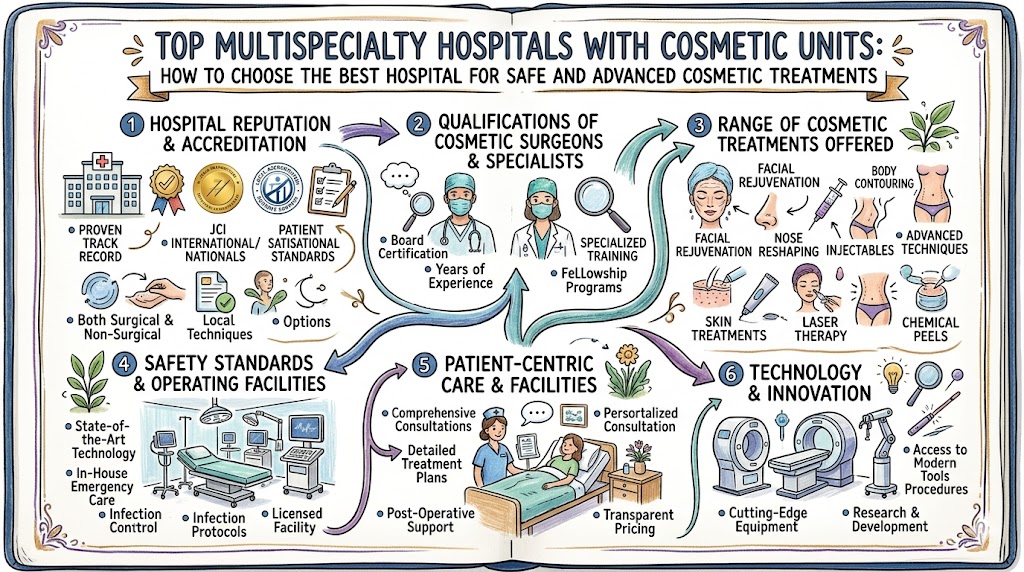
In the pursuit of aesthetic enhancement, safety, precision, and medical oversight are non-negotiable. Whether you are considering a minor non-surgical treatment or a complex reconstructive procedure, the setting in which your treatment takes place is as critical as the surgeon’s skill itself. Today, more patients are opting for top multispecialty hospitals with cosmetic units to ensure their transformation is handled in a medically secure, fully-equipped environment.Navigating the multitude of clinics and aesthetic centers can be overwhelming, but you do not have to conduct your search in the dark. BestCosmeticHospitals helps patients compare cosmetic hospitals, explore highly-rated specialists, understand diverse procedures, and review treatment options to make informed, confident healthcare decisions. In this guide, we will explore the distinct advantages of multispecialty-integrated cosmetic care, the technologies setting industry standards, and the essential checklists every patient needs before stepping into a consultation room.
Understanding Cosmetic Units in Multispecialty Hospitals
Unlike standalone aesthetic boutiques, cosmetic units integrated within large multispecialty hospitals function under strict institutional oversight. These units are built on a foundation of hospital-grade safety protocols, including advanced anesthesia support, specialized surgical suites, and round-the-clock emergency infrastructure.When a cosmetic unit is part of a larger medical system, it benefits from a multidisciplinary support network. If a patient has underlying health conditions, their cosmetic surgeon can easily consult with anesthesiologists, cardiologists, or endocrinologists on-site, ensuring that the procedure is not only aesthetically successful but also physiologically safe.
Benefits of Choosing Multispecialty Hospitals for Cosmetic Procedures
Choosing a multispecialty environment provides a safety net that smaller clinics simply cannot replicate.
- Hospital-Grade Sterilization: These units adhere to the same rigorous infection-control protocols used in life-saving surgical departments.
- Comprehensive Emergency Care: Should a complication arise during or after surgery, the hospital has the full resources—including intensive care units (ICU) and rapid response teams—immediately available.
- Integrated Pathological Support: On-site labs allow for instant blood tests, biopsy analysis, and metabolic screenings, facilitating faster and more accurate pre-operative assessments.
- Holistic Pre- and Post-Op Care: Patients have access to nutritional counseling, physical therapy, and psychological support services that promote a smoother, more sustainable recovery.
What Makes a Cosmetic Unit Stand Out?
The top multispecialty hospitals with cosmetic units distinguish themselves through a blend of artistry and clinical rigor. A standout unit is defined by:
- Board-Certified Specialists: A team comprising plastic surgeons, dermatologists, and reconstructive experts with extensive specialized training.
- Cutting-Edge Technology: Access to the latest 3D imaging software, laser systems, and minimally invasive surgical tools.
- Patient-Centric Philosophy: A focus on natural-looking results that align with the patient’s individual features rather than “cookie-cutter” trends.
- Transparent Communication: Clear, honest discussions regarding expectations, limitations, potential risks, and recovery timelines.
Common Cosmetic Procedures Available
Table 1: Popular Cosmetic Procedures
| Procedure | Purpose | Recovery Time | Benefits |
| Rhinoplasty | Reshaping the nose | 2–3 weeks | Improved facial balance and breathing |
| Liposuction | Removing localized fat | 2–4 weeks | Contoured physique and refined shape |
| Facelift | Tightening facial skin | 3–4 weeks | Reduced sagging and youthful appearance |
| Tummy Tuck | Removing excess skin/fat | 4–6 weeks | Flatter, firmer abdominal profile |
| Hair Transplant | Restoring hair density | 7–10 days | Regained confidence and volume |
| Breast Procedures | Reshaping or augmentation | 4–6 weeks | Enhanced proportions and symmetry |
| Skin Rejuvenation | Smoothing texture/tone | 1–5 days | Vibrant, clear, and healthy-looking skin |
Surgical vs Non-Surgical Cosmetic Treatments
Understanding the distinction is vital for setting realistic expectations regarding downtime and longevity.
Table 2: Surgical vs Non-Surgical Cosmetic Treatments
| Feature | Surgical | Non-Surgical |
| Invasiveness | Requires incisions/anesthesia | Minimally invasive or topical |
| Results | Often dramatic and long-lasting | Subtle, requires maintenance |
| Recovery | Significant downtime required | Little to no downtime |
| Procedure Type | Facelifts, Lipo, Breast Surgery | Fillers, Botox, Laser therapy |
Advanced Technologies Used in Cosmetic Units
Modern aesthetic medicine relies on high-precision technology to minimize trauma and maximize outcome quality.
- 3D Digital Imaging: Patients can visualize their projected results before the surgery even begins.
- Laser-Assisted Lipolysis: Uses thermal energy to liquefy fat cells before removal, leading to less bruising and tighter skin.
- Endoscopic Surgery: Allows surgeons to perform complex procedures through small “keyhole” incisions, resulting in invisible scarring.
- Plasma Skin Resurfacing: A non-surgical way to treat deep wrinkles and scarring by stimulating deep-tissue collagen regeneration.
How to Choose the Right Cosmetic Hospital
Selecting the facility where you will undergo your procedure is the most important decision in your aesthetic journey.
Table 3: Factors to Consider When Choosing a Cosmetic Hospital
| Factor | Importance | Questions to Ask |
| Surgeon Credentials | Directly influences safety and results | “Is the surgeon board-certified in plastic surgery?” |
| Hospital Accreditation | Ensures safety and standard compliance | “Is this unit officially accredited for surgery?” |
| Before/After Portfolio | Demonstrates the surgeon’s aesthetic eye | “Can I see photos of similar cases?” |
| Emergency Protocols | Vital for patient safety | “What is the procedure for emergency support?” |
Recovery and Post-Procedure Care
A successful outcome is often determined by the recovery phase. In a top multispecialty setting, your surgeon will provide a tailored plan that includes:
- Scheduled Follow-ups: Regular assessments to monitor incision healing and swelling.
- Prescribed Physical Therapy: Especially for procedures like tummy tucks to ensure proper mobility and muscle recovery.
- Compression Garment Guidance: Ensuring correct wear to minimize edema and help the skin adhere to new contours.
- Nutrition Support: Recommendations on supplements and hydration that facilitate tissue repair.
Table 4: Recovery Timeline for Common Cosmetic Procedures
| Procedure | Recovery Period | Follow-Up Care |
| Dermal Fillers | 24–48 hours | Avoid intense heat/massage |
| Liposuction | 2–4 weeks | Compression garments; light walking |
| Breast Augmentation | 4–6 weeks | No heavy lifting; monitoring sutures |
| Facelift | 3–4 weeks | Sun protection; lymphatic massage |
Patient Preparation Checklist
Preparing yourself physically and mentally is key to a smooth process.
- Comprehensive Medical Clearance: Undergo a full checkup to ensure you are fit for anesthesia.
- Medication Audit: Disclose all supplements and blood thinners, as these must be stopped weeks before surgery.
- Home Preparation: Set up a recovery space with pillows, hydration, and easy-access meals.
- Logistics: Arrange for a trusted person to drive you home and stay with you for the first 24–48 hours.
- Smoking Cessation: Quit smoking at least 4 weeks prior, as it severely hinders blood flow and tissue healing.
Frequently Asked Questions
- What makes multispecialty hospitals safer for cosmetic surgery? They offer full-service hospital support including ICUs and specialized medical staff.
- Are cosmetic procedures painful? Surgeons use modern anesthesia and post-op pain management to keep you comfortable.
- How long do results last? Results vary by procedure; facelifts can last 10+ years, while injectables last 6–18 months.
- Can I combine multiple procedures? Yes, “mommy makeovers” or facial combinations are common but depend on patient health.
- Is it better to have surgery abroad? Always weigh safety over cost; local multispecialty hospitals offer superior follow-up.
- What if I don’t like the results? Discuss revision policies and expectations clearly with your surgeon beforehand.
- Is cosmetic surgery covered by insurance? Typically no, unless it is reconstructive (e.g., breast reduction for health reasons).
- How do I choose the best surgeon? Look for board certifications, peer reviews, and hospital affiliations.
- Are cosmetic units strictly for wealthy patients? No, they cater to a wide demographic seeking safe, high-quality results.
- What is a “board-certified” plastic surgeon? A specialist who has passed rigorous exams and training in aesthetic and reconstructive surgery.
- Do I need an overnight stay? Depends on the procedure; major surgeries usually require at least one night of monitoring.
- What are the risks of filler injections? Rare but serious risks include vascular occlusion; choose experts to avoid this.
- How far in advance should I book? Book at least 2–3 months ahead to allow time for pre-op tests and planning.
- Is hair transplant painful? Local anesthesia is used, making the procedure quite comfortable.
- How long after surgery can I return to work? Depends on the procedure, usually 1–3 weeks.
- Will I have visible scars? Surgeons use techniques to hide incisions in natural skin folds.
- Can I exercise after surgery? Follow your surgeon’s specific timeline, usually beginning with light walking.
- What are the signs of infection post-op? Fever, redness, spreading warmth, or foul-smelling discharge.
- How does 3D imaging work? It uses scanners to create a map of your face or body, allowing a “preview” of the final look.
- Where can I find reputable hospitals? Start your search at BestCosmeticHospitals.com.
Conclusion
Choosing the right facility is arguably the most critical decision in your aesthetic journey. Throughout this guide, we have explored why Top Multispecialty Hospitals with Cosmetic Units serve as the gold standard for anyone seeking significant aesthetic improvements. By choosing a multispecialty environment, you are not just selecting a place for a procedure; you are opting for a foundation of medical excellence where safety, rigorous sterilization, and emergency preparedness are deeply embedded in the hospital culture.The integration of advanced medical technology—from 3D diagnostic imaging to minimally invasive robotic surgical tools—allows these hospitals to deliver precision results with reduced trauma and faster healing times. Furthermore, the ability of cosmetic surgeons to collaborate with specialists across other departments—such as cardiology or endocrinology—ensures that your treatment plan is not only aesthetically satisfying but also fundamentally safe for your specific physiological needs. When you select a premier multispecialty hospital, you are gaining access to a comprehensive care team that prioritizes patient wellness at every stage of the journey, from the initial consultation to the final follow-up.