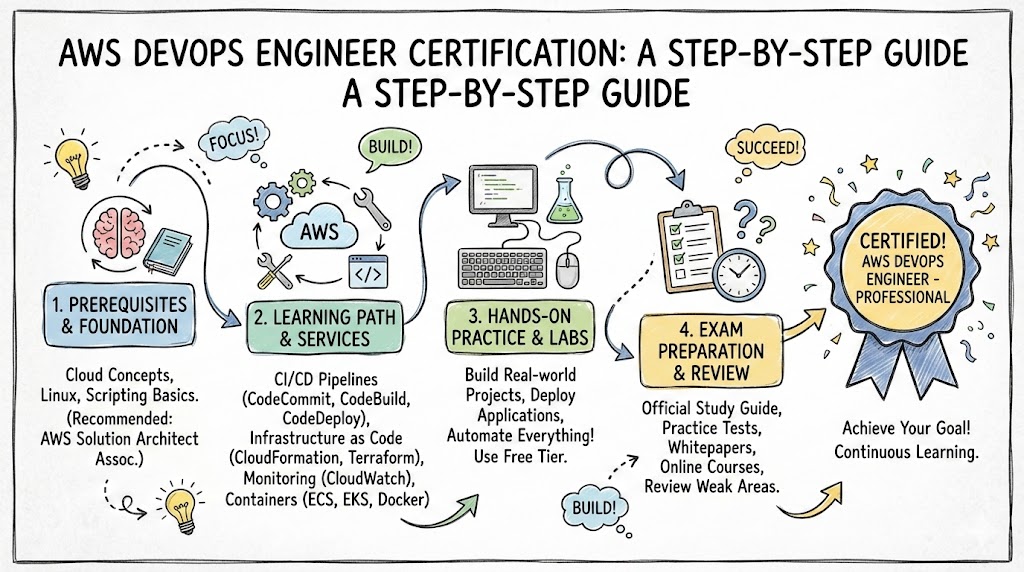
Introduction
The AWS DevOps Engineer – Professional certification is one of the most advanced and respected credentials in the cloud computing industry. This certification is designed for professionals who specialize in managing and automating AWS environments using DevOps practices. With businesses increasingly moving to the cloud, the demand for skilled DevOps engineers who can ensure automation, scalability, and high availability is at an all-time high.In this guide, we will provide in-depth information about the AWS DevOps Engineer – Professional certification, including what it is, who should pursue it, the skills it validates, preparation strategies, and how it can impact your career growth. Whether you are new to DevOps or looking to further your expertise, this certification is a valuable milestone.
What is AWS DevOps Engineer – Professional?
The AWS Certified DevOps Engineer – Professional certification is an advanced-level qualification designed to validate your ability to implement, automate, and manage continuous delivery systems and methodologies on AWS. The certification focuses on the essential skills for working with AWS DevOps services such as AWS CodePipeline, CodeDeploy, CloudFormation, and other tools to manage the software delivery lifecycle.
This exam tests your knowledge in automating infrastructure, optimizing deployment pipelines, ensuring continuous integration and delivery (CI/CD), monitoring application performance, and enhancing cloud security. It also emphasizes high availability, disaster recovery, and cost optimization in the cloud.
Key areas covered include:
- Automation of infrastructure and deployments.
- CI/CD pipeline management.
- Infrastructure as Code (IaC).
- Application monitoring and performance tuning.
- Security and compliance in cloud environments.
- Cost management and resource optimization.
This certification validates that you are capable of handling the complex challenges involved in managing modern cloud applications using DevOps practices on AWS.
Who Should Consider This Certification?
The AWS Certified DevOps Engineer – Professional certification is meant for individuals who already have experience with AWS and are looking to specialize in advanced DevOps practices. It is most beneficial for professionals who have:
- Experience in DevOps: If you have experience with continuous integration, delivery, and automation, this certification will validate your expertise in applying these practices in an AWS environment.
- Hands-on AWS experience: Familiarity with AWS core services like EC2, S3, IAM, and RDS is recommended. Experience in automating infrastructure and deploying applications on AWS will be crucial for passing the exam.
- Interest in DevOps tools and processes: Whether you’re currently in a DevOps role or transitioning from another IT or software engineering position, this certification will deepen your understanding of how to automate and manage cloud-based systems efficiently.
Roles that benefit from this certification include:
- DevOps Engineers
- Cloud Engineers
- Infrastructure Engineers
- Site Reliability Engineers (SREs)
- Software Engineers with a DevOps focus
Skills You Will Develop
Pursuing this certification will equip you with a wide range of advanced technical skills, including:
- Automation: You will learn how to automate the deployment of applications and infrastructure in AWS using tools like AWS CodePipeline, CodeDeploy, and CloudFormation.
- Continuous Integration/Continuous Deployment (CI/CD): The certification covers best practices for building CI/CD pipelines that integrate code changes automatically, ensuring smooth and fast application releases.
- Infrastructure as Code (IaC): You will develop the skills to manage cloud resources using IaC tools such as AWS CloudFormation or Terraform, which ensures the provisioning of infrastructure is repeatable, consistent, and automated.
- Monitoring and Security: Learn to monitor cloud applications using AWS CloudWatch, manage logs, implement AWS IAM (Identity and Access Management), and enforce security best practices to ensure that cloud systems are both secure and compliant.
- Scalability and Reliability: You will gain expertise in designing cloud systems that are fault-tolerant, scalable, and highly available by using AWS services like Auto Scaling, Elastic Load Balancing (ELB), and Amazon RDS.
- Cost Management: AWS provides a suite of tools for cost management and optimization, which will help you understand how to make cost-effective decisions when running cloud applications.
Real-World Projects You’ll Tackle
The skills developed during preparation will enable you to lead and participate in several impactful projects, such as:
- Building and Managing CI/CD Pipelines: You will automate the software build, test, and deployment process using AWS services like AWS CodePipeline and CodeBuild. This ensures that software is always delivered reliably and quickly.
- Automating Infrastructure Provisioning: By using CloudFormation or Terraform, you will automate the creation of AWS resources, reducing human error and improving operational efficiency.
- Scaling Cloud Applications: Design and implement auto-scaling solutions to ensure that applications can handle fluctuations in demand without manual intervention. You will set up load balancing across multiple instances to provide fault tolerance.
- Ensuring Security and Compliance: Implement best practices for securing cloud resources, such as configuring IAM roles, setting up multi-factor authentication (MFA), and ensuring compliance with industry regulations.
- Optimizing Cloud Costs: Using AWS tools like AWS Cost Explorer and Trusted Advisor, you will optimize cloud resource usage to minimize costs while ensuring maximum performance.
Preparation Plan
7-14 Days (Beginner to Intermediate)
- Get Hands-On with AWS Services: Familiarize yourself with core AWS services like EC2, S3, IAM, RDS, and CloudFormation. If you’re new to AWS, start with their free-tier services to get hands-on practice.
- Understand DevOps Basics: Brush up on DevOps concepts, including automation, continuous integration, and infrastructure as code (IaC).
- Review Key AWS Tools: Learn how to use AWS CodePipeline, CodeDeploy, and CloudFormation for setting up automated pipelines and managing infrastructure.
30 Days (Intermediate)
- Dive Deeper into AWS Services: Study more advanced AWS services like Elastic Beanstalk, ECS, EKS, and Lambda. Understanding how to scale applications using these services is key to the exam.
- Focus on Security and Monitoring: Learn AWS security best practices and how to monitor applications using CloudWatch, CloudTrail, and CloudFormation.
- Work on Hands-On Labs: Set up an end-to-end CI/CD pipeline and automate deployments to get a feel for real-world applications of AWS DevOps tools.
60 Days (Advanced)
- Master Automation and Scaling: Build out more complex infrastructure and deployment pipelines using IaC. Practice scaling and optimizing applications to handle large traffic volumes.
- Simulate the Exam: Take practice exams and review the AWS DevOps Engineer Professional exam guide. Focus on understanding the reasoning behind each question.
- Join Discussion Forums: Participate in AWS and DevOps discussion forums to resolve doubts and learn from other professionals.
Common Pitfalls to Avoid
- Skipping Hands-On Practice: The exam focuses heavily on practical knowledge, so ensure that you gain as much hands-on experience as possible with AWS services.
- Overlooking Security: Security is a key part of the exam. Always integrate security practices into your automation processes and ensure that your cloud applications are secure.
- Not Reviewing AWS Whitepapers: AWS whitepapers provide in-depth knowledge about best practices, which are crucial for understanding AWS services in detail.
Next Certifications to Consider
After completing the AWS DevOps Engineer – Professional certification, consider these certifications to further enhance your expertise:
- Same Track: AWS Certified Advanced Networking – Specialty
- Cross-Track: AWS Certified Security – Specialty
- Leadership Track: AWS Certified Solutions Architect – Professional
Choose Your Career Path
After completing the AWS Certified DevOps Engineer – Professional certification, you can further specialize in one of the following paths:
1. DevOps
- Focus: Automating infrastructure and software delivery.
- Skills: CI/CD, Infrastructure as Code (IaC).
- Certifications: AWS Certified DevOps Engineer – Professional, Google Cloud DevOps.
2. DevSecOps
- Focus: Integrating security into the DevOps process.
- Skills: Automated security testing, compliance.
- Certifications: AWS Certified Security – Specialty, CKS.
3. SRE (Site Reliability Engineering)
- Focus: Ensuring system reliability and performance.
- Skills: Monitoring, scaling, incident management.
- Certifications: Google Cloud DevOps Engineer, AWS Certified SysOps Administrator.
4. AIOps/MLOps
- Focus: Using AI/ML for automated operations and model deployment.
- Skills: Anomaly detection, predictive analytics, automation.
- Certifications: AWS Certified Machine Learning – Specialty.
5. DataOps
- Focus: Automating data workflows and ensuring data quality.
- Skills: Data pipelines, governance, cloud data operations.
- Certifications: AWS Certified Big Data – Specialty.
6. FinOps
- Focus: Managing and optimizing cloud costs.
- Skills: Cloud financial management, cost optimization.
- Certifications: AWS Certified Cloud Financial Management.
Role → Recommended Certifications Mapping
Here’s a helpful table to guide you in choosing your next certification based on your current or desired role:
| Role | Recommended Certifications |
|---|---|
| DevOps Engineer | AWS DevOps Engineer – Professional, AWS Certified Solutions Architect – Associate |
| SRE | Google Cloud Professional Cloud DevOps Engineer, AWS DevOps Engineer |
| Cloud Engineer | AWS Certified Solutions Architect – Associate, AWS DevOps Engineer |
| Security Engineer | AWS Certified Security – Specialty, AWS DevOps Engineer |
| Platform Engineer | AWS Certified SysOps Administrator, AWS DevOps Engineer |
| Data Engineer | AWS Certified Big Data – Specialty, AWS DevOps Engineer |
| FinOps Practitioner | AWS Certified Cloud Financial Management, AWS DevOps Engineer |
| Engineering Manager | AWS Certified Solutions Architect – Professional, AWS DevOps Engineer |
Certification Comparison Table
| Certification | Track | Level | Ideal For | Prerequisites | Skills Covered | Recommended Order |
|---|---|---|---|---|---|---|
| AWS DevOps Engineer – Professional | DevOps | Professional | DevOps Engineers, Cloud Engineers, IT Operations | 2+ years of hands-on AWS experience, Basic DevOps knowledge | Automating AWS environments, CI/CD, Infrastructure as Code (IaC), security, monitoring | AWS Certified Solutions Architect – Associate (Recommended) |
| AWS Certified Solutions Architect – Professional | Cloud Architecture | Professional | Cloud Architects, Technical Leads | AWS Certified Solutions Architect – Associate | Advanced cloud architecture, high-availability design, cost management, security | Start with AWS Certified Solutions Architect – Associate |
| Google Cloud Professional Cloud DevOps Engineer | Cloud DevOps | Professional | DevOps Engineers, Cloud Engineers | Experience with Google Cloud Platform (GCP) and DevOps tools | Automation, monitoring, CI/CD, Google Cloud services | AWS DevOps Engineer or similar certification |
| Microsoft Azure DevOps Engineer Expert | DevOps | Expert | DevOps Engineers, Azure Cloud Engineers | Microsoft Certified: Azure Administrator Associate | CI/CD, infrastructure management, Azure DevOps tools, security, governance | Microsoft Certified: Azure Developer Associate |
| Certified Kubernetes Administrator (CKA) | Kubernetes/Cloud | Associate | Kubernetes Administrators, Cloud Engineers | Experience with Kubernetes, cloud platforms | Managing and orchestrating Kubernetes clusters, scaling, monitoring, troubleshooting | DevOps/Cloud experience required |
| Certified Kubernetes Application Developer (CKAD) | Kubernetes/Cloud | Associate | Developers, Cloud Engineers, Kubernetes Specialists | Experience with Kubernetes and containerized applications | Application development using Kubernetes, deploying workloads, services, and storage | CKA recommended for a deeper understanding |
Institutions Offering Training for AWS DevOps Engineer – Professional
Here are some of the most recognized training providers that help learners prepare for the AWS Certified DevOps Engineer – Professional certification with expert‑led instruction, hands‑on labs, and real project experience:
- DevOpsSchool
DevOpsSchool offers a structured AWS DevOps certification program that includes live online classes, practical lab sessions, and mock exam practice. Their courses focus on real‑world scenarios with mentorship support to strengthen both concepts and hands‑on skills. - Cotocus
Cotocus delivers industry‑aligned AWS DevOps training with strong emphasis on practice and project work. Candidates get guidance on setting up CI/CD pipelines, automation tools, and performance monitoring, along with instructor support and career advice. - Scmgalaxy
Scmgalaxy provides affordable yet comprehensive AWS DevOps Engineer training. Their program blends theoretical classes with hands‑on exercises to help learners master automation, deployment strategies, and cloud best practices using AWS services. - BestDevOps
BestDevOps focuses on practical DevOps training tailored to real workplace requirements. Their AWS DevOps course includes practical labs on automation, monitoring, scaling applications, and managing cloud resources — making concepts easier to apply in real environments. - DevSecOpsSchool
DevSecOpsSchool specializes in security‑centric DevOps training. Their AWS DevOps course places strong emphasis on integrating security into automation and DevOps pipelines — a valuable advantage for learners who want to build secure cloud solutions. - SRESchool
SRESchool offers targeted training for Site Reliability Engineering along with AWS DevOps practices. Their curriculum helps learners build systems that are not only automated but also reliable, scalable, and resilient — aligning well with enterprise needs. - AIOpsSchool
AIOpsSchool blends machine learning and automation into traditional DevOps workflows. Their AWS DevOps training focuses on using AI for predictive monitoring, anomaly detection, and intelligent automation — drawing learners toward next‑gen DevOps roles. - DataOpsSchool
DataOpsSchool focuses on automated data pipeline management and data workflows within AWS environments. Their training helps learners master large‑scale data operations, allowing them to bridge DevOps and data engineering responsibilities effectively. - FinOpsSchool
FinOpsSchool offers training that combines cloud cost management with DevOps principles. Their AWS DevOps preparation includes strategies to optimize cloud expenditure while maintaining performance — ideal for professionals focused on financial efficiency in cloud operations.
FAQs
Q1: What is the AWS DevOps Engineer – Professional certification?
A1: This certification validates expertise in automating, managing, and securing AWS environments using DevOps practices.
Q2: What are the prerequisites for the certification?
A2: At least two years of hands-on experience with AWS and familiarity with DevOps concepts are recommended.
Q3: How much does the exam cost?
A3: The exam fee is $300 USD.
Q4: How long is the exam?
A4: You have 180 minutes to answer 75 multiple-choice questions.
Q5: What is the passing score for the exam?
A5: The passing score is 750 out of 1000.
Q6: How difficult is the exam?
A6: The exam is challenging and requires in-depth knowledge of AWS tools and DevOps practices.
Q7: Can I take the exam online?
A7: Yes, the exam can be taken online via AWS’s exam provider Pearson VUE.
Q8: How should I prepare for the exam?
A8: Review AWS whitepapers, take practice exams, gain hands-on experience, and study AWS documentation.
Q9: How long should I study for the exam?
A9: Preparation typically takes 2–3 months depending on your existing knowledge of AWS and DevOps.
Q10: What topics are covered in the exam?
A10: Key topics include automation, CI/CD, security, scaling, monitoring, and cost management.
Q11: What job roles can I pursue with this certification?
A11: You can pursue roles like DevOps Engineer, Cloud Engineer, SRE, Platform Engineer, and more.
Q12: How long is the certification valid?
A12: The certification is valid for three years.
FAQs
Q1: What is the AWS DevOps Engineer – Professional certification?
A1: The AWS Certified DevOps Engineer – Professional certification is a professional-level credential that validates your skills in automating, deploying, and managing AWS cloud infrastructures using DevOps practices. It focuses on CI/CD pipelines, security, automation, monitoring, and infrastructure management.
Q2: What are the prerequisites for this certification?
A2: AWS recommends having at least 2 years of hands-on experience with AWS and a strong understanding of DevOps concepts, including automation, CI/CD, and cloud infrastructure management.
Q3: How long does the AWS DevOps Engineer exam take?
A3: The exam consists of 75 multiple-choice questions, and you have 180 minutes (3 hours) to complete it.
Q4: What is the cost of the AWS DevOps Engineer – Professional exam?
A4: The exam costs $300 USD.
Q5: What topics are covered in the AWS DevOps Engineer exam?
A5: Topics include CI/CD, automation, monitoring, infrastructure as code (IaC), security, high availability, scalability, and cost optimization on AWS.
Q6: How difficult is the AWS DevOps Engineer exam?
A6: The exam is considered challenging and requires both theoretical knowledge and hands-on experience with AWS tools and DevOps processes.
Q7: Can I take the AWS DevOps Engineer exam online?
A7: Yes, the exam can be taken online via AWS’s partner Pearson VUE or at an in-person testing center.
Q8: How can I prepare for the AWS DevOps Engineer certification?
A8: You can prepare by studying AWS whitepapers, taking official training courses, working on hands-on labs, and reviewing the official exam guide provided by AWS. Practice exams can also help familiarize you with the format.
Conclusion
Earning the AWS Certified DevOps Engineer – Professional certification is a significant achievement in the field of cloud computing. This credential not only showcases your expertise in automating and managing cloud environments but also positions you as a professional who can design and manage high-availability, scalable, and cost-effective applications on AWS.The certification demonstrates your proficiency in DevOps practices, infrastructure automation, and cloud management, making you a valuable asset to organizations leveraging AWS for their cloud operations. By preparing for this certification, you gain not only the technical skills needed to excel in cloud infrastructure management but also the confidence to tackle real-world challenges in a rapidly evolving technological landscape.