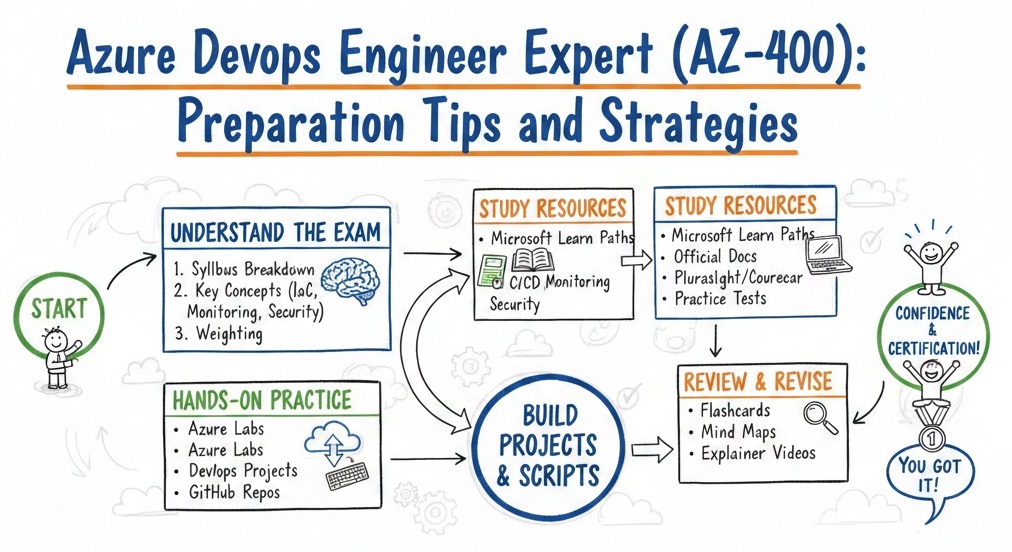
Introduction
The Azure DevOps Engineer Expert (AZ-400) certification is one of the most recognized certifications for professionals in the DevOps and cloud engineering space. It validates your ability to implement DevOps practices using Microsoft Azure tools and services, which play a critical role in automating and optimizing the software development lifecycle. This guide will cover everything you need to know about the AZ-400 certification, from preparation strategies to career outcomes.
What is Azure DevOps Engineer Expert (AZ-400)?
The AZ-400 certification focuses on testing your knowledge and skills in using Azure DevOps Services to automate and implement continuous integration and continuous delivery (CI/CD) pipelines, manage infrastructure, and ensure that teams can collaborate efficiently in software development. It encompasses a range of topics, including:
- DevOps practices: Implementing automation, continuous integration, and continuous delivery strategies.
- Infrastructure as Code (IaC): Automating infrastructure deployment using Azure and tools like Terraform.
- Monitoring & feedback loops: Implementing feedback and monitoring systems to improve application reliability.
Who Should Take It?
The AZ-400 certification is intended for professionals already working in DevOps or cloud-based environments. It’s especially beneficial for the following roles:
- DevOps Engineers
- Cloud Engineers
- Platform Engineers
- Software Developers with an interest in DevOps and CI/CD
- System Administrators who want to move into DevOps roles
Skills You’ll Gain
With the AZ-400 certification, you’ll gain critical skills to help you automate software delivery and improve collaboration across teams, including:
- Building and managing CI/CD pipelines
- Managing infrastructure as code (IaC)
- Implementing security within the DevOps pipeline
- Monitoring and managing applications and infrastructure in Azure
- Using containerization tools like Azure Kubernetes Service (AKS) to manage scalable applications
Azure DevOps Tools Comparison Table
Here’s a detailed comparison table of Azure DevOps tools and their features. These tools are central to the AZ-400 exam and will help you understand the full scope of Azure DevOps practices.
| Tool/Service | Purpose | Key Features | Best For | Integration |
|---|---|---|---|---|
| Azure Pipelines | Automates builds and releases | Continuous integration and delivery (CI/CD) pipelines, YAML and classic editors | Developers, DevOps Engineers | GitHub, Azure Repos, Docker, Kubernetes |
| Azure Repos | Source code management (version control) | Git repositories, pull requests, code reviews, branching strategies | Software Developers, Platform Engineers | GitHub, Azure Pipelines |
| Azure Artifacts | Manages packages (e.g., Maven, npm) | Package management, version control for dependencies | Developers, DevOps Engineers | Azure Pipelines, Azure DevOps, Maven, npm |
| Azure Test Plans | Manual and automated testing | Test case management, running manual and automated tests | QA Engineers, Developers | Azure Pipelines, GitHub, Azure Repos |
| Azure Kubernetes Service (AKS) | Manages containerized applications at scale | Simplified Kubernetes management, automatic scaling, integrated CI/CD | DevOps Engineers, Platform Engineers | Azure DevOps, Docker, Helm |
| Terraform | Infrastructure as Code (IaC) | Declarative configuration files for automating infrastructure deployment | Cloud Engineers, DevOps Engineers | Azure, AWS, Google Cloud, Kubernetes |
| Azure CLI | Command-line interface for Azure | Manage Azure resources from the command line | Cloud Engineers, DevOps Engineers | Azure Pipelines, GitHub, Kubernetes |
| Azure Monitor | Monitoring and diagnostics for applications and infrastructure | Performance metrics, logs, alerts, and application insights | Cloud Engineers, DevOps Engineers, IT Operations Teams | Azure Pipelines, Application Insights, Azure Repos |
| Azure DevOps Boards | Agile project management | Work item tracking, backlogs, sprints, kanban boards, reporting | Project Managers, DevOps Engineers, Engineering Teams | Azure Pipelines, Azure Repos |
| Azure Security Center | Unified security management | Threat protection, compliance management, security policies | Security Engineers, DevSecOps | Azure Pipelines, Azure Repos, GitHub, Kubernetes |
Real-World Projects You Should Be Able to Do After It
After earning the AZ-400, you’ll be able to apply the following real-world skills:
- Design and Implement CI/CD Pipelines: Automate the software development lifecycle by designing CI/CD pipelines for building, testing, and deploying applications.
- Infrastructure as Code (IaC) Implementation: Create infrastructure deployment scripts using Terraform or ARM templates to manage Azure resources.
- Containerization and Orchestration: Set up Azure Kubernetes Service (AKS) to deploy and manage containerized applications.
- Security Integration in DevOps Pipelines: Integrate security checks within your CI/CD pipeline, ensuring vulnerabilities are identified before code is released.
Preparation Plan
Here’s a detailed plan based on different timelines:
7–14 Days (Quick Plan)
- Day 1–3: Focus on version control and setting up a basic Azure DevOps project.
- Day 4–7: Study Azure Pipelines, learn how to create a simple CI/CD pipeline.
- Day 8–10: Dive into Azure Resource Manager (ARM) templates and Terraform for infrastructure management.
- Day 11–14: Explore Azure Kubernetes Service (AKS) and understand container orchestration.
30 Days (Standard Plan)
- Week 1: Study Azure DevOps tools like Azure Repos and Azure Pipelines.
- Week 2: Focus on IaC using Terraform and Azure CLI to manage Azure resources.
- Week 3: Learn security in DevOps, including automated testing and vulnerability scanning.
- Week 4: Experiment with deploying containerized applications using AKS.
60 Days (Comprehensive Plan)
- Week 1–2: Review core DevOps principles and implement version control, CI/CD pipelines.
- Week 3–4: Focus on Terraform for infrastructure automation and learn Azure DevOps security practices.
- Week 5–6: Deep dive into Kubernetes and Azure Monitor for real-time performance insights.
Common Mistakes to Avoid
- Not Having Hands-On Experience: DevOps is all about real-world practices. Ensure you work on live projects to apply what you’ve learned.
- Overlooking Security: Security is a key aspect of DevOps pipelines—don’t neglect it.
- Skipping Monitoring Tools: Monitoring and logging tools like Azure Monitor are crucial for troubleshooting and ensuring high availability.
- Not Utilizing Azure DevOps Tools: Fully explore Azure Pipelines, Azure Repos, and other Azure DevOps services to optimize your workflow.
Best Next Certification After This
Once you’ve earned your AZ-400, here are a few certifications you can consider next:
- Same Track: Azure Solutions Architect Expert (AZ-303) — Learn to design Azure-based solutions.
- Cross-Track: Certified Kubernetes Administrator (CKA) — Master container orchestration with Kubernetes.
- Leadership: Certified ScrumMaster (CSM) — Move towards leadership roles in Agile and DevOps management.
Choose Your Path: 6 Learning Tracks
- DevOps: Enhance collaboration between development and operations teams to deliver software faster and more reliably.
- DevSecOps: Implement security at every stage of the DevOps pipeline to ensure secure software delivery.
- SRE: Focus on managing the reliability, scalability, and performance of applications.
- AIOps/MLOps: Apply machine learning and AI to automate and optimize DevOps processes.
- DataOps: Automate data pipelines and improve collaboration between data engineers and other teams.
- FinOps: Optimize cloud costs by applying financial governance and operational efficiency to cloud environments.
Role → Recommended Certifications Mapping
| Role | Recommended Certifications |
|---|---|
| DevOps Engineer | AZ-400, CKA, AWS Certified DevOps Engineer |
| Cloud Engineer | AZ-303, AZ-400, AWS Certified Solutions Architect |
| Platform Engineer | AZ-400, AZ-303, AWS Certified SysOps Administrator |
| SRE (Site Reliability Engineer) | Google Cloud Professional DevOps Engineer, AZ-400 |
| Security Engineer | CompTIA Security+, CISSP, AZ-400 |
| Data Engineer | Azure Data Engineer, AZ-400, AWS Certified Big Data |
| FinOps Practitioner | AWS Certified Cloud Financial Management, Azure Cost Management |
| Engineering Manager | ScrumMaster, AZ-400, AWS Certified DevOps Engineer |
FAQs
- What is the difficulty level of the AZ-400 exam?
- The AZ-400 exam is considered intermediate to advanced. It requires practical experience with Azure and DevOps practices.
- How long should I prepare for the AZ-400 exam?
- Preparation can range from 30–60 days, depending on your experience with Azure and DevOps.
- What are the prerequisites for the AZ-400 exam?
- While there are no formal prerequisites, hands-on experience with Azure DevOps tools and basic DevOps concepts is strongly recommended.
- Can I take the AZ-400 exam without a DevOps background?
- While a background in DevOps is beneficial, the exam can be approached by those familiar with Azure tools, version control, and CI/CD principles.
- How much time is required to complete the AZ-400 exam?
- The AZ-400 exam typically takes about 2 hours to complete.
- How much does the AZ-400 certification cost?
- The exam fee is approximately $165 USD.
- What is the career outlook after getting AZ-400 certified?
- After certification, you’ll be eligible for roles such as DevOps Engineer, Cloud Engineer, Platform Engineer, and SRE, with excellent salary prospects.
- Is hands-on practice necessary for the AZ-400 exam?
- Yes, hands-on practice is essential to pass the exam and succeed in DevOps roles.
Next Certifications to Take
- Same Track: Azure Solutions Architect Expert
- Cross-Track: Certified Kubernetes Administrator (CKA)
- Leadership: Certified ScrumMaster (CSM)
Institutions Offering Azure DevOps Engineer Expert (AZ-400) Training
- DevOpsSchool: Offers comprehensive training with hands-on labs for Azure DevOps certification preparation.
- Cotocus: Provides a detailed course focusing on practical Azure DevOps applications.
- Scmgalaxy: Offers tailored Azure DevOps training to equip you with the tools and skills needed for the exam.
- BestDevOps: Known for in-depth training and project-based learning to prepare for Azure DevOps Engineer Expert certification.
- DevSecOpsSchool: Provides specialized training in integrating security within the DevOps pipeline using Azure DevOps tools.
- SRESchool: Focuses on Azure DevOps training combined with Site Reliability Engineering (SRE) principles.
- AIOpsSchool: Offers training for professionals looking to combine DevOps and AI automation with Azure.
- DataOpsSchool: Specializes in DevOps training for data professionals to automate and streamline data pipelines.
- FinOpsSchool: Offers specialized training on managing cloud costs in Azure DevOps environments.
FAQs
- What is the AZ-400 certification exam?
- The AZ-400 exam is designed to validate the skills required to implement DevOps practices in Azure environments, focusing on continuous integration, delivery, infrastructure automation, and monitoring using Azure tools.
- How long is the AZ-400 exam?
- The AZ-400 exam typically lasts for 2 hours.
- What is the passing score for the AZ-400 exam?
- The passing score for the AZ-400 exam is 700 out of 1000.
- How much does the AZ-400 exam cost?
- The exam fee for AZ-400 is around $165 USD.
- How difficult is the AZ-400 exam?
- The AZ-400 exam is considered intermediate to advanced, and it requires hands-on experience with Azure DevOps tools and a solid understanding of DevOps practices.
- What are the prerequisites for the AZ-400 exam?
- While there are no official prerequisites, it’s highly recommended to have prior experience with Azure and foundational knowledge in DevOps practices.
- Do I need hands-on experience for the AZ-400 exam?
- Yes, practical experience is essential. The exam tests both theoretical knowledge and real-world application of Azure DevOps tools.
- Can I take the AZ-400 exam if I’m new to DevOps?
- If you are new to DevOps, it’s advisable to first familiarize yourself with the basic principles of DevOps and Azure services. You may consider starting with foundational Azure certifications before taking AZ-400.
- What tools should I focus on for the AZ-400 exam?
- Focus on Azure Pipelines, Azure Repos, Azure Test Plans, Azure Kubernetes Service (AKS), Terraform, and Azure Monitor. Hands-on experience with these tools is crucial for exam preparation.
- How long should I study for the AZ-400 exam?
- The study time for the AZ-400 exam typically ranges from 30 to 60 days, depending on your current knowledge and experience with Azure DevOps.
- What are the career benefits of earning the AZ-400 certification?
- Earning the AZ-400 certification can open up career opportunities in DevOps, Cloud Engineering, and SRE roles. You’ll gain the skills to automate processes, implement CI/CD pipelines, and manage cloud-based applications, all of which are in high demand in the tech industry.
- What other certifications should I pursue after the AZ-400?
- After completing the AZ-400, consider pursuing Azure Solutions Architect Expert (AZ-303 or AZ-304), Certified Kubernetes Administrator (CKA), or leadership certifications like Certified ScrumMaster (CSM).
Conclusion
The Azure DevOps Engineer Expert (AZ-400) certification is a key credential for anyone looking to advance their career in DevOps, Cloud Engineering, or Site Reliability Engineering (SRE). It provides an in-depth understanding of how to integrate development, testing, and operations workflows, using Microsoft’s Azure tools and services.By achieving the AZ-400, you demonstrate your ability to automate continuous integration, delivery, and deployment pipelines, manage infrastructure as code, and ensure the security and compliance of your DevOps pipeline. With the practical, hands-on skills gained through this certification, you will be well-prepared for roles such as DevOps Engineer, Platform Engineer, or Cloud Engineer, with competitive salaries and high career potential.