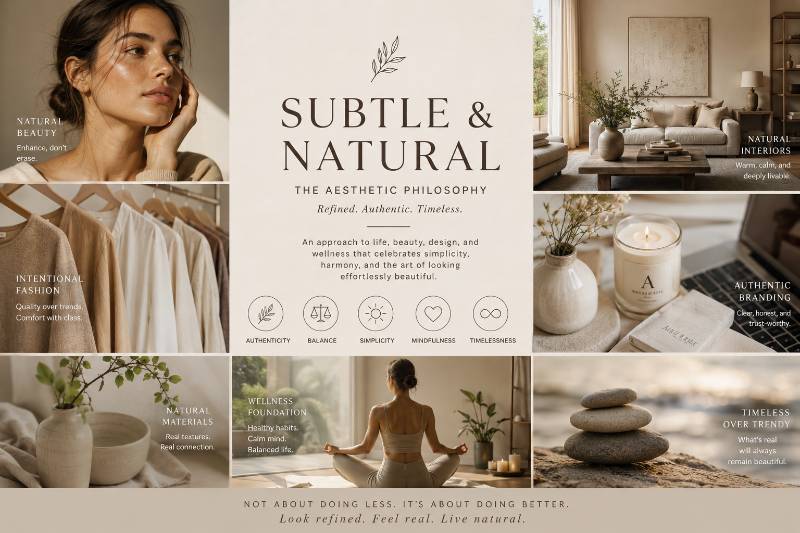
Subtle & Natural: The Aesthetic Philosophy of Quiet Confidence
In a world overloaded with filters, loud branding, dramatic transformations, and fast-changing trends, the “Subtle & Natural” aesthetic philosophy feels like a return to sanity.
It is not about looking plain. It is not about doing nothing. It is not about rejecting beauty, luxury, design, or self-improvement.
It is about refinement without excess.
It is the art of making something look effortless, believable, balanced, and deeply human. Whether applied to personal beauty, fashion, interiors, branding, photography, wellness, architecture, or lifestyle, the Subtle & Natural philosophy says one powerful thing:
The best aesthetic does not scream for attention — it earns attention quietly.
This philosophy has become especially relevant in 2026 because audiences are becoming tired of overdone appearances. In facial aesthetics, the American Academy of Facial Plastic and Reconstructive Surgery reported that one of the biggest patient concerns is no longer just cost or downtime, but the fear of looking “done” or unnatural.
What Is the “Subtle & Natural” Aesthetic Philosophy?
The Subtle & Natural aesthetic philosophy is a design and lifestyle approach based on restraint, harmony, authenticity, softness, and timeless appeal.
It focuses on enhancing what already exists rather than replacing it with something artificial.
In beauty, it means glowing skin, balanced features, natural movement, healthy hair, and makeup that supports the face instead of covering it.
In fashion, it means clean silhouettes, quality fabrics, thoughtful colors, and clothes that feel lived-in rather than costume-like.
In interiors, it means warm materials, natural textures, calming colors, layered lighting, and spaces that feel emotionally comfortable instead of showroom-perfect.
In branding, it means honest messaging, clean visual identity, strong typography, and trust-building design rather than noisy graphics and aggressive selling.
At its heart, Subtle & Natural is about this:
Make it better, but do not make it obvious.
Why Subtle & Natural Is Becoming So Powerful
For many years, digital culture pushed people toward exaggeration. Bigger lips. Sharper jawlines. Brighter filters. Heavier edits. Louder interiors. Viral outfits. Trend-based identity.
But now, the mood is changing.
People are looking for things that feel more real, more personal, and more sustainable. In aesthetic medicine, 2026 trends are moving toward regeneration, precision, personalization, micro-dosing, and natural-looking results that preserve individual expression.
The global aesthetic market also shows that people are still highly interested in beauty and self-improvement, but with more emphasis on refinement and careful choices. ISAPS reported nearly 38 million surgical and non-surgical aesthetic procedures in 2024, with botulinum toxin and hyaluronic acid fillers remaining among the most common non-surgical procedures worldwide.
The American Society of Plastic Surgeons also reported that cosmetic surgeries and minimally invasive treatments remained stable in 2024, with surgical procedures up 1% and minimally invasive treatments up 3% year over year.
This proves something important: people are not abandoning aesthetics. They are becoming more selective.
They want results that feel polished but not fake. Elevated but not forced. Beautiful but still human.
The Core Principles of the Subtle & Natural Aesthetic
1. Enhancement Over Transformation
The first rule of Subtle & Natural is simple:
Improve, do not erase.
This philosophy respects original identity. It does not try to turn one person, room, brand, or object into a copy of something else.
For a face, this means preserving natural expressions, facial character, age-appropriate beauty, and individual proportions.
For a home, it means working with natural light, existing architecture, local materials, and personal memories.
For a brand, it means amplifying the real value of the business instead of hiding behind visual noise.
A subtle aesthetic does not ask, “How can we make this look trendy?”
It asks, “How can we make this feel more true?”
2. Restraint as Luxury
Real luxury is rarely loud.
The most elegant spaces, faces, outfits, and brands usually share one quality: restraint.
A beautifully tailored white shirt. A soft linen curtain. A natural smile. A calm website. A warm wooden table. A fragrance that is noticed only when someone comes close.
Subtle & Natural aesthetics rely on discipline. They remove what is unnecessary. They avoid over-decoration. They allow breathing space.
This is why subtle design often ages better than trend-heavy design. What is loud today can look outdated tomorrow. What is balanced today often remains beautiful for years.
3. Natural Texture and Imperfection
Nature is not perfectly symmetrical, glossy, or flat.
Wood has grain. Stone has veins. Skin has texture. Linen has creases. Handmade ceramics have small irregularities. Real homes have signs of life.
The Subtle & Natural philosophy welcomes these imperfections because they create emotional warmth.
In interiors, 2025–2026 design discussions have moved toward warmth, craftsmanship, material honesty, tactile surfaces, and timelessness instead of disposable aesthetics.
This is the opposite of sterile perfection.
A subtle natural space should not feel dead. It should feel calm, warm, and alive.
4. Harmony Before Attention
A loud aesthetic tries to dominate the eye.
A subtle aesthetic guides the eye.
It thinks about proportion, rhythm, softness, spacing, light, and balance. Nothing feels accidental, but nothing feels desperate.
In beauty, harmony means features that work together. In fashion, it means colors, fabric, shape, and body movement are aligned. In interiors, it means furniture, texture, light, and empty space support each other.
The result is not boring. It is composed.
Good subtle design is like good background music in a luxury hotel. You may not notice every note, but you feel the atmosphere.
5. Longevity Over Virality
The Subtle & Natural philosophy rejects the pressure to chase every trend.
Trends can be fun, but they should not control identity.
A subtle natural aesthetic asks:
Will this still feel good after five years?
Will this still suit me when the algorithm moves on?
Is this based on my real taste, or am I copying a moment?
Does this improve my life, or only my image?
This is why subtle natural aesthetics are closely connected to timelessness. They are not anti-modern. They simply avoid becoming disposable.
Subtle & Natural in Beauty
Beauty is one of the clearest places where this philosophy appears.
The old idea of beauty often focused on correction: cover, reshape, hide, lift, contour, transform.
The newer subtle natural approach focuses on health, balance, and believability.
It values:
Natural-looking skin
Soft radiance
Balanced brows
Healthy lips
Fresh eyes
Facial movement
Skin quality
Good sleep
Hydration
Minimal but intelligent makeup
Age-appropriate refinement
Treatments that support collagen and skin health
In 2026, the beauty industry is also seeing movement away from the fully standardized “clean girl” look toward more expressive beauty. Trend forecasters have noted that clean-girl and no-makeup makeup became dominant because consumers wanted safe, optimized routines, but the next cycle is becoming more expressive and individual.
That is an important distinction.
Subtle & Natural does not mean everyone should look the same. It means each person should look like the most comfortable, refined version of themselves.
The goal is not “perfect skin.”
The goal is alive skin.
The goal is not “a new face.”
The goal is a rested, confident, believable face.
Subtle & Natural in Fashion
In fashion, Subtle & Natural is not about wearing only beige clothes. That is a common misunderstanding.
It is about intentional dressing.
A subtle natural wardrobe may include earthy tones, whites, creams, browns, charcoal, navy, olive, muted pastels, or even rich colors — but the styling feels balanced.
Key elements include:
Well-fitted basics
Natural fabrics like cotton, linen, wool, silk, hemp, leather, and cashmere
Soft tailoring
Minimal logos
Comfortable silhouettes
Neutral layering
Quality footwear
Simple jewelry
Colors inspired by nature
Clothes that move well with the body
The best subtle fashion does not look like someone tried too hard.
It looks considered, comfortable, and quietly expensive — even when it is not expensive.
A person dressed in the Subtle & Natural style may not be the loudest in the room, but they often appear the most grounded.
Subtle & Natural in Interior Design
In interiors, this philosophy creates spaces that feel calm, warm, and deeply livable.
A subtle natural home is not empty. It is not cold minimalism. It is not a staged hotel room.
It usually includes:
Natural wood
Stone
Clay
Ceramic
Linen
Cotton
Wool
Warm lighting
Soft neutral colors
Indoor plants
Handmade objects
Personal books
Textured rugs
Curved furniture
Quiet corners
Functional storage
Meaningful art
The goal is to create a home that supports the nervous system.
A subtle natural home should make people breathe more slowly when they enter.
It should feel like a place where one can think, rest, cook, talk, read, host, recover, and live fully.
The most beautiful version of this aesthetic is not “Instagram clean.” It is emotionally clean.
Subtle & Natural in Branding and Business
For brands, the Subtle & Natural aesthetic is becoming extremely powerful because customers are tired of exaggerated promises.
A subtle natural brand feels trustworthy.
It uses:
Clean typography
Soft but confident colors
Clear messaging
Human photography
Authentic testimonials
Simple layouts
Thoughtful spacing
Honest product descriptions
Calm user experience
Less shouting, more clarity
This works especially well for premium services, wellness brands, healthcare platforms, consulting companies, hospitality businesses, luxury products, sustainable brands, personal brands, and education platforms.
A subtle brand does not need to scream “We are premium.”
It behaves premium.
The design is clean. The words are precise. The user journey is smooth. The photography feels real. The promises are believable.
In branding, subtlety creates trust because it signals confidence.
A desperate brand over-explains.
A mature brand communicates clearly.
Subtle & Natural in Photography and Social Media
Social media made exaggerated aesthetics normal. Heavy filters, unrealistic skin smoothing, artificial backgrounds, over-saturated colors, and copied poses became common.
The Subtle & Natural approach brings photography back toward reality.
It favors:
Natural light
Soft shadows
Real skin tone
Minimal editing
Candid expressions
Calm backgrounds
Human posture
Real environments
Warm composition
Story over perfection
This does not mean poor-quality visuals. In fact, subtle photography often requires better taste and more control.
The editing is invisible.
The lighting is gentle.
The subject feels present.
The final image should feel like a beautiful memory, not a manufactured advertisement.
Subtle & Natural in Wellness
Aesthetic philosophy is not only visual. It is also physical and emotional.
A person cannot maintain a natural glow through products alone. The body eventually reveals lifestyle.
The Subtle & Natural wellness approach includes:
Sleep consistency
Hydration
Balanced food
Walking
Strength training
Sun protection
Stress management
Breathing practices
Digital boundaries
Good posture
Skincare discipline
Moderate routines
Regular health checkups
It avoids extreme “glow-up” culture.
No crash diets.
No obsessive routines.
No unrealistic body goals.
No constant self-fixing.
Instead, it asks: What can I do daily that makes me healthier, calmer, and more naturally alive?
That is the real foundation of subtle beauty.
The Difference Between Minimal, Clean, Quiet Luxury, and Subtle Natural
These terms are often mixed together, but they are not exactly the same.
Minimal Aesthetic
Focuses on reduction, simplicity, empty space, and fewer elements.
Clean Aesthetic
Focuses on polished, fresh, organized, hygienic, smooth, and visually neat presentation.
Quiet Luxury
Focuses on understated wealth, premium materials, fine craftsmanship, and logo-free elegance.
Subtle & Natural
Focuses on authenticity, softness, restraint, harmony, believability, and organic refinement.
Subtle & Natural can include minimalism, clean beauty, and quiet luxury — but it is warmer and more human than all three.
It is not only about looking expensive.
It is about looking real, balanced, and timeless.
Common Mistakes in Trying to Create a Subtle & Natural Look
Mistake 1: Thinking Natural Means No Effort
Natural-looking results often require more skill, not less.
A natural makeup look can take careful blending. A natural interior may require thoughtful materials. A natural brand identity may need strong design discipline.
The effort is there. It is simply not visible.
Mistake 2: Copying Beige Aesthetics Blindly
Subtle does not mean colorless.
Nature has many colors: forest green, terracotta, sand, charcoal, ocean blue, rose, clay, cream, bark brown, deep plum, and soft gold.
A subtle palette can be rich. It just should not feel chaotic.
Mistake 3: Removing Personality
Some people make the mistake of stripping everything down until there is no soul left.
A subtle natural home still needs personal objects.
A subtle outfit still needs character.
A subtle face still needs expression.
A subtle brand still needs a point of view.
Subtle does not mean anonymous.
Mistake 4: Over-Perfecting
Too much smoothing, polishing, matching, correcting, and editing can kill natural beauty.
The philosophy depends on a little softness.
Let linen wrinkle.
Let wood show grain.
Let skin have texture.
Let a room have one unexpected object.
Let a brand sound human.
Perfection often feels less natural than confidence.
Mistake 5: Confusing Subtle with Cheap or Basic
Subtle does not mean low-effort or low-value.
A subtle aesthetic often depends on better quality: better fabric, better lighting, better spacing, better materials, better typography, better craftsmanship, better clinical judgment, better editing.
The beauty is quiet, but the standards are high.
How to Apply the Subtle & Natural Philosophy in Daily Life
For Personal Beauty
Focus on skin health before makeup. Choose treatments carefully. Avoid anything that removes your natural expression. Use makeup to brighten and balance, not mask.
For Wardrobe
Build around quality basics. Choose colors that suit your skin tone. Prefer fit over trend. Use accessories sparingly but meaningfully.
For Home
Use warm lighting, natural materials, clean storage, and personal details. Avoid buying decor only because it is trending online.
For Brand or Website
Use clear design, honest copy, real images, strong spacing, and calm colors. Avoid visual clutter and exaggerated claims.
For Social Media
Post less artificial content. Use real light, real expressions, useful captions, and consistent visual tone.
For Lifestyle
Invest in routines that make you feel naturally better: sleep, movement, food, hydration, skincare, learning, and calm spaces.
The Emotional Power of Subtle & Natural
The reason this philosophy works so well is not only visual.
It is emotional.
People are overwhelmed. They are tired of being sold to. They are tired of comparison. They are tired of artificial perfection. They are tired of designs that look good online but feel empty in real life.
Subtle & Natural offers relief.
It tells people:
You do not need to become someone else.
You do not need to look artificial to look beautiful.
You do not need a loud home to have taste.
You do not need a noisy brand to be powerful.
You do not need to chase every trend to remain relevant.
You can refine what is already there.
That message is deeply modern.
Future of the Subtle & Natural Aesthetic
The future of this aesthetic will not be about doing less. It will be about doing better.
In beauty, we will likely see more skin-first treatments, regenerative approaches, precision injectables, personalized routines, and natural-looking outcomes. AAFPRS has already identified regenerative aesthetics, biostimulators, AI-driven facial mapping, tailored dosing, and integrative wellness as important 2026 directions.
In interiors, the future will continue moving toward warmth, craft, material honesty, layered textures, and homes that feel meaningful rather than performative.
In makeup and personal style, subtle natural beauty will likely become more individual — less standardized clean-girl sameness, more personality, more healthy color, and more freedom.
The strongest version of Subtle & Natural will not be a fixed “look.”
It will be a philosophy of intelligent refinement.
Conclusion: The Beauty of Not Overdoing It
The Subtle & Natural aesthetic philosophy is not a passing trend. It is a mature response to a world that has become too edited, too loud, too fast, and too artificial.
It celebrates beauty, but not vanity.
It values design, but not decoration for decoration’s sake.
It supports self-improvement, but not self-erasure.
It respects luxury, but not loud status.
It welcomes modern techniques, but only when they preserve authenticity.
The best version of this philosophy can be summed up in one sentence:
Look refined, feel real, and let the beauty appear effortless.
That is the quiet power of Subtle & Natural.