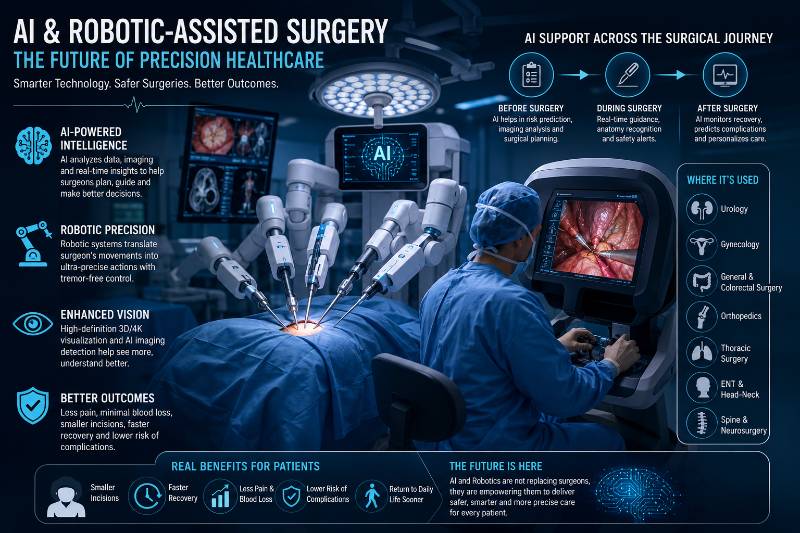
Introduction: Surgery Is Becoming More Digital, But the Surgeon Is Still in Charge
A common misunderstanding is that “robotic surgery” means a robot performs the operation by itself. In most real operating rooms today, that is not true. Robotic-assisted surgery usually means a trained surgeon controls robotic arms from a console while using high-definition 3D vision, wristed instruments, motion scaling, and tremor reduction to perform minimally invasive procedures with greater precision.
Artificial intelligence is now being added around that robotic foundation. AI can help surgeons plan operations, analyze imaging, recognize anatomy, track instruments, review surgical video, measure performance, support training, and predict complications. In simple terms: robotics gives surgery better hands; AI gives it better eyes, memory, maps, and feedback.
This is one of the fastest-moving areas in modern healthcare. By 2026, robotic-assisted surgery has expanded beyond urology into general surgery, colorectal surgery, gynecology, orthopedics, thoracic surgery, ENT, spine, and cancer surgery. At the same time, regulators and hospitals are paying closer attention to evidence, safety, cost, cybersecurity, training, and ethical use of surgical data.
What Is Robotic-Assisted Surgery?
Robotic-assisted surgery is a form of minimally invasive surgery where robotic instruments help the surgeon perform an operation through small incisions. The surgeon usually sits at a console and controls robotic arms in real time. The robot does not “think” independently in most procedures; it translates the surgeon’s hand movements into precise instrument movements inside the patient.
The major advantages come from:
| Feature | Why It Matters |
|---|---|
| 3D high-definition visualization | Surgeons can see anatomy in depth and detail. |
| Wristed instruments | Tools can bend and rotate more than standard laparoscopic instruments. |
| Motion scaling | Large hand movements can become tiny, controlled movements. |
| Tremor filtering | Small natural hand tremors can be reduced. |
| Ergonomic console | Surgeons may operate with less physical strain during long procedures. |
| Digital data capture | Surgical video and system data can be analyzed for training and quality improvement. |
Robotic-assisted surgery is especially useful when surgeons need to work in narrow, deep, delicate, or hard-to-reach spaces, such as the pelvis, prostate, rectum, chest, throat, spine, or joints.
What Does AI Add to Robotic Surgery?
AI does not only mean “autonomous robots.” In surgery, AI is more often used as decision-support, perception, prediction, and workflow intelligence.
A Nature Medicine review describes AI in surgery as a developing field across the preoperative, intraoperative, and postoperative phases, with growing potential from foundation models, wearable technologies, and improved surgical data infrastructure. (Nature)
1. Before surgery: better planning
AI can help combine CT scans, MRI, ultrasound, pathology, lab results, and patient history to support risk prediction and surgical planning. In the future, surgeons may use AI-generated 3D models or “digital twins” to rehearse complex procedures before entering the operating room.
2. During surgery: real-time guidance
AI can analyze surgical video and imaging to identify anatomy, detect tissue boundaries, estimate blood flow, recognize surgical phases, and warn when the surgeon is approaching a risky area. This is where computer vision becomes powerful: the system can “watch” the procedure and provide context.
3. After surgery: prediction and recovery monitoring
AI can help predict complications, monitor recovery patterns, analyze surgical video for performance improvement, and support personalized follow-up. This matters because surgical quality does not end when the incision is closed.
The Latest State of AI and Robotic-Assisted Surgery in 2026
Robotic surgery is no longer a niche technology. It is becoming a core part of hospital strategy in many countries.
Intuitive Surgical, maker of the da Vinci platform, reported that about 3.153 million da Vinci procedures were performed worldwide in 2025, up from about 2.683 million in 2024. The company also reported placing 1,721 da Vinci systems in 2025, including 870 da Vinci 5 systems. (Nasdaq)
The da Vinci 5 system received FDA clearance in 2024, and Intuitive announced more than 100 updates and user-experience improvements for da Vinci 5 in May 2026, including telepresence improvements for remote physician observation and guidance. Intuitive also said its global network includes more than 101,000 da Vinci-trained surgeons. (Nasdaq)
Competition is also rising. Medtronic’s Hugo robotic-assisted surgery system received FDA clearance in December 2025 for minimally invasive urologic procedures, including prostatectomy, nephrectomy, and cystectomy; Medtronic said Hugo had already been used outside the U.S. in tens of thousands of urologic, gynecologic, and general surgery procedures across more than 30 countries. (Medtronic News)
CMR Surgical’s Versius Plus received FDA 510(k) clearance in December 2025 for cholecystectomy procedures, positioning the company for a U.S. commercial launch. (CMR Surgical)
Johnson & Johnson submitted its OTTAVA robotic surgical system to the FDA in January 2026 through a De Novo classification request, using data from an IDE study in Roux-en-Y gastric bypass procedures, and also received approval for a second U.S. clinical trial in inguinal hernia repair. (JNJ.com)
In orthopedics, Stryker’s Mako SmartRobotics platform continues expanding across hip, knee, spine, and shoulder procedures. Stryker reported in 2025 that more than 1.5 million Mako procedures had been performed globally across 45 countries. (Stryker)
The public-health direction is clear too. NHS England projected that robotic surgery could support 500,000 operations per year by 2035, up from 70,000 in 2023/24, and estimated that 9 in 10 keyhole surgeries could be robot-assisted within the next decade. (NHS England)
Where Robotic-Assisted Surgery Is Used Today
Robotic-assisted surgery is now used across many specialties:
Urology
Urology was one of the earliest and strongest areas of adoption. Robotic prostatectomy, kidney surgery, bladder surgery, and reconstructive urology are common examples. The deep pelvic anatomy and need for delicate nerve-sparing techniques make robotics valuable.
Gynecology
Robotic systems are used in hysterectomy, endometriosis surgery, fibroid surgery, pelvic reconstruction, and gynecologic oncology. The technology can help in complex pelvic surgery where precision and visualization matter.
General and colorectal surgery
Robotics is increasingly used for hernia repair, gallbladder surgery, bariatric surgery, colorectal cancer, rectal surgery, and other abdominal operations. The evidence is strongest in certain complex cases, while routine use still depends on surgeon skill, hospital volume, cost, and patient selection.
Orthopedics
Orthopedic robots often work differently from soft-tissue robots. In knee, hip, spine, and shoulder procedures, robotics may assist with 3D planning, alignment, bone preparation, implant positioning, and navigation.
Thoracic, cardiac, ENT, and head-and-neck surgery
Robotic platforms can help surgeons operate in narrow spaces with limited access, such as the chest cavity, throat, and head-and-neck region. These areas benefit from precision, stable visualization, and small-incision access.
Spine and neurosurgery
Robotic and AI-guided navigation tools can support screw placement, spinal alignment planning, and image-guided procedures. Newer AI surgical guidance platforms are also emerging for real-time measurement and visualization.
Benefits of AI and Robotic-Assisted Surgery
1. Smaller incisions and faster recovery
Because many robotic procedures are minimally invasive, patients may experience less pain, reduced blood loss, shorter hospital stays, and faster return to daily life compared with open surgery. However, the benefits depend heavily on the procedure, surgeon experience, patient condition, and whether the comparison is with open surgery or conventional laparoscopy.
2. Greater precision in difficult anatomy
Robotic instruments can rotate and articulate in ways that standard laparoscopic tools cannot. That can be especially useful in tight spaces like the pelvis, around nerves and blood vessels, or in complex reconstructive procedures.
3. Better visualization
High-definition 3D visualization can help surgeons see small structures more clearly. AI-enhanced visualization may eventually highlight anatomy, tissue perfusion, tumor margins, or danger zones in real time.
4. Surgeon ergonomics and endurance
Robotic consoles can reduce physical strain compared with standing for long laparoscopic procedures. This matters because surgeon fatigue is a real safety and workforce issue.
5. More structured training
Robotic systems generate video, movement, timing, and instrument-use data. AI can turn that data into feedback for trainees, helping surgeons learn faster and standardize best practices.
6. Quality improvement through surgical data
Hospitals can use surgical video and robotic-system data to review cases, understand variation, improve workflows, and build safer operating-room protocols. This is one of AI’s biggest long-term opportunities.
What the Evidence Says: Promising, But Not Magic
The honest evidence picture is mixed and procedure-specific.
A BMJ Open review concluded that robotic surgery has a strong clinical effectiveness evidence base supporting expanded use in several common intracavity procedures, especially as a way to increase minimally invasive surgery. But the same review also emphasized higher incremental cost and longer operative time, and called for more economic studies. (BMJ Open)
A 2025 review of randomized trials found robotic surgery to be safe and technically feasible, with comparable or improved short-term outcomes in selected contexts, especially anatomically complex cases such as rectal cancer or pancreatic surgery. (MDPI)
But robotic surgery is not automatically better for every operation. For some procedures, conventional laparoscopy may offer similar outcomes at lower cost. A JAMA Surgery cohort study on robotic-assisted cholecystectomy in acute care surgery concluded that more research is needed to optimize robotic outcomes and costs in that setting. (JAMA Network)
The practical takeaway: robotic surgery is most valuable when it improves access to minimally invasive surgery, helps in technically complex anatomy, or produces measurable improvements in outcomes, recovery, training, or system efficiency.
Is the Robot Autonomous?
Usually, no.
Most surgical robots in clinical use are surgeon-controlled. A systematic review of FDA-cleared surgical robots from 2015 to 2023 found that most were Level 1 “robot assistance” systems, while the most advanced cleared systems reached Level 3 “conditional autonomy.” The review found no Level 4 or Level 5 surgical robots cleared for clinical use. (Nature)
That said, autonomy research is advancing quickly. Johns Hopkins researchers reported in 2025 that a robotic system performed realistic gallbladder-removal tasks on pig organs without direct human help, building on earlier Smart Tissue Autonomous Robot work. This was a major research milestone, but it was not the same as routine autonomous surgery in human patients. (Whiting School of Engineering)
The future will likely arrive step by step: not “robot replaces surgeon,” but robot automates narrow, well-defined surgical subtasks under surgeon supervision.
Examples could include:
- Camera control
- Suturing assistance
- Bone milling
- Tool positioning
- Tissue measurement
- Surgical phase recognition
- Safety-zone alerts
- Automated documentation
- Postoperative video analysis
That is a more realistic and safer path than jumping straight to fully autonomous operations.
The Role of Regulation and Safety
AI-enabled medical devices must be validated, monitored, and regulated carefully because surgical decisions can be high-risk. The FDA maintains an AI-enabled medical device list to identify AI-enabled devices authorized for U.S. marketing, while noting that the list is not comprehensive and is updated periodically. (U.S. Food and Drug Administration)
The FDA also issued guidance on Predetermined Change Control Plans for AI-enabled device software functions, allowing manufacturers to describe in advance how certain AI device updates may be made while still protecting safety and effectiveness. (U.S. Food and Drug Administration)
This matters because AI systems can change over time. A model that performs well in one hospital, patient population, camera setup, or procedure type may not perform the same everywhere. Surgical AI must be tested not only in the lab, but in real clinical workflows.
Risks and Challenges Readers Should Understand
1. Cost
Robotic systems are expensive to buy, maintain, staff, and train on. Hospitals must prove that better outcomes, shorter stays, higher surgical capacity, or fewer complications justify the investment.
2. Learning curve
Robotic surgery requires specialized training. Outcomes improve when surgeons and teams perform enough cases and follow structured credentialing, mentoring, and quality review.
3. Overuse and marketing hype
Robotic surgery should not be used just because it sounds advanced. The right question is: Does this approach improve safety, recovery, precision, access, or long-term outcomes for this patient?
4. Data privacy
AI surgery depends on surgical video, imaging, device logs, patient records, and outcomes data. Hospitals must protect patient privacy and define who owns and can use surgical data.
5. Bias and generalizability
AI models trained on limited datasets may perform poorly for underrepresented populations, unusual anatomy, rare procedures, or hospitals with different equipment.
6. Cybersecurity
Connected operating rooms introduce cybersecurity concerns. Robotic platforms, cloud analytics, remote proctoring, and hospital networks must be secured by design.
7. Liability
If an AI system gives guidance and a complication occurs, responsibility can become complicated. Surgeons, hospitals, manufacturers, regulators, and insurers will need clearer frameworks.
8. Inequality of access
High-cost technology often reaches wealthy hospitals first. Without careful policy, robotic-assisted surgery could widen gaps between urban and rural hospitals, public and private systems, and high-income and low-income regions.
What Patients Should Ask Before Robotic Surgery
Patients do not need to become engineers, but they should ask practical questions:
- Why is robotic surgery recommended for my case?
- What are the alternatives: open surgery, laparoscopy, medication, radiation, or watchful waiting?
- How many robotic procedures like mine has the surgeon performed?
- What are the expected benefits for me specifically?
- Will robotic surgery reduce my hospital stay, pain, blood loss, or complication risk?
- Could the operation be converted to open surgery if needed?
- Are there extra costs?
- What complications should I understand?
- How will my surgical data or video be used, if recorded?
- What does recovery look like compared with other approaches?
A good surgeon should welcome these questions.
What Hospitals Need for a Successful Robotic Surgery Program
Buying the robot is the easy part. Building a safe robotic surgery program is harder.
A strong program needs:
- Careful procedure selection
- Credentialing and competency standards
- Surgeon and team training
- Simulation and dry-lab practice
- Proctoring and mentoring
- Data-driven outcome tracking
- Maintenance and technical support
- Cybersecurity controls
- Transparent patient consent
- Cost-effectiveness review
- Equity planning so access is not limited to privileged patients
The best hospitals will treat robotic surgery not as a shiny machine, but as a full clinical system.
The Future: Where AI and Surgical Robotics Are Going
1. AI-powered surgical copilots
Future systems may act like a surgical copilot: watching the operation, recognizing anatomy, warning about risk, suggesting next steps, and documenting events automatically.
2. Real-time tissue intelligence
AI may help surgeons identify blood flow, oxygenation, cancer margins, nerve locations, or tissue quality in real time. This could reduce guesswork and improve precision.
3. More automation of small tasks
Fully autonomous surgery is still far away, but automation of narrow surgical subtasks is realistic. The safest model is surgeon-supervised autonomy.
4. Personalized surgical planning
AI may help create patient-specific plans based on anatomy, imaging, disease stage, risk profile, and surgeon preference.
5. Remote mentoring and telepresence
Telepresence can allow expert surgeons to observe and guide procedures remotely. This could improve training and expand access to specialist knowledge, especially in underserved regions.
6. Surgical video as a learning engine
Every operation creates data. With proper privacy protection, AI can learn from surgical videos to improve education, detect best practices, and reduce avoidable variation.
7. More competition and lower costs
As more platforms enter the market, hospitals may gain more choices. Competition could reduce costs, improve interoperability, and accelerate innovation.
Myths vs Reality
| Myth | Reality |
|---|---|
| The robot performs the surgery alone. | In most cases, the surgeon controls the robot throughout the procedure. |
| Robotic surgery is always better. | It depends on the procedure, patient, surgeon experience, and hospital program. |
| AI will replace surgeons soon. | AI is more likely to assist, guide, measure, and automate small tasks under supervision. |
| Robotic surgery means zero risk. | All surgery has risk. Robotics changes the risk profile but does not remove risk. |
| The newest robot guarantees the best outcome. | Surgeon skill, team training, patient selection, and hospital quality matter more than branding. |
Final Thoughts: The Smart Operating Room Is Coming
AI and robotic-assisted surgery are changing the operating room from a place of manual skill alone into a connected, data-rich, precision-guided environment. The best future is not one where machines replace surgeons. The best future is one where surgeons are amplified by better tools, better imaging, better feedback, and safer systems.
Robotic surgery has already helped millions of patients receive minimally invasive care. AI is now pushing the field toward smarter planning, real-time guidance, personalized recovery, and eventually carefully supervised autonomy. But the technology must be judged by outcomes, not hype.
The real question is not, “Can a robot do surgery?”
The better question is: Can AI and robotics help surgical teams deliver safer, more precise, more accessible, and more human-centered care?
That is the future worth building.