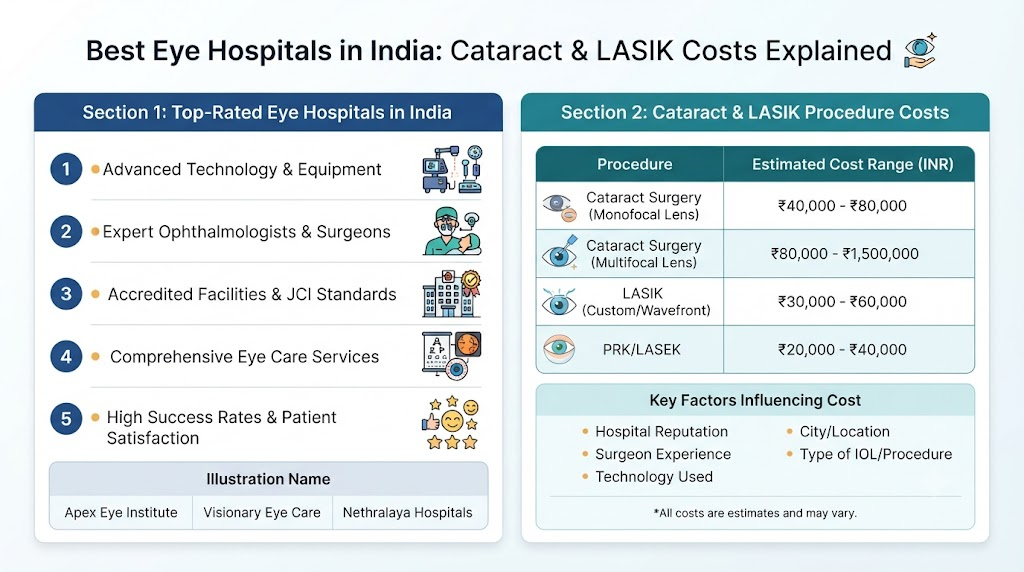
Navigating global health systems to resolve complex vision issues can feel overwhelming. When clear vision is at stake, matching your structural visual condition with the right clinical expertise is a vital prerequisite for a successful recovery.Today, patients are no longer restricted to local providers. Medical tourism and digital transparency platforms allow individuals to compare specialized institutions globally. This educational guide breaks down how to identify the best eye hospitals, weigh critical procedural variations like cataracts and LASIK, understand international pricing, and make structured, data-driven decisions for your vision care planning.
Why Choosing the Right Eye Hospital Matters
Ophthalmology is a highly mechanized medical field that relies heavily on diagnostic accuracy and precise micro-surgical technology. Choosing a center from among the best eye surgery hospitals ensures access to a broad ecosystem of clinical infrastructure. Specialized institutions bring together multiple fields of study under one roof—ensuring that if a routine treatment reveals a complex condition, a specialized cornea, retina, or glaucoma expert is available to handle it immediately.
Furthermore, leading facilities invest heavily in modern diagnostic imaging, such as Optical Coherence Tomography (OCT) and corneal topography maps. These high-resolution imaging systems allow an eye surgeon to map the structural layers of your eye with incredible accuracy before making a single incision. Clinical data from the American Academy of Ophthalmology (AAO) consistently shows that high-volume centers utilizing these modern mapping technologies experience far lower post-operative adjustment rates.
Cataract Surgery Overview: Techniques and Innovations
A cataract is the progressive clouding of the eye’s natural crystalline lens, typically caused by natural metabolic changes over time. When standard corrective lenses can no longer fix the visual blur, surgical intervention becomes necessary. The procedure involves removing the clouded lens and replacing it with a clear artificial intraocular lens (IOL).
[Clouded Natural Lens] ──> [Phacoemulsification / Laser Fragmentation] ──> [Clear Artificial IOL Inserted]
Modern medicine offers two primary methods for clearing away cataracts:
- Traditional Phacoemulsification: The eye surgeon uses a manual blade to create a small structural incision at the edge of the cornea. An ultrasonic probe then vibrates at a high frequency to break up the clouded lens material so it can be gently vacuumed away.
- Laser-Assisted Cataract Surgery: A computer-guided femtosecond laser makes the initial corneal incisions and softens the dense cataract. This reduces the amount of ultrasonic energy needed inside the eye, which helps protect the delicate corneal lining.
Selecting the right replacement intraocular lens (IOL) is a critical part of planning your treatment. Monofocal lenses are set for one specific distance (usually distance vision), meaning you will still need glasses for reading. Premium options, such as multifocal, trifocal, or extended depth of focus (EDOF) lenses, alter how light bends inside the eye to provide clear vision at multiple distances, frequently minimizing the need for glasses after surgery.
LASIK and Refractive Surgery Breakthroughs
Refractive surgeries rewrite how light focuses onto the retina by reshaping the clear outer surface of the eye (the cornea). For patients looking to fix nearsightedness, farsightedness, or astigmatism, selecting the best hospitals for LASIK surgery provides access to specialized custom mapping profiles.
                  [Wavefront Custom Mapping]
                              │
                              ▼
    [Femtosecond Laser] ──> Creates Flap
    [Excimer Laser]     ──> Reshapes Inner Stroma
    [Flap Repositioned] ──> Natural Visual Recovery
Modern laser eye surgery has evolved far beyond standard prescriptions:
- Wavefront-Guided LASIK: This system measures how light waves travel through your eye to map tiny, unique imperfections. The laser then uses this map to customize the treatment, which can improve contrast sensitivity and reduce glare at night.
- Topography-Guided Abberometry: This approach builds a detailed digital map of the unique curves on your corneal surface, treating your eye based on its precise shape rather than just your glasses prescription.
Beyond traditional LASIK, premier clinics offer alternative options like Photorefractive Keratectomy (PRK) for patients with thin corneas, or ReLEx SMILE (Small Incision Lenticule Extraction), which leaves the surface of the cornea completely intact.
Key Factors to Compare Global Eye Care Centers
When comparing options among the best ophthalmology hospitals in the world, look beyond basic marketing claims. Use these specific, objective metrics to evaluate facilities:
- International Accreditations: Look for certifications from recognized global bodies like the Joint Commission International (JCI). A JCI seal confirms that the hospital meets strict international standards for surgical hygiene, infection control, and patient safety.
- Surgeon Volume Metrics: Ask how many procedures your chosen specialist performs each year. High-volume surgeons who perform hundreds of cataract or refractive surgeries annually develop excellent spatial awareness and precise muscle memory, which helps minimize micro-surgical complications.
- Technological Infrastructure: Verify that the facility uses modern laser platforms (such as the latest excimer and femtosecond technologies) and has up-to-date diagnostic imaging tools.
- Integrated Specialty Sub-fields: Ensure the hospital has dedicated, on-site departments for the retina, cornea, and glaucoma to provide comprehensive care if unexpected issues arise.
Cataract Surgery vs. LASIK Surgery
To help you understand how these two common procedures compare, the table below outlines their core technical and practical differences:
| Feature | Cataract Surgery | LASIK Surgery |
| Primary Clinical Purpose | Replaces a physically clouded internal lens to restore lost clarity. | Reshapes a healthy cornea to correct refractive focus errors. |
| Surgical Technique | Ultrasonic or laser fragmentation followed by clear IOL insertion. | Creating a thin flap to reshape the internal stromal tissue. |
| Key Structural Advantages | Permanently resolves cataracts; provides permanent multi-distance focus with premium IOLs. | Rapid visual recovery; often eliminates dependence on glasses or contacts. |
| Primary Structural Limitations | Requires internal eye access; gradual structural adaptation period. | Dependent on having adequate corneal thickness; temporary dry eye symptoms. |
| Ideal Patient Profile | Individuals with age-related or secondary crystalline lens clouding. | Adults with stable prescriptions and healthy corneal structure. |
| Cost Frameworks | Varies by choice of IOL (Monofocal vs. Premium Multifocal options). | Fixed per-eye surgical fee based on the chosen laser tracking system. |
India as a Leading Destination for Vision Care
India has become a premier global hub for specialized vision care, attracting thousands of international patients each year. The country’s reputation is anchored by world-class institutions like Aravind Eye Care System, Sankara Nethralaya, and L.V. Prasad Eye Institute, which are globally recognized for their clinical research and massive procedural volumes.
Choosing the best eye hospitals in India offers a distinct advantage: you can access highly experienced, fellowship-trained eye doctors in India who regularly manage complex cases, all while utilizing the exact same JCI-accredited diagnostic equipment found in top Western clinics.
Global Treatment Cost Considerations
For many families, treatment costs are a major factor when planning care. Choosing to travel for procedures can offer significant financial advantages without compromising on quality. The table below shows a cost comparison for common procedures across different regions:
| Destination Option | Cataract Surgery (Per Eye, Standard) | LASIK Surgery (Both Eyes, Custom) | Average Processing Wait Time |
| United States | $3,500 – $5,000 | $4,000 – $6,000 | 4 to 12 Weeks |
| United Kingdom | £2,500 – £4,000 | £3,000 – £5,500 | 8 to 24 Weeks (NHS/Private Variation) |
| India | $600 – $1,500 | $800 – $1,800 | Immediate Availability |
| Thailand | $1,500 – $2,500 | $1,800 – $3,200 | 1 to 2 Weeks |
Note: Estimates reflect base clinical and surgical costs as of 2026. Final expenses vary based on specific diagnostic requirements and lens choices.
Advanced Surgical Variations: LASIK vs. PRK
For patients exploring laser vision correction, understanding the structural differences between LASIK and PRK is key to finding the right match for your eyes:
| Metric Evaluation | LASIK (Laser In-Situ Keratomileusis) | PRK (Photorefractive Keratectomy) |
| Structural Approach | A thin flap is cut in the cornea and flipped back to reshape the tissue underneath. | The thin outer layer (epithelium) is removed entirely, and the surface is reshaped directly. |
| Recovery Experience | Rapid comfort improvement; functional vision often returns within 24 hours. | Gradual recovery over 3 to 5 days while the outer cell layer naturally regrows. |
| Structural Limitations | Requires sufficient baseline corneal thickness to safely create the flap. | Can be performed on patients with thinner or asymmetric corneas. |
| Long-Term Impact | Excellent structural stability; rare, minimal risks of late-stage flap displacement. | No risk of flap complications; slightly higher initial need for post-op eye drops. |
| Cost Frameworks | Standard pricing based on the specific laser equipment used. | Often comparable to LASIK, though requires additional follow-up protection lenses. |
Actionable Best Practices for Planning Eye Treatment
- Secure Complete Digital Medical Records: Always request high-resolution copies of your optical scans, topography maps, and prescription histories. Having these documents ready makes it easy to seek a reliable second medical opinion without needing to redo basic tests.
- Stop Wearing Contact Lenses Early: If you are planning for laser vision correction, stop wearing soft contact lenses at least two weeks before your final evaluation (and at least four weeks for hard lenses). This allows your cornea to return to its natural shape for accurate diagnostic mapping.
- Plan for Post-Operative Rest: Arrange for a caregiver or travel companion to assist you during the first 48 hours after surgery. Your eyes will be sensitive to light, and your spatial coordination will be temporarily altered.
- Strictly Follow Your Eye Drop Schedule: Set clear timers for all prescribed anti-inflammatory and antibiotic eye drops. These drops are essential for preventing infection and ensuring smooth healing.
Expert Tips for Patients and Caregivers
When evaluating a hospital’s technology, look beyond brand names and ask about the specific diagnostic tools they use. A top-tier surgical center should always combine its laser platforms with advanced pre-operative mapping tools, like corneal wavefront analyzers.
If you are traveling abroad for medical care, make sure the hospital has a dedicated international patient service wing. A good international team coordinates your travel schedule with your healing timeline, ensuring you don’t book a return flight before your eyes can safely handle cabin pressure changes and dry airplane air.
Common Mistakes to Avoid
- Focusing Only on Base Costs: Avoid choosing a clinic based solely on the lowest advertised price. Low upfront rates often exclude essential costs like pre-operative diagnostic imaging, specialized post-op eye drops, or follow-up appointments.
- Confusing Optometrists with Ophthalmologists: An optometrist focuses primarily on vision tests and general eye health management. For surgical procedures like cataracts or LASIK, your care should be managed by an ophthalmologist—a medical doctor specifically trained to perform delicate eye surgeries.
- Ignoring Local Environmental Factors: When traveling for eye care, remember that dust, high humidity, or heavy pollution can affect your early recovery. Choose accommodations that allow you to rest in a clean, climate-controlled environment immediately after your procedure.
Why Use BestEyeHospitals.com
Finding your way through international eye care options doesn’t have to be a complicated guessing game. BestEyeHospitals.com provides a structured, neutral platform designed to bring clarity to your research. The site serves as a comprehensive global knowledge hub, allowing patients to easily compare accredited eye care centers, verify surgeon credentials, and read detailed overviews of advanced treatments.
By organizing complex clinical data into clear, accessible categories, the platform helps you evaluate technology options, understand global cost differences, and find specialized care centers around the world. Whether you are seeking an expert second opinion for a complex retinal condition or planning a direct trip for laser vision correction, BestEyeHospitals.com gives you the tools and information you need to take control of your vision care journey.
Frequently Asked Questions
1. What is the fundamental difference between an ophthalmologist and an optometrist?
An ophthalmologist is a medical doctor (MD or DO) who specializes in advanced eye care and is fully trained to perform complex surgical procedures. An optometrist focuses on primary vision care, conducting routine eye examinations, writing lens prescriptions, and managing general, non-surgical eye health issues.
2. Is international hospital accreditation important when selecting an eye care center?
Yes, choosing a hospital with international accreditations, such as JCI, guarantees that the facility follows strict global healthcare standards. These certifications verify proper operating room sterilization, patient safety protocols, and structured quality metrics to minimize surgical risks.
3. How long does the visual recovery process take after standard LASIK surgery?
Most patients notice a significant improvement in their vision within 24 hours of a LASIK procedure. While slight fluctuations, mild dryness, or light sensitivity can continue for a few weeks, most individuals can comfortably return to work and resume their normal daily routines within one to two days.
4. Can a patient develop a cataract again after undergoing extraction surgery?
No, a true cataract cannot return because the eye’s natural crystalline lens is completely removed during surgery. However, some patients may develop a common condition called Posterior Capsule Opacification (PCO), where the thin membrane holding the new artificial lens becomes cloudy. This is easily treated with a quick, non-surgical laser procedure.
5. Why is the cost of cataract surgery so much lower in India compared to Western nations?
The lower cost of cataract surgery in India is primarily driven by lower local operational costs, institutional efficiencies, and favorable currency exchange rates. This allows top Indian hospitals to offer the exact same advanced laser technology and premium imported lenses at a fraction of Western prices.
6. What are premium intraocular lenses (IOLs), and do I really need them?
Premium IOLs include multifocal, trifocal, and extended depth of focus (EDOF) designs that allow the eye to focus clearly at multiple distances. While standard monofocal lenses are highly effective, they only focus at one distance (usually far away), meaning you will still need reading glasses for close-up tasks.
7. Am I allowed to fly home immediately after completing an eye surgery abroad?
You should generally avoid flying for at least 3 to 7 days following an internal eye surgery, such as cataract extraction, to allow your eye to stabilize. The dry air and pressure changes in airplane cabins can worsen dry eye symptoms and stress healing ocular incisions.
8. What is the difference between traditional phacoemulsification and laser-assisted cataract surgery?
Traditional phacoemulsification uses manual handheld blades to make small corneal incisions and relies on ultrasonic waves to break up the cataract. The laser-assisted method replaces these manual cuts with a computer-guided femtosecond laser, which softens the cataract first and uses less overall energy inside the eye.
9. What are the baseline corneal thickness requirements for undergoing standard LASIK?
A patient typically needs a residual corneal stromal bed thickness of at least 250 to 300 microns beneath the surgical flap to ensure long-term eye stability. If your pre-op diagnostic mapping shows your corneas are naturally thin, your surgeon may recommend surface procedures like PRK instead.
10. How can I get a reliable second medical opinion from an international eye specialist?
You can easily request a second opinion by gathering your complete digital eye records, including your latest prescriptions, OCT scans, and corneal topography maps. Sharing these documents digitally allows global specialists to review your case and confirm your treatment plan before you travel.
11. Does laser vision correction permanently guarantee perfect vision for the rest of my life?
LASIK permanently reshapes your corneal tissue to correct your current prescription, but it cannot stop the eye’s natural aging process. As you get older, you will likely still experience presbyopia—the natural loss of close-up reading vision that typically begins around age 40.
12. What specific steps should I take to prepare my eyes for a LASIK consultation?
The most important step is to stop wearing soft contact lenses for at least two full weeks (and hard lenses for four weeks) before your appointment. Contact lenses can temporarily alter the shape of your cornea, which can lead to inaccurate measurements during your diagnostic mapping.
13. What are the most common signs of a post-operative eye infection?
Contact your eye specialist immediately if you experience a sudden increase in pain, worsening redness around the eye, unusual discharge, extreme sensitivity to light, or a sudden drop in your vision. Catching these symptoms early is key to protecting your eyesight.
14. Are international patients required to speak the local language at top eye hospitals?
No, premier global hospitals that serve international patients maintain dedicated international departments with fluent, multilingual coordinators. These team members assist you with language translation, medical scheduling, and local logistics throughout your stay.
15. How long should I expect to stay abroad when planning an eye surgery?
For standard, uncomplicated procedures like cataracts or LASIK, plan to stay in the host country for 7 to 10 days. This timeline ensures you can complete all initial diagnostic tests, finish your surgery, and attend your essential early post-operative checkups safely.
Conclusion
Taking charge of your vision care requires a balance of clear information and careful planning. Whether you are managing an advanced cataracts diagnosis or exploring options for laser vision correction, the key to a successful outcome lies in choosing the right combination of clinical experience and modern technology. By carefully comparing international accreditation standards, checking surgeon volumes, and understanding the details of treatment costs, you can make informed choices that protect your long-term eye health. Always remember that your vision is an invaluable asset—take the time to research your options thoroughly, seek expert second opinions when needed, and use reliable, data-driven platforms to guide your care planning.