Introduction
People researching cosmetic surgery may come across hospital ratings, accreditation badges, safety certifications, patient reviews, and quality claims. These terms can sound similar, but they represent different types of information. Accreditation usually involves an external review against defined healthcare standards, while ratings may summarize selected quality, safety, outcome, or patient-experience measures. Certifications may focus on a particular service or program. Understanding these differences can help patients look beyond marketing claims and ask better questions about where their procedure will take place. BestCosmeticHospitals provides general information for people researching cosmetic surgery facilities. Looking at several quality signals together can give patients a clearer picture without treating any single rating or accreditation as a guarantee.
What Does Cosmetic Surgery Hospital Accreditation Mean?
Cosmetic surgery hospital accreditation is a formal process in which an independent organization evaluates a healthcare facility against established quality and patient-safety standards.
Depending on the accreditation program, the evaluation may examine infection prevention, medication management, patient rights, surgical processes, emergency readiness, staff practices, patient records, and other safety systems.
Accreditation requirements vary between countries, accrediting organizations, and healthcare settings. Patients should therefore find out which organization granted the accreditation, when it was granted, and what was actually evaluated.
The Joint Commission describes accreditation as an objective evaluation process intended to help healthcare organizations measure, assess, and improve quality and patient safety.
What Do Cosmetic Surgery Hospital Ratings Mean?
A cosmetic surgery hospital rating may be based on several types of information. Depending on the organization providing the rating, it might consider patient experience, safety measures, clinical outcomes, quality indicators, surveys, reputation, or a combination of measures.
Different rating organizations may use different data sources, patient populations, time periods, and scoring methods. This means two ratings for the same facility may not be directly comparable.
Rather than focusing only on an overall score, check what the rating actually measures and whether the information relates specifically to cosmetic surgery.
Ratings, Accreditation, and Certification: What Is the Difference?
These terms should not be treated as interchangeable.
Accreditation generally involves evaluating an organization against broader standards for healthcare quality and safety.
Certification may focus on a particular clinical service, program, or area of care. A facility can have broad accreditation while also having separate certification or recognition for a particular program.
Ratings summarize selected information according to a particular methodology. A rating does not necessarily involve the formal external evaluation used for accreditation.
A certification for one service also does not automatically mean every other service offered by the facility has been evaluated in exactly the same way.
Why Does Accreditation Matter for Cosmetic Surgery Facilities?
Formal quality and safety standards can encourage facilities to maintain structured processes for patient identification, informed consent, infection prevention, medication safety, surgical safety, emergency preparation, and continuous quality improvement.
Current accreditation frameworks may also emphasize measurable safety and quality goals. For example, the Joint Commission’s hospital standards include National Performance Goals covering areas such as infection prevention, safe informed care, emergency readiness, and medication management.
Accreditation is one quality signal, not a promise of a particular cosmetic surgery result. Individual outcomes can depend on the procedure, surgeon, patient health, anesthesia, aftercare, and many other factors.
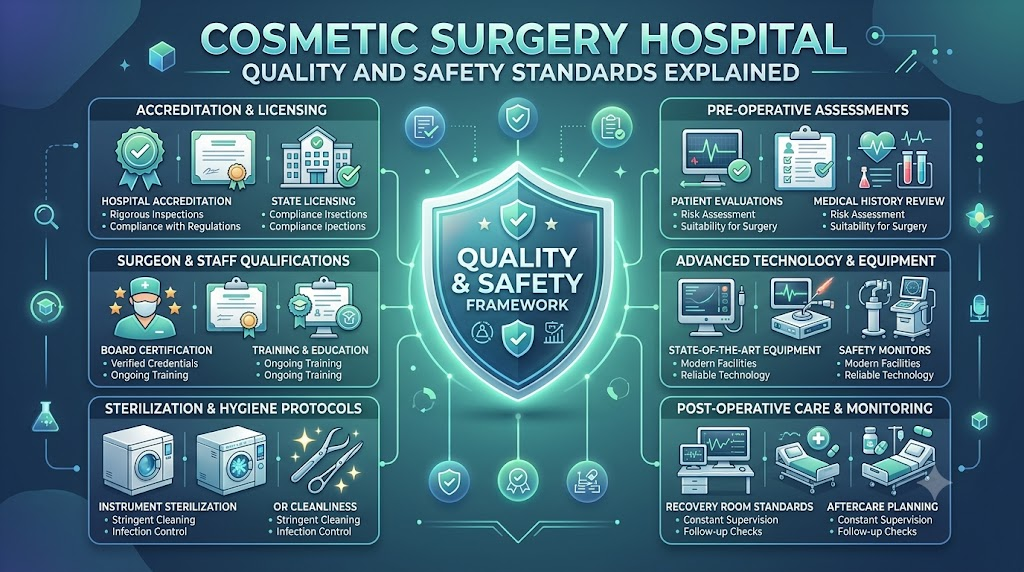
What May Accreditation Evaluate in Cosmetic Surgery Settings?
Depending on the facility and accreditation program, evaluation may include:
- Preoperative patient assessment
- Informed-consent processes
- Surgical-site safety
- Anesthesia processes
- Infection prevention
- Medication management
- Emergency equipment and preparedness
- Staff qualifications and responsibilities
- Patient monitoring
- Postoperative care
- Discharge planning
- Follow-up systems
Cosmetic procedures can take place in hospitals, ambulatory surgical centers, specialty facilities, or appropriately regulated office-based settings. The required standards and available services may differ depending on the facility type and procedure.
How to Read a Cosmetic Surgery Hospital Rating
Look beyond the overall number or rating label.
First, find out what was measured and when the information was collected. Check whether the data included patients having cosmetic procedures and whether the measure relates to safety, patient experience, clinical outcomes, or another category.
A patient-experience rating may provide information about communication, staff behavior, or the overall facility experience. A clinical-quality measure addresses a different area. Neither one automatically describes every aspect of surgical care.
Important Quality and Safety Factors for Cosmetic Surgery Patients
Ratings are only one part of researching a facility. Patients may also want to investigate the surgeon’s qualifications and experience with the specific procedure.
Other relevant factors can include anesthesia arrangements, emergency preparedness, infection-control practices, facility accreditation or regulatory status where applicable, preoperative assessment, postoperative monitoring, follow-up access, and how complications are managed.
The importance of each factor depends on the procedure and the patient’s medical circumstances.
How to Verify Cosmetic Surgery Facility Accreditation
Start by identifying the accrediting organization. Then check whether the accreditation is current and whether it applies to the specific facility, location, program, or service.
Do not assume that an accreditation badge covers every location owned by an organization or every procedure performed there.
Recognized accrediting organizations may provide directories or verification tools, although the process varies by country and organization. Where possible, verify the information through the accrediting organization’s own records rather than relying only on promotional material.
Why Accreditation Alone Should Not Determine Where Surgery Is Performed
A facility’s accreditation is useful information, but it should not be the only consideration.
Patients should also look at the specific procedure, the surgeon’s training and experience, anesthesia arrangements, facility type, emergency support, postoperative monitoring, follow-up access, complication management, and costs or payment arrangements.
The facility should also be appropriate for the patient’s health needs and the complexity of the planned procedure.
Cosmetic Surgery Ratings vs. Surgeon Qualifications
A hospital or facility rating does not replace checking the qualifications of the individual surgeon.
Patients should understand who will perform the procedure, what relevant training and experience they have, and whether they are appropriately registered or licensed under the applicable healthcare system.
When anesthesia is involved, patients should also understand who will provide it and what monitoring and emergency arrangements are available.
Patient Reviews and Testimonials
Patient reviews can provide useful information about communication, staff behavior, scheduling, facility experience, and how patients felt during their care.
However, reviews describe individual experiences. They cannot independently prove that a facility provides a particular level of surgical quality or guarantee a specific result.
Detailed personal experiences may be more informative than broad promotional statements, but reviews should still be considered alongside formal quality and safety information.
Limitations of Cosmetic Surgery Hospital Ratings and Accreditation
Ratings may differ because organizations use different methodologies, patient groups, data periods, and measures. Information may also be incomplete or updated at different times.
Accreditation has a defined scope and reflects an evaluation against particular standards. It does not provide a complete assessment of every surgeon, procedure, patient experience, or individual outcome.
Accreditation programs can also change as healthcare practices and safety priorities develop. Updated approaches may place greater emphasis on ongoing engagement, measurable quality, patient safety, and outcomes rather than treating accreditation as a static checklist.
How to Compare Cosmetic Surgery Hospitals Carefully
Begin by identifying the exact procedure you are considering. Then gather information from several reliable sources and compare similar types of quality information.
Verify facility accreditation or regulatory status, review the surgeon’s qualifications and relevant experience, understand the anesthesia arrangements, and ask how postoperative care and complications will be handled.
A qualified healthcare professional can also help you understand which facility and safety factors are particularly relevant to your medical situation.
Quality Information at a Glance
| Quality Information | What It Tells You | What to Check Further |
|---|---|---|
| Accreditation | Whether a facility met defined organizational standards | Accrediting organization, current status, and scope |
| Certification | Evaluation of a specific service or program | Exactly which service is covered |
| Quality rating | Selected quality, safety, outcome, or experience measures | Methodology, data date, and patient population |
| Patient reviews | Individual experiences with the facility | Whether comments are detailed, recent, and relevant |
| Surgeon qualifications | Training, registration, and relevant experience | Experience with the specific planned procedure |
What Accreditation Does Not Mean
Accreditation does not mean a facility is risk-free. It does not guarantee a particular cosmetic result, eliminate surgical complications, or mean every surgeon working there has identical training or experience.
It also does not replace a consultation with a qualified medical professional. Patients still need to understand the specific procedure, possible risks, recovery, aftercare, and their own health considerations.
Frequently Asked Questions
1. What does cosmetic surgery hospital accreditation mean?
It means an external organization has evaluated a healthcare facility against defined standards. These may cover patient safety, quality systems, infection prevention, surgical processes, and other areas.
2. How are cosmetic surgery hospital ratings created?
Ratings may use patient experience, safety information, clinical outcomes, surveys, quality measures, or other data. The methodology differs between rating organizations.
3. What is the difference between accreditation and certification?
Accreditation generally covers broader organizational standards, while certification often focuses on a particular program or service. They represent different types of evaluation.
4. Does accreditation guarantee safe cosmetic surgery?
No. Accreditation indicates that a facility was evaluated against a defined set of standards. It cannot guarantee a specific surgical result or eliminate all possible complications.
5. How can patients verify accreditation?
Identify the accrediting organization and check its current records or verification system when available. Confirm that the accreditation applies to the specific facility or location you are considering.
6. What quality factors should I check before cosmetic surgery?
Consider the surgeon’s qualifications and relevant experience, facility standards, anesthesia arrangements, infection control, emergency preparedness, postoperative monitoring, follow-up care, and complication management.
7. Do hospital ratings evaluate individual surgeons?
Usually, a facility rating describes selected aspects of the organization or its services. It does not replace checking the qualifications, registration, and relevant experience of the individual surgeon.
8. How should patient reviews be interpreted?
Reviews can provide insight into personal experiences, communication, staff behavior, and facility interactions. They should not be treated as independent proof of surgical quality or guaranteed outcomes.
9. Why might different hospitals have different ratings?
Different rating organizations may use different data, time periods, patient groups, and scoring methods. As a result, ratings may not be measuring the same thing.
10. What should patients consider besides ratings and accreditation?
Consider the specific procedure, surgeon qualifications, facility type, anesthesia arrangements, emergency support, recovery and aftercare, follow-up access, costs, and your individual medical needs.
Conclusion
Cosmetic surgery hospital ratings and accreditation can provide useful information about quality systems, patient-safety processes, and facility standards, but they should be interpreted carefully. Accreditation is not a guarantee of a successful cosmetic surgery outcome, and a rating cannot replace proper research. Patients should consider the specific procedure, surgeon qualifications and experience, facility standards, anesthesia arrangements, emergency preparedness, aftercare, and individual health needs. Looking at these factors together can help patients ask informed questions and make healthcare decisions based on relevant information rather than relying on a single rating or accreditation badge.