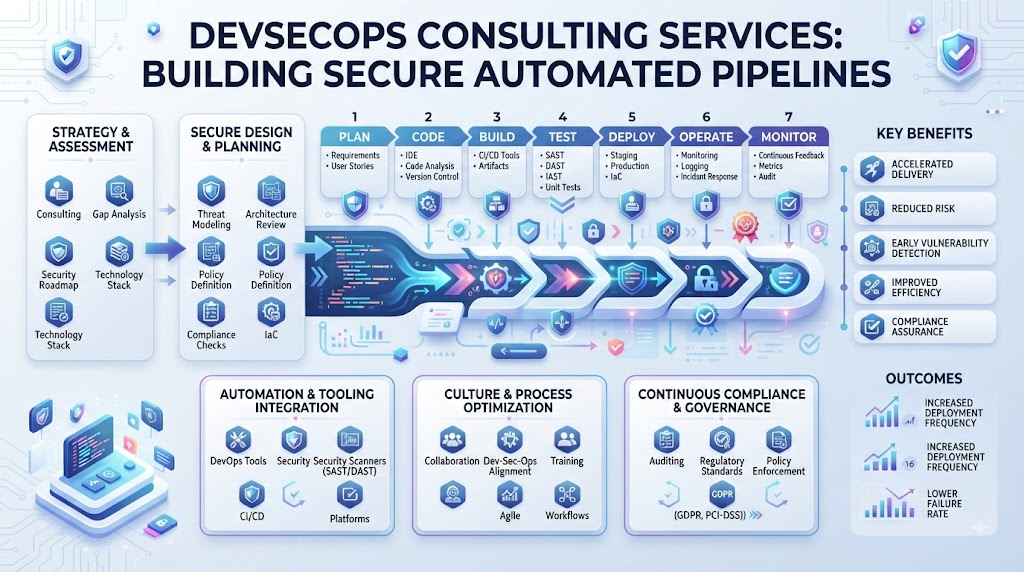
Modern software engineering moves fast, but rapid delivery often exposes critical security vulnerabilities. Many organizations push code rapidly into production only to discover exposed API keys, unpatched container dependencies, or cloud misconfigurations after deployment. Traditional security models, which rely on manual reviews right before release, create bottlenecks that slow down engineering teams and increase risk.Integrating security directly into the software development lifecycle solves this operational friction. By embedding automated security checks, policy enforcement, and continuous monitoring into existing workflows, teams deliver resilient code without sacrificing velocity. Professional DevSecOps Consulting Services enable organizations to transition from reactive patching to proactive, automated security architecture.
What Is DevSecOps?
DevSecOps stands for Development, Security, and Operations. It is a cultural and technical practice that integrates security as a shared responsibility across the entire software delivery workflow.
Definition of DevSecOps
Rather than treating security as an isolated audit at the end of a release cycle, DevSecOps embeds automated security gates and continuous checks throughout the software development lifecycle (SDLC).
[ Plan ] ➔ [ Code ] ➔ [ Build ] ➔ [ Test ] ➔ [ Release ] ➔ [ Deploy ] ➔ [ Monitor ]
   |          |          |          |           |           |           |
 [Threat   [SAST &    [SCA &     [DAST &     [IaC &      [Cluster    [Runtime
 Modeling] Secrets]   SBOM]     Pen-Test]   Policies]   Security]   Shields]
DevOps vs. DevSecOps
Traditional DevOps emphasizes speed, continuous integration, and rapid deployment. DevSecOps extends this foundation by injecting automated testing, policy controls, and vulnerability scanning directly into those continuous pipelines. Speed remains paramount, but delivery becomes measurably more secure.
Why Security Must Shift Left
Shift Left means moving security evaluations earlier in the development lifecycle. Finding a vulnerability while an engineer is writing code costs significantly less time and capital than remediating a breach in a live production database.
Security Throughout the SDLC
DevSecOps enforces security continuously across every development phase:
- Planning: Threat modeling and security requirements definition.
- Coding: Static analysis and secret detection inside IDEs.
- Building: Dependency analysis and container scanning.
- Deployment: Infrastructure as Code (IaC) verification and environment validation.
- Operations: Runtime protection, log auditing, and continuous monitoring.
Role of Automation
Automation eliminates manual inspection delays. Automated pipeline checks provide developers with real-time feedback, ensuring non-compliant code is flagged immediately within native pull requests.
What Are DevSecOps Consulting Services?
Navigating security frameworks and modern toolchains requires technical precision. Partnering with expert consultants helps organizations streamline security adoption without disrupting existing development velocity.
DevSecOps Strategy
Consultants assess current organizational maturity and design customized transformation roadmaps aligned with specific compliance and operational goals.
Security Integration
Strategic consulting seamlessly embeds security checks into platform infrastructure, developer environments, and release workflows.
CI/CD Security
Securing integration and deployment pipelines prevents attackers from exploiting build systems or injecting malicious code during automated builds.
Cloud Security
Experts align cloud environments with industry standard frameworks, ensuring proper identity governance, network isolation, and encryption configurations.
Application Security
Through tailored application security strategies, organizations mitigate risk within business logic, internal interfaces, and external APIs.
Infrastructure Security
Consultants enforce Policy as Code and configuration baselines so infrastructure assets deploy consistently in secure states.
Container Security
Containerized microservices receive dedicated image scans, vulnerability triage, and minimal base-image governance.
Continuous Security Monitoring
Tailored DevSecOps Consulting Services establish automated feedback loops, collecting metrics across runtime environments to detect operational anomalies quickly.
DevSecOps Implementation Services
Transforming strategy into operational reality requires structured deployment of security tools and practices. Engaging dedicated DevSecOps Implementation Services helps engineering teams integrate advanced tooling directly into build environments.
Key technologies implemented include:
- SAST (Static Application Security Testing): Scans source code for security bugs during development.
- DAST (Dynamic Application Security Testing): Analyzes running applications for exploitable dynamic endpoints.
- SCA (Software Composition Analysis): Identifies vulnerable third-party libraries and licenses.
- Secrets Scanning: Detects hardcoded passwords, tokens, and private keys in version control history.
- Container Scanning: Inspects container base images for missing patches or runtime flaws.
- IaC Security: Audits Terraform, CloudFormation, or Ansible code for infrastructure misconfigurations.
- Policy as Code: Enforces regulatory compliance using automated tooling such as Open Policy Agent (OPA).
- Vulnerability Management: Centralizes, deduplicates, and prioritizes actionable security findings.
Practical CI/CD Pipeline Example:
When a developer opens a pull request, automated SAST and secrets scanners evaluate the branch. If an engineer accidentally commits an unencrypted API token, the pipeline fails automatically, alerts the developer in Slack or Jira, and blocks the pull request merge until corrected.
DevSecOps Managed Services
Maintaining secure pipelines requires ongoing operational oversight. Leveraging specialized DevSecOps Managed Services provides continuous technical support for organizations lacking dedicated internal security staff.
Managed services cover critical maintenance areas:
- Pipeline Monitoring: Continuous oversight of build logs and deployment security gates.
- Vulnerability Management: Ongoing triage and prioritization of newly discovered CVEs.
- Policy Updates: Continuous updates to security baselines as threat vectors evolve.
- Remediation Support: Direct technical assistance for development teams resolving complex code defects.
- Continuous Improvement: Ongoing refinement of scanning rules to reduce false positives.
- Incident & Compliance Support: Quick incident handling assistance and audit evidence compilation.
Organizations benefit from managed support when scaling infrastructure rapidly, experiencing operational resource constraints, or handling high-volume deployment schedules.
DevSecOps Training
Security tools are only as effective as the engineers operating them. Comprehensive DevSecOps Training equips technical staff with the skills necessary to write secure code and manage automated tools independently.
Core training modules cover:
- Principles of secure SDLC design.
- Integrating security scanners within local developer workflows.
- Cloud and container configuration hardening.
- Threat modeling for microservice architectures.
- Understanding common software vulnerabilities like the OWASP Top 10.
Corporate DevSecOps Training
For enterprise organizations, upskilling entire departments requires structured learning frameworks designed for diverse technical roles.
Targeted corporate training aligns cross-functional engineering groups:
- Development Teams: Secure coding practices, secret management, and fast remediation workflows.
- DevOps & Platform Teams: Pipeline hardening, build security, and Policy as Code.
- Security Teams: Automated policy writing, triage acceleration, and continuous visibility.
- SRE & Cloud Teams: Cloud posture management, drift detection, and automated incident triage.
Hands-on corporate programs utilize sandbox environments, real-world scenario simulations, and tool-based workshops to build durable security practices across business units.
DevSecOps Assessment Services
Before introducing new tools, organizations must baseline their existing security strengths and operational bottlenecks. Structured DevSecOps assessment programs provide clear operational visibility.
An assessment evaluates critical infrastructure layers:
+-----------------------------------------------------------------------+
|                       DEVSECOPS ASSESSMENT SCOPE                      |
+-----------------------------------+-----------------------------------+
|  Architecture & Pipeline          |  Infrastructure & Runtime         |
|  - Source Code & Secret Analysis  |  - Cloud Security Posture         |
|  - CI/CD Build Hardening          |  - Container & Kubernetes RBAC    |
|  - Identity & Access Management   |  - Automated Compliance Checks    |
+-----------------------------------+-----------------------------------+
Detailed assessment findings produce an actionable, prioritized transformation roadmap that helps leadership invest resources effectively.
Cloud Security Consulting Services
Modern applications rely on complex public cloud infrastructure across AWS, Microsoft Azure, and Google Cloud Platform. Professional Cloud Security Consulting Services ensure cloud-native architectures remain secure by design.
Key cloud security focus areas include:
- Identity and Access Management (IAM): Enforcing least-privilege policies across users, roles, and workloads.
- Infrastructure Configuration: Eliminating public cloud bucket exposures and insecure security groups.
- Network Isolation: Designing private subnets, service endpoints, and zero-trust perimeter boundaries.
- Data Encryption: Securing data at rest and in transit using robust cryptographic key management.
- Logging & Audit Compliance: Centralizing log storage for threat detection and regulatory alignment.
Kubernetes Security Consulting Services
Container orchestrators introduce unique operational complexity. Specialized Kubernetes Security Consulting Services safeguard cluster environments throughout their lifecycle.
Essential Kubernetes security practices include:
- Enforcing strict Role-Based Access Control (RBAC).
- Configuring Network Policies to isolate pod-to-pod communications.
- Deploying Admission Controllers (e.g., OPA Gatekeeper, Kyverno) to block insecure pods.
- Implementing secure cluster-native secrets management tools.
- Managing container image signatures and base runtime protection.
Scenario: A developer accidentally attempts to deploy a container running as root with an unrestricted file system. An admission controller intercepts the deployment request, evaluates it against security policies, and blocks cluster execution until root permissions are dropped.
Software Supply Chain Security Services
Modern software applications rely heavily on open-source packages and external cloud dependencies. Robust Software Supply Chain Security Services help protect organizations from upstream dependency compromise.
Key elements of software supply chain security include:
- Generating and auditing Software Bill of Materials (SBOM) artifacts.
- Verifying package integrity through digital code signing techniques (e.g., Sigstore).
- Hardening build environments against malicious script injection.
- Auditing third-party artifact repositories and registry endpoints.
Maintaining comprehensive supply chain visibility protects applications against compromised upstream libraries before they reach production.
Penetration Testing Services
While automated scanning catches common code and configuration errors, simulated human attacks evaluate practical defense strength under real-world conditions. Comprehensive Penetration Testing Services complement automated pipeline security.
Penetration testing evaluates:
- Web applications and public API interfaces.
- Cloud tenant configuration flaws and IAM escalation vectors.
- Kubernetes control planes and runtime pod environments.
- Internal network parameters and service mesh implementations.
Penetration testing does not replace automated DevSecOps controls; rather, it validates that automated controls are functioning as intended.
DevSecOps Security Toolchain
A structured security architecture categorizes specialized tools across distinct development phases.
| Security Layer | Objective | Common Tooling Category |
| Code Security | Analyze raw source code for structural flaws | SAST (Static Application Security Testing) |
| Dependency Analysis | Detect vulnerable third-party components | SCA (Software Composition Analysis) |
| Secrets Management | Prevent credential exposure in code repositories | Secrets Scanning & Vault Solutions |
| Dynamic Testing | Probe active web endpoints for runtime flaws | DAST (Dynamic Application Security Testing) |
| Container Scanning | Verify container image layers and base packages | Image Registry Vulnerability Scanners |
| Infrastructure Security | Audit cloud templates before deployment | IaC Scanners & Policy Enforcers |
| Supply Chain Validation | Track components and build provenance | SBOM Generators & Artifact Signers |
| Runtime Protection | Audit live workload activity in real time | Container Security & Observability Platforms |
Benefits of DevSecOps Consulting
Engaging external DevSecOps experts offers clear operational and risk-reduction advantages:
- Early Vulnerability Detection: Identifying flaws during development dramatically reduces fix costs.
- Accelerated Feature Delivery: Automated security gates prevent manual pre-release release holds.
- Enhanced Developer Collaboration: Shared security ownership bridges technical communication gaps.
- Improved Cloud & Container Security: Standardized policy controls prevent public misconfigurations.
- Streamlined Compliance Reporting: Automated audit logs simplify regulatory compliance processes.
- Reduced Operational Overhead: Automated scanning minimizes time spent on tedious manual reviews.
DevSecOps Implementation Process
A successful security transformation follows a structured, multi-phase execution strategy:
[Phase 1: Assess] ➔ [Phase 2: Roadmap] ➔ [Phase 3: CI/CD Integration] ➔ [Phase 4: Cloud & Cluster] ➔ [Phase 5: Optimize]
Step 1: Assess the Current Environment
Review existing development processes, toolchains, cloud architecture, and security governance policies.
Step 2: Identify Security Gaps
Determine missing security controls, manual release bottlenecks, and unmanaged attack surfaces.
Step 3: Define Security Requirements
Establish clear security baseline criteria, regulatory compliance targets, and failure thresholds.
Step 4: Build the DevSecOps Roadmap
Construct a phased implementation timeline prioritizing high-risk vulnerabilities and high-impact workflows.
Step 5: Integrate Security into CI/CD
Deploy automated SAST, SCA, and secrets scanning directly into active deployment pipelines.
Step 6: Secure Cloud and Infrastructure
Enforce Policy as Code baselines, secure identity access, and implement cloud security monitoring.
Step 7: Secure Containers and Kubernetes
Implement container image scanning, RBAC restrictions, admission controls, and runtime monitoring.
Step 8: Implement Monitoring and Continuous Improvement
Monitor real-time pipeline metrics, refine rule sets to eliminate false positives, and scale secure practices.
Common DevSecOps Mistakes
Organizations often run into predictable challenges when adopting DevSecOps strategies.
- Treating Security as an End-Stage Gate: Delaying security reviews creates severe delivery bottlenecks.
- Solution: Integrate lightweight scanning tools directly into local developer environments and early pull requests.
- Deploying Too Many Tools at Once: Overwhelming teams with security tools leads to alert fatigue.
- Solution: Start with high-impact scanners (secrets and SCA) before expanding toolchains.
- Ignoring Developer User Experience: Cumbersome security tools slow down developer output.
- Solution: Deliver actionable security feedback directly inside developer IDEs and Git platforms.
- Failing to Prioritize Vulnerabilities: Treating minor vulnerabilities as critical blockers stalls releases.
- Solution: Establish risk-based scoring rules based on exploitability and asset criticality.
- Neglecting Cloud and Container Configuration: Securing code while leaving cloud buckets open creates severe exposures.
- Solution: Implement automated IaC scanning and continuous cloud compliance tracking.
Best Practices
Applying proven security practices establishes long-term pipeline reliability:
- Shift security controls as far left as possible into developer workflows.
- Automate security checks within existing CI/CD build scripts.
- Enforce least-privilege access across cloud identities and build environments.
- Maintain complete software component inventories using automated SBOM generation.
- Secure infrastructure configurations using version-controlled Policy as Code.
- Continuously train engineering teams on modern attack vectors and secure coding techniques.
How to Choose DevSecOps Consulting Services
Selecting the right security partner requires evaluating technical expertise against organizational requirements.
Key evaluation criteria:
- Proven Technical Experience: Verify practical background in cloud architecture, container platforms, and modern deployment pipelines.
- Comprehensive Tooling Knowledge: Ensure expertise across open-source and enterprise security platforms.
- Developer-Centric Approach: Look for partners that prioritize developer workflows rather than rigid control enforcement.
- Pragmatic Assessment Methodology: Ensure the partner delivers clear prioritization rather than overwhelming, uncurated findings.
- Scalable Service Capabilities: Confirm the vendor offers services spanning initial assessments, active implementation, and ongoing training.
DevSecOpsNow.com Service Fit
DevSecOpsNow.com provides specialized consulting, implementation, and training services tailored to modern cloud-native engineering environments.
| Organizational Requirement | Recommended Platform Service |
| Evaluating Security Gaps & Maturity | DevSecOps Assessment Services |
| Automating CI/CD Pipeline Security | DevSecOps Implementation Services |
| Hardening Cloud & Kubernetes Infrastructure | Cloud & Kubernetes Security Consulting Services |
| Upskilling Technical Engineering Staff | DevSecOps Training & Corporate Training |
| Validating Defenses Against Active Attacks | Penetration Testing Services |
| Securing Open-Source Dependencies | Software Supply Chain Security Services |
| Ongoing Pipeline Security Operations | DevSecOps Managed Services |
Frequently Asked Questions
1.What are DevSecOps Consulting Services?
DevSecOps Consulting Services help organizations integrate automated security practices, policies, and tooling directly into their software development and deployment pipelines. Consultants analyze technical processes, design tailored security roadmaps, and implement continuous security controls without reducing development velocity.
2.How does DevSecOps differ from traditional DevOps?
DevOps focuses primarily on speed, continuous delivery, and automation between development and operations teams. DevSecOps embeds automated security checks, policy guardrails, and compliance testing into those existing DevOps pipelines, ensuring speed and security co-exist.
3.What are the main components of DevSecOps Implementation Services?
Implementation services establish automated tooling within build pipelines, including SAST, DAST, SCA, secrets detection, container image scanning, IaC auditing, Policy as Code, and centralized vulnerability management.
4.Why are DevSecOps Managed Services beneficial?
Managed services provide continuous operational oversight, vulnerability triage, rule updates, and technical assistance for organizations that require expert security management but lack internal security headcount.
5.What is covered during Corporate DevSecOps Training?
Corporate training upskills developers, DevOps engineers, platform teams, and security specialists through practical exercises covering secure coding, container security, pipeline hardening, cloud configuration, and vulnerability remediation.
6.How do DevSecOps Assessment Services help engineering teams?
Assessment services audit an organization’s existing development workflow, cloud configurations, pipeline tools, and security processes to identify operational gaps and build a realistic transformation roadmap.
7.What is included in Cloud Security Consulting Services?
Cloud security consulting focuses on securing cloud provider environments (AWS, Azure, GCP) through identity access management, network segmentation, encryption enforcement, posture management, and continuous log auditing.
8.Why is Kubernetes security critical in a DevSecOps strategy?
Kubernetes orchestrates containerized workloads, making its control plane, network policies, RBAC configurations, and runtime environments critical attack surfaces. Proper security prevents pod breaches and lateral cluster escalation.
9.What is software supply chain security?
Software supply chain security protects applications from vulnerabilities introduced by external dependencies, open-source packages, and build infrastructure through tactics like SBOM generation, package scanning, and artifact verification.
10.Does penetration testing replace automated DevSecOps scanning?
No. Penetration testing simulates manual cyberattacks to uncover complex business logic flaws and multi-stage exploitation vectors, complementing automated continuous scanning tools.
Conclusion
Integrating security across modern development pipelines is essential for delivering secure software applications. Traditional, manual security evaluations can no longer keep pace with rapid cloud-native release cycles. By embedding automated security checks, policy guardrails, and continuous operational visibility directly into daily engineering workflows, organizations minimize enterprise exposure while retaining delivery speed.Professional DevSecOps Consulting Services provide the technical expertise necessary to evaluate maturity, implement automated tooling, harden cloud architectures, and upskill technical teams efficiently. Building secure software requires an ongoing commitment to automated continuous improvement, clear technical governance, and cross-team collaboration.