Introduction
Laser skin resurfacing is one of the most versatile and effective modalities in modern aesthetic medicine for addressing photoaging, deep rhytids (wrinkles), atrophic acne scars, and irregular skin texture. However, achieving predictable, aesthetically pleasing results while minimizing the risk of complications requires understanding a fundamental truth: laser resurfacing is a controlled medical procedure, not an ordinary beauty salon service.To help patients navigate the complex landscape of aesthetic medicine, platforms like BESTCOSMETICHOSPITALS offer centralized directories of cosmetic surgery centers, dermatology departments, and medical tourism destinations worldwide. Using structured research tools enables patients to review institutional capabilities objectively. While directory platforms serve as helpful educational starting points, they do not independently certify clinical outcomes or replace an in-person clinical assessment by a board-certified dermatologist or plastic surgeon.
What Is Laser Skin Resurfacing?
Laser skin resurfacing uses focused light beams to deliver targeted thermal and mechanical energy into specific layers of the skin. This controlled injury stimulates the body’s natural wound-healing cascade, promoting neocollagenesis (new collagen synthesis) and elastin remodeling while replacing aged, photo-damaged cells with healthier, smoother epidermal tissue.
┌────────────────────────────────────────────────────────────────────────┐
│                   Target Concerns for Laser Resurfacing                │
├───────────────────────────────────┬────────────────────────────────────┤
│ Structural & Texture Concerns     │ • Fine lines and perioral rhytids  │
│                                   │ • Deep static wrinkles             │
│                                   │ • Atrophic acne & surgical scars   │
│                                   │ • Coarse skin texture & large pores│
├───────────────────────────────────┼────────────────────────────────────┤
│ Chromatic & Pigmentary Concerns   │ • Solar lentigines (sun spots)     │
│                                   │ • Mottled pigmentation             │
│                                   │ • Post-inflammatory dyschromia     │
│                                   │ • Actinic bronzing & photodamage   │
└───────────────────────────────────┴────────────────────────────────────┘
Laser resurfacing encompasses a spectrum of technological approaches rather than a single standardized treatment. Depending on the depth of tissue targeted and the clinical objective, treatments range from gentle surface remodeling with minimal downtime to intensive full-thickness dermal reorganization requiring dedicated clinical aftercare.
How Laser Resurfacing Works: The Science of Controlled Thermal Injury
Cosmetic lasers operate on the principle of selective photothermolysis—delivering a specific wavelength of light absorbed primarily by a chosen target tissue or chromophore (such as intracellular water, melanin, or hemoglobin) while sparing surrounding structures.
                      ┌─────────────────────────────────────────┐
                      │    Mechanism of Action in Resurfacing   │
                      └────────────────────┬────────────────────┘
                                           │
         ┌─────────────────────────────────┴─────────────────────────────────┐
         ▼                                                                   ▼
┌────────────────────────────────┐                  ┌────────────────────────────────┐
│   Optical Energy Absorption    │                  │  Thermal Dermal Stimulation    │
│ Water inside skin cells absorbs│                  │ Controlled heat induces        │
│ laser energy, vaporizing micro-│                  │ fibroblast activation, leading │
│ scopic epidermal/dermal columns│                  │ to neocollagenesis over months │
└────────────────────────────────┘                  └────────────────────────────────┘
The restorative process unfolds in several key stages:
- Energy Absorption & Micro-Vaporization: For ablative lasers, intracellular water rapidly absorbs the laser energy, heating to boiling point and causing microscopic vaporization of tissue.
- Thermal Coagulation Zone: Surrounding the vaporized area, a controlled zone of residual thermal heating denatures aged collagen fibers, triggering immediate tissue contraction.
- Inflammatory & Proliferative Cascade: Over the subsequent days to weeks, cytokines and growth factors stimulate fibroblasts to synthesize fresh, organized Type I and Type III collagen alongside extracellular matrix components.
- Re-epithelialization: Epidermal cells migrate from wound margins or preserved adnexal structures (hair follicles and sweat ducts) to form a renewed, smoother skin surface.
Ablative vs. Non-Ablative Lasers: Understanding the Difference
A central distinction in laser dermatology is between ablative and non-ablative technologies. Each category serves specific clinical purposes and involves distinct trade-offs between clinical intensity and recovery time.
| Feature | Ablative Lasers | Non-Ablative Lasers |
| Epidermal Surface Action | Vaporizes and removes controlled layers of the epidermis and upper dermis. | Keeps the epidermal surface largely intact while heating deeper dermal layers. |
| Treatment Intensity | Highly intensive; creates an open micro-wound requiring active healing. | Moderate to mild; targets dermal collagen without creating an open wound. |
| Clinical Efficacy per Session | Significant structural improvement, often achievable in a single session. | Gradual, progressive improvement typically requiring a series of 3 to 6 sessions. |
| Expected Recovery & Downtime | Significant (typically 7 to 14+ days of peeling, oozing, crusting, and erythema). | Minimal to moderate (typically 1 to 3 days of mild redness and edema). |
| Primary Clinical Indications | Deep wrinkles, pronounced photodamage, severe acne scars, rhinophyma. | Early fine lines, mild texture roughness, pore appearance, mild dyschromia. |
| Risk Profile | Higher risk of prolonged redness, post-inflammatory hyperpigmentation, or infection. | Lower complication profile; reduced risk of prolonged barrier disruption. |
Neither category is universally “better.” A comprehensive aesthetic hospital maintains both technologies, selecting the appropriate approach based on the patient’s individual skin condition, risk tolerance, and available recovery time.
Common Laser Resurfacing Technologies
Modern cosmetic centers utilize various laser platforms tailored to specific anatomical areas, skin phototypes, and clinical indications:
┌─────────────────────────────────────────────────────────────────────────────┐
│                    Major Laser Resurfacing Modalities                       │
├──────────────────────┬────────────────────────┬─────────────────────────────┤
│ Technology           │ Primary Chromophore    │ Clinical Utility            │
├──────────────────────┼────────────────────────┼─────────────────────────────┤
│ CO2 Laser (10,600 nm)│ Water                  │ Gold-standard ablative for  │
│                      │                        │ deep wrinkles & severe scars│
├──────────────────────┼────────────────────────┼─────────────────────────────┤
│ Erbium:YAG (2,940 nm)│ Water (highly absorbed)│ Precise ablative resurfacing│
│                      │                        │ with minimal thermal spread │
├──────────────────────┼────────────────────────┼─────────────────────────────┤
│ Fractional Lasers    │ Water                  │ Microscopic treatment zones │
│ (Ablative/Non-Abl.)  │                        │ with rapid re-epithelization│
├──────────────────────┼────────────────────────┼─────────────────────────────┤
│ Non-Ablative (1550/  │ Water                  │ Dermal remodeling with an   │
│ 1540/1927 nm)        │                        │ intact outer skin barrier   │
├──────────────────────┼────────────────────────┼─────────────────────────────┤
│ Nd:YAG (1064 nm) &   │ Hemoglobin / Melanin / │ Deep vascular/collagen work;│
│ Picosecond Lasers    │ Water                  │ safer for darker skin tones │
└──────────────────────┴────────────────────────┴─────────────────────────────┘
Carbon Dioxide (CO2) Lasers (10,600 nm)
Emitting in the far-infrared spectrum, CO2 lasers are absorbed by tissue water, generating significant thermal effects alongside ablation. They are effective for treating deep facial rhytids, periorbital/perioral aging, and pronounced acne scars, while also producing tissue tightening.
Erbium:YAG Lasers (2,940 nm)
With an absorption coefficient for water roughly 10 to 16 times higher than that of CO2 lasers, the Erbium:YAG laser vaporizes tissue with extreme precision and minimal residual thermal damage. This makes it an excellent option for delicate anatomical zones (such as the neck and chest), moderate photodamage, and patients seeking shorter post-procedure erythema.
Fractional Laser Technology
Rather than ablating an entire continuous sheet of skin, fractional lasers create microscopic treatment zones (MTZs)—columns of thermal injury surrounded by intact, untreated tissue reservoirs. These uninjured surrounding cells facilitate rapid epithelial migration, substantially reducing healing times and lowering the incidence of scarring. Fractional delivery is available in both ablative (CO2, Erbium) and non-ablative formats.
Non-Ablative Fractional Lasers (e.g., 1550 nm, 1540 nm, 1927 nm)
These platforms coagulate columns of the dermis and dermal-epidermal junction while leaving the stratum corneum intact. They are well-suited for early photoaging, mild atrophic scarring, and tone irregularity, allowing patients to resume normal routines quickly.
Nd:YAG (1064 nm) and Multi-Wavelength Systems
The longer 1064 nm wavelength penetrates deeply into the dermis while bypassing higher concentrations of epidermal melanin. This property makes long-pulsed and Q-switched/Picosecond Nd:YAG systems valuable tools for non-ablative collagen toning and rejuvenation in patients with higher baseline melanin concentrations.
What Skin Concerns Can Laser Resurfacing Address?
Laser resurfacing may improve multiple structural and chromatic dermatological concerns:
| Aesthetic / Medical Concern | Potential Role of Laser Therapy | Important Considerations |
| Fine Lines & Static Wrinkles | May soften wrinkle depth by stimulating dermal collagen and smoothing skin surface. | Dynamic expression lines (e.g., crow’s feet, frown lines) often require neuromodulators alongside laser therapy. |
| Atrophic Acne Scarring | Fractional and ablative lasers can soften boxcar and rolling scar edges and stimulate dermal volume. | Deep ice-pick scars or tethered scars may require subcision or chemical reconstruction (CROSS) prior to laser treatment. |
| Solar Lentigines & Sun Damage | Can target dysplastic keratinocytes and pigmented lesions, evening out skin appearance. | Requires ongoing sun protection to prevent UV-induced recurrence. |
| Uneven Texture & Enlarged Pores | Can refine surface irregularities through epidermal remodeling and collagen synthesis around pore walls. | Requires tailored energy parameters and appropriate home skincare support. |
| Surgical & Traumatic Scars | May improve scar pliability, reduce contour step-offs, and blend scar margins with surrounding tissue. | Timing relative to scar maturation is an important clinical factor. |
Clinical Note: Lasers cannot replicate the surgical repositioning of deep structural tissues achieved through rhytidectomy (facelift) or blepharoplasty, but they can be combined with surgical approaches to improve skin surface quality.
Assessing Patient Candidacy
Determining whether an individual is an appropriate candidate for laser resurfacing requires an evaluation by a qualified medical professional:
- Primary Dermatological Concern: Matching the patient’s specific issue (e.g., deep scars vs. superficial dullness) to the appropriate laser modality.
- Skin Phototype (Fitzpatrick Scale): Evaluating baseline melanin concentration to select safe wavelengths and conservative treatment settings.
- Medical & Medication History: Screening for systemic conditions that impair wound healing (such as uncontrolled diabetes or autoimmune connective tissue disorders).
- Recent Oral Isotretinoin Use: Reviewing past isotretinoin therapy; clinical guidelines recommend tailoring treatment timing and choosing conservative parameters.
- History of Herpes Simplex Virus (HSV): Identifying prior oral herpes outbreaks to initiate mandatory prophylactic antiviral therapy before perioral resurfacing.
- Propensity for Abnormal Scarring: Evaluating any personal history of hypertrophic scarring or keloid formation.
- Patient Expectations & Downtime Availability: Aligning realistic clinical outcomes with the patient’s ability to follow recovery requirements and take time away from public activities.
Why Skin Type Matters: Safety Across the Fitzpatrick Scale
One of the most critical safety considerations in cosmetic laser medicine is the patient’s skin phototype, commonly categorized using the Fitzpatrick Scale (Types I through VI).
┌─────────────────────────────────────────────────────────────────────────────┐
│                          The Fitzpatrick Skin Spectrum                      │
├───────────────────────────────────┬─────────────────────────────────────────┤
│ Types I – II (Fair / Pale)        │ High tolerance for visible/infrared     │
│                                   │ lasers; lower risk of hyperpigmentation │
├───────────────────────────────────┼─────────────────────────────────────────┤
│ Types III – IV (Medium / Olive)   │ Moderate risk; requires cautious energy │
│                                   │ fluences and tailored pre-conditioning  │
├───────────────────────────────────┼─────────────────────────────────────────┤
│ Types V – VI (Brown / Deep Brown) │ High risk of post-inflammatory pigment  │
│                                   │ changes; requires non-ablative/Nd:YAG   │
└───────────────────────────────────┴─────────────────────────────────────────┘
When laser light passes through the epidermis, melanin acts as a competing chromophore. In skin with higher baseline melanin concentrations (Types IV–VI), non-specific absorption of laser energy by epidermal melanocytes can generate unintended thermal collateral damage. This can lead to:
- Post-Inflammatory Hyperpigmentation (PIH): Darkened patches resulting from melanocyte stimulation during thermal healing.
- Post-Inflammatory Hypopigmentation: Loss of pigment caused by thermal destruction of melanocytes, which can be permanent and challenging to treat.
- Blistering and Thermal Burns: Occurs when surface melanin absorbs energy intended for deeper dermal structures.
Clinical Best Practices for Darker Skin Tones:
Patients with deeper skin tones are not automatically excluded from laser treatments, but they require experienced practitioners who utilize conservative fractional densities, longer wavelengths (e.g., 1064 nm Nd:YAG), dedicated surface cooling, and pre-treatment topical pigment-stabilizing regimens.
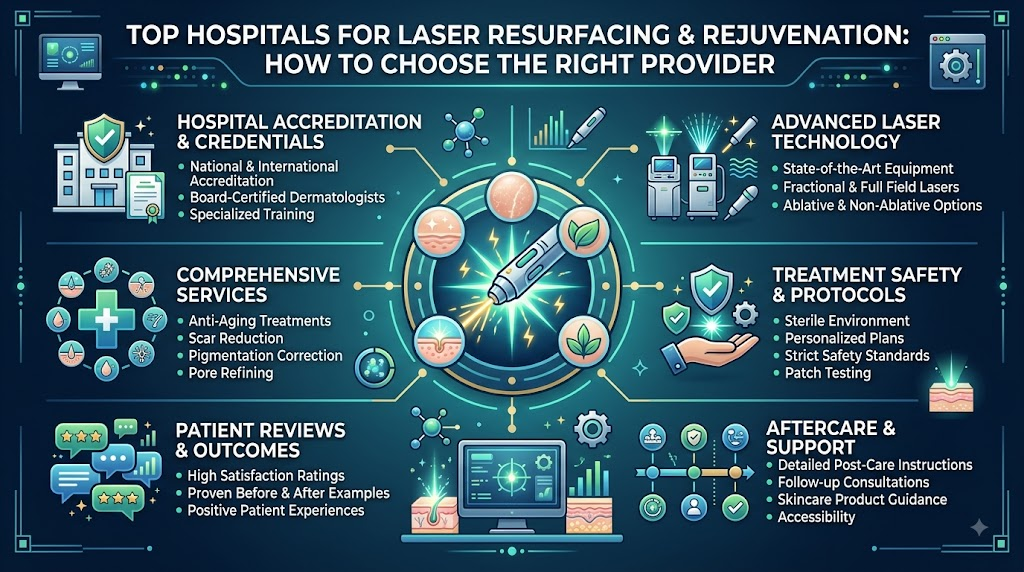
Criteria for Evaluating a Top Laser Resurfacing Hospital
When evaluating aesthetic hospitals and clinical dermatology centers, prioritize institutional safety, clinical qualifications, and comprehensive facilities over promotional marketing:
                      ┌───────────────────────────────────────┐
                      │    Leading Laser Hospital Pillars     │
                      └──────────────────┬────────────────────┘
                                         │
     ┌──────────────────┬────────────────┼────────────────┬──────────────────┐
     ▼                  ▼                ▼                ▼                  ▼
┌──────────┐     ┌─────────────┐  ┌─────────────┐  ┌─────────────┐    ┌─────────────┐
│ Board-   │     │ Advanced,   │  │ Rigorous    │  │ Structured  │    │ Dedicated   │
│ Certified│     │ Maintained  │  │ Diagnostic  │  │ Safety & Eye│    │ Medical     │
│ Doctors  │     │ Laser Tech  │  │ Assessments │  │ Protection  │    │ Aftercare   │
└──────────┘     └─────────────┘  └─────────────┘  └─────────────┘    └─────────────┘
- Board-Certified Specialists: Procedures are performed or directly supervised by board-certified dermatologists or plastic surgeons with documented subspecialty training in cutaneous laser surgery.
- Diverse, Medical-Grade Laser Inventory: The facility maintains multiple distinct laser platforms (ablative, non-ablative, vascular, and fractional) rather than attempting to treat every patient with a single multi-use device.
- Comprehensive Diagnostic Equipment: High-resolution cross-polarized and UV clinical photography systems (e.g., VISIA) to objectively document skin health and monitor treatment progress.
- Laser Safety Standards: Strict adherence to international laser safety standards, including wavelength-specific protective eyewear, dedicated smoke-evacuation systems for surgical plumes, and controlled-access laser suites.
- Medical Complication Management: Established clinical protocols to identify and manage unexpected side effects, including atypical infections, persistent erythema, or pigmentary changes.
Verifying Practitioner Credentials
The skill, clinical judgment, and anatomical knowledge of the treating physician are paramount to treatment safety. Patients should verify:
- Medical Licensing & Board Certification: Confirm certification in Dermatology, Plastic Surgery, or an equivalent recognized surgical specialty.
- Dedicated Laser Fellowship Training: Completion of specialized fellowship training or accredited continuing medical education in cosmetic and laser dermatology.
- Experience with Specific Technologies: Inquire about the practitioner’s specific clinical experience with the exact laser platform recommended for your treatment.
- Institutional Privileges: Operating privileges at accredited medical centers or certified ambulatory surgical facilities.
- Transparent Communication: A practitioner who clearly explains the limitations, risks, and expected recovery process rather than promising effortless results.
What to Ask About Laser Equipment
Do not hesitate to inquire about the specific technologies used in your proposed treatment plan:
- What is the specific make, model, and wavelength of the laser system recommended for my treatment?
- Why is this specific laser platform well-suited to my skin condition and Fitzpatrick phototype?
- Is this procedure fully ablative, fractional ablative, or non-ablative?
- How frequently is this equipment calibrated, serviced, and inspected by certified biomedical engineers?
- Does the facility utilize dedicated, high-efficiency smoke evacuators to filter laser plumes during ablative procedures?
- Are wavelength-specific protective goggles provided for both the patient and all clinical staff in the room?
Caution: The newest or most heavily marketed machine is not automatically the most appropriate choice for your skin. Practitioner expertise and treatment parameter selection remain the primary drivers of safety.
The Comprehensive Pre-Treatment Consultation
A formal clinical consultation is mandatory before scheduling any laser resurfacing procedure. A comprehensive consultation should include:
- Detailed Cutaneous Examination: Palpation and close visual inspection of skin thickness, elasticity, baseline photodamage, and active inflammatory lesions.
- Targeted Medical History: Review of past hypertrophic scarring, keloids, healing history, vitiligo, psoriasis, and recent tanning bed or sun exposure.
- Medication & Supplement Review: Assessing the use of photosensitizing medications (e.g., doxycycline, hydrochlorothiazide), topical retinoids, blood-thinning agents, and oral supplements.
- HSV Screening & Prophylaxis Planning: Prescribing preventive oral antiviral medications for patients undergoing perioral or full-face resurfacing.
- Skin Conditioning Regimen: When clinically indicated (particularly in darker skin tones), prescribing a 2- to 4-week pre-treatment regimen of topical retinoids, tyrosinase inhibitors, and broad-spectrum sunscreen to stabilize melanocytes.
- Realistic Goal Setting & Informed Consent: Outlining expected outcomes, potential complications, alternative therapeutic options, and the required recovery timeline.
What to Expect During the Procedure
While individual protocols vary based on the laser technology selected, a standard laser resurfacing procedure follows these structured steps:
┌─────────────────────────────────────────────────────────────────────────────┐
│                       In-Clinic Procedure Steps                             │
├─────────────────────────────────────────────────────────────────────────────┤
│ 1. Skin Preparation: Thorough cleansing & degreasing of the treatment area │
│                                      │                                      │
│ 2. Anesthesia Delivery: Topical anesthetic cream (30-60 min) +/- local      │
│    nerve blocks or light sedation for deeper ablative treatments            │
│                                      │                                      │
│ 3. Eye Protection: Placement of wavelength-matched external shields or     │
│    corneal eye shields for periocular treatments                           │
│                                      │                                      │
│ 4. Test Spots: Performing initial test pulses to assess tissue response     │
│                                      │                                      │
│ 5. Laser Delivery: Systematic delivery of laser energy with active cooling  │
│                                      │                                      │
│ 6. Post-Treatment Dressing: Application of soothing thermal water, occlusive│
│    ointments, or specialized biological dressings                           │
└─────────────────────────────────────────────────────────────────────────────┘
Recovery Timelines and What to Expect
Recovery varies widely depending on whether the procedure is ablative or non-ablative, the depth of energy penetration, and individual healing responses:
┌─────────────────────────────────────────────────────────────────────────────┐
│                         Typical Recovery Pathways                           │
├──────────────────────┬────────────────────────┬─────────────────────────────┤
│ Modality             │ Immediate Post-Op (1-3 d)│ Intermediate (4-10 d)     │
├──────────────────────┼────────────────────────┼─────────────────────────────┤
│ Non-Ablative         │ Mild erythema & edema; │ Subtle bronzing & flaking;  │
│ Fractional           │ feels like mild sunburn│ normal makeup resumed       │
├──────────────────────┼────────────────────────┼─────────────────────────────┤
│ Ablative Fractional  │ Pinpoint bleeding,     │ Peeling & crusting slough;  │
│ (CO2 / Erbium)       │ serous oozing, swelling│ pink skin emerges; healing  │
├──────────────────────┼────────────────────────┼─────────────────────────────┤
│ Fully Ablative       │ Heavy oozing, marked   │ Epithelialization completes │
│ Resurfacing          │ edema, occlusive care  │ around day 10-14; pinkness  │
└──────────────────────┴────────────────────────┴─────────────────────────────┘
Common Post-Procedure Sensations:
- Erythema & Edema: Mild redness and swelling are expected physiological responses to controlled thermal injury.
- Serous Exudate & Crusting: Ablative treatments produce a temporary protective crust as new skin forms underneath.
- Pruritus & Skin Tightness: Mild itching and tightness are common during re-epithelialization.
- Post-Procedure Pinkness: Residual mild redness can persist for several weeks or months following deep ablative treatments as collagen remodeling continues.
Crucial Aftercare and Sun Protection Protocols
The quality of post-treatment aftercare directly influences clinical outcomes and helps prevent complications:
- Adhere Strictly to Prescribed Cleansing Protocols: Cleanse treated areas gently using sterile saline, diluted acetic acid soaks, or mild, non-soap cleansers as directed by your physician to prevent crust buildup and infection.
- Maintain Continuous Barrier Occlusion: Apply prescribed bland petrolatum-based ointments or post-procedure barrier creams to keep healing tissue continuously moist.
- Never Pick, Scratch, or Exfoliate Healing Skin: Allow crusts and peeling skin to slough off naturally to avoid scarring or pigment irregularities.
- Strict UV Avoidance & Broad-Spectrum Photoprotection: Protect healing skin from direct sun exposure with wide-brimmed hats and physical shade. Once re-epithelialization is complete, apply a broad-spectrum mineral sunscreen (zinc oxide/titanium dioxide with SPF 50+) daily.
- Pause Active Topical Skincare: Avoid retinoids, alpha/beta-hydroxy acids, vitamin C serums, and mechanical exfoliants until authorized by your dermatologist.
- Attend Scheduled Follow-Up Visits: Return for post-procedure checks so your care team can assess epithelialization and identify any early signs of infection.
Potential Risks and Complications
While laser resurfacing has a well-established safety profile when performed by trained professionals, patients must have a clear understanding of potential complications:
- Persistent Erythema: Redness persisting beyond the expected healing timeframe, sometimes requiring vascular laser intervention.
- Infections: Bacterial (Staphylococcus), viral (HSV reactivation), or fungal infections that can compromise healing if not identified and treated promptly.
- Post-Inflammatory Hyperpigmentation (PIH) / Hypopigmentation: Pigment darkening or lightening, more common in darker skin types or following premature sun exposure.
- Milia & Acneiform Eruptions: Small white cysts or temporary acne breakouts caused by thick occlusive ointments on healing skin.
- Hypertrophic or Atrophic Scarring: Rare, serious complications typically resulting from excessive energy delivery, unrecognized infection, or aggressive crust picking.
- Ocular Injury: Retinal or corneal damage caused by inadequate eye protection during laser firing.
Choosing a certified medical facility with experienced practitioners significantly reduces these clinical risks.
Laser Resurfacing for Acne Scars
Atrophic acne scars (such as boxcar, rolling, and select ice-pick scars) respond well to targeted laser remodeling:
- Fractional Ablative Lasers (CO2/Erbium): Vaporize microscopic columns of scar tissue, release fibrous tension, and stimulate fresh dermal collagen synthesis to elevate depressed scars.
- Non-Ablative Fractional Systems: Provide gradual improvement in scar texture and elasticity across multiple sessions with minimal social downtime.
- Multimodal Treatment Strategies: Dermatologists often combine laser resurfacing with subcision (to release deep tethered bands), punch excision, dermal fillers, or chemical reconstruction (TCA CROSS) to treat mixed scar patterns effectively.
Note: Complete scar eradication is rarely possible, but meaningful improvements in skin texture and scar depth are commonly achieved.
Comparing Facial Rejuvenation Modalities
Laser resurfacing is one of several clinical approaches to facial rejuvenation. Understanding how it compares with other treatments helps clarify which modality best aligns with your clinical goals:
| Treatment Modality | Primary Mechanism | Primary Indications | Expected Downtime |
| Laser Resurfacing | Optical/thermal ablation & dermal collagen remodeling. | Moderate-to-deep wrinkles, severe texture irregularities, atrophic scars, photodamage. | 2 to 14+ days (varies by ablative vs. non-ablative). |
| Medium/Deep Chemical Peels | Controlled chemical exfoliation using acids (e.g., TCA, Glycolic, Phenol). | Surface pigmentation, actinic keratoses, superficial-to-moderate wrinkles. | 3 to 10 days of peeling and shedding. |
| Microneedling (w/ or w/o RF) | Mechanical puncture or radiofrequency thermal delivery into the dermis. | Mild acne scarring, early skin laxity, skin texture maintenance. | 1 to 3 days of mild redness and swelling. |
| Intense Pulsed Light (IPL) | Broad-spectrum pulsed light targeting melanin and hemoglobin. | Discrete vascular lesions, rosacea flushing, superficial solar freckles. | Minimal to none; mild temporary darkening of spots. |
| LED Phototherapy | Low-level light therapy modulating cellular metabolism. | Adjunctive post-procedure soothing, mild inflammatory acne. | Zero downtime. |
Hospital Evaluation & Research Matrix
Use this structured framework to compare prospective cosmetic dermatology hospitals and laser centers:
| Assessment Factor | Hospital A | Hospital B | Hospital C |
| Primary Practitioner Credentials | Board-Certified Dermatologist | Board-Certified Dermatologist | Board-Certified Dermatologist |
| Available Laser Technologies | CO2 / Erbium / Fractional / Nd:YAG | CO2 / Erbium / Fractional / Nd:YAG | CO2 / Erbium / Fractional / Nd:YAG |
| Fitzpatrick Skin-Type Evaluation | Documented protocol | Documented protocol | Documented protocol |
| Standardized Diagnostic Photography | High-resolution cross-polarized | High-resolution cross-polarized | High-resolution cross-polarized |
| In-Room Laser Safety & Eye Protection | Wavelength-matched certified | Wavelength-matched certified | Wavelength-matched certified |
| Dedicated Smoke Evacuation Systems | Present in all laser suites | Present in all laser suites | Present in all laser suites |
| Formal Pre-Treatment HSV / Pigment Plan | Standard clinical protocol | Standard clinical protocol | Standard clinical protocol |
| Structured Post-Procedure Aftercare Visits | Included in care pathway | Included in care pathway | Included in care pathway |
| Transparent, Itemized Pricing | Written quote provided | Written quote provided | Written quote provided |
| Emergency Contact & Complication Support | 24/7 clinical access | 24/7 clinical access | 24/7 clinical access |
Understanding the Cost of Laser Resurfacing
The total financial investment for laser resurfacing depends on several clinical and institutional factors:
- Technology Selected: Advanced fractional ablative platforms generally involve higher single-session costs than light non-ablative treatments.
- Treatment Area: Spot treatments (e.g., perioral or periorbital) carry different pricing compared to full-face, neck, chest, or hand resurfacing.
- Number of Sessions: Non-ablative treatments typically require a series of 3 to 6 sessions, whereas ablative treatments often achieve the desired result in 1 or 2 sessions.
- Provider Expertise: Procedures performed by board-certified dermatologists or facial plastic surgeons reflect specialized training and clinical oversight.
- Anesthesia & Facility Support: General anesthesia or intravenous sedation in an accredited surgical center carries additional fees compared to topical anesthesia in an outpatient clinic.
- Post-Procedure Skincare Regimens: Specialized barrier ointments, healing dressings, and post-procedure skincare kits.
Patients should request a transparent, written quotation detailing consultation fees, procedural charges, anesthesia costs, and follow-up appointments.
Common Mistakes When Choosing a Laser Resurfacing Hospital
- Choosing Based Solely on the Lowest Price: Prioritizing cheap promotional deals over verified clinical qualifications and hospital safety standards.
- Assuming Any Cosmetic Clinic Is Qualified: Overlooking the necessity of board-certified medical supervision and specialized laser training.
- Ignoring Skin-Type Compatibility: Failing to ensure the provider has specific expertise and safe protocols for your Fitzpatrick skin phototype.
- Underestimating Required Downtime: Booking an intensive ablative procedure without allocating adequate time for wound care and social recovery.
- Relying on Filtered Social Media Photos: Basing expectations on promotional imagery rather than standardized, unedited clinical case documentation.
- Skipping Post-Procedure Sun Protection: Exposing healing, newly epithelialized skin to UV light, which significantly increases hyperpigmentation risks.
- Picking or Scrubbing Peeling Skin: Manually removing peeling skin, which can cause scarring, prolonged erythema, and infection.
- Failing to Disclose Complete Medical History: Withholding information about past cold sores, isotretinoin use, or keloid tendencies from your doctor.
- Expecting Permanent Rejuvenation: Assuming laser treatment permanently stops natural intrinsic and extrinsic skin aging.
Myths vs. Facts About Laser Resurfacing
| Myth | Fact |
| Myth: Laser resurfacing is completely risk-free because it is non-surgical. | Fact: Laser resurfacing is an advanced medical procedure carrying potential risks of burns, pigment changes, infection, and scarring if misapplied. |
| Myth: The strongest ablative laser is always the best choice for every patient. | Fact: Treatment selection must balance the specific skin condition, patient skin phototype, medical history, and acceptable recovery downtime. |
| Myth: One laser session will permanently resolve all wrinkles and aging signs. | Fact: While significant improvement is possible, natural skin aging continues, and non-ablative modalities typically require multiple sessions. |
| Myth: Laser skin resurfacing works identically on all skin colors. | Fact: Higher melanin concentrations absorb laser energy differently, requiring specialized wavelengths, conservative settings, and careful protocols. |
| Myth: Modern laser treatments involve zero downtime. | Fact: Effective resurfacing induces controlled thermal healing; downtime ranges from mild redness to 1 to 2 weeks of active healing. |
| Myth: Non-medical aesthetic spas provide the same safety standards as specialized hospitals. | Fact: Hospital-based dermatology departments offer advanced diagnostic tools, sterile protocols, and immediate medical support for complications. |
How BESTCOSMETICHOSPITALS Can Support Your Research
Researching and comparing cosmetic medical centers is an essential initial step toward safe aesthetic care. BESTCOSMETICHOSPITALS.COM offers structured educational resources to help patients evaluate facilities:
- Hospital & Clinic Discovery: Search hospital listings and cosmetic dermatology departments across major healthcare centers and medical tourism destinations.
- Treatment & Technology Education: Explore detailed information on ablative lasers, fractional systems, non-ablative platforms, and complementary rejuvenation procedures like chemical peels and microneedling.
- Comparative Research: Review departmental capabilities, available aesthetic technologies, and facility overviews in one centralized location.
- Consultation Preparation: Use structured clinical checklists to prepare informed, specific questions before speaking with a treating specialist.
Platform Note: BESTCOSMETICHOSPITALS.COM is an informational healthcare directory designed for research and educational purposes. The platform does not independently certify clinical outcomes, rank facilities without documentation, or provide individualized medical diagnoses. All clinical decisions should be made in direct consultation with a qualified medical specialist.
Frequently Asked Questions (FAQs)
1.What is laser skin resurfacing?
Laser skin resurfacing is a medical aesthetic procedure that uses focused light energy to remove damaged outer skin layers and heat deeper dermal tissue, stimulating collagen remodeling to improve wrinkles, scars, and overall texture.
2.What is the best hospital for laser resurfacing?
The best hospital or clinic is an accredited facility staffed by board-certified dermatologists or plastic surgeons who evaluate your Fitzpatrick skin type, utilize modern, well-maintained laser technologies, and provide structured aftercare and safety protocols.
3.How do I choose a laser resurfacing specialist?
Verify that the physician is board-certified in dermatology or plastic surgery, has dedicated training in laser medicine, regularly treats your specific skin type, and offers an in-depth consultation discussing both risks and realistic outcomes.
4.What types of lasers are used for skin resurfacing?
The primary types include ablative lasers (CO2 and Erbium:YAG), non-ablative fractional lasers (e.g., 1550 nm / 1927 nm), and specialized pigment- or vascular-specific platforms like Nd:YAG and picosecond lasers.
5.Is fractional laser better than traditional fully ablative resurfacing?
Neither is universally better. Fractional lasers treat microscopic columns of skin while leaving surrounding tissue intact for faster healing and lower risk, whereas fully ablative lasers treat the entire skin surface for deeper, single-session structural correction.
6.Can laser resurfacing treat acne scars?
Yes, ablative and fractional lasers can significantly improve the appearance and depth of atrophic acne scars (such as rolling and boxcar scars) by smoothing scar edges and stimulating new dermal collagen.
7.Can laser resurfacing reduce wrinkles?
Yes, laser resurfacing softens fine lines and static wrinkles by vaporizing photo-damaged epidermal layers and stimulating new collagen and elastin production in the underlying dermis.
8.Can laser resurfacing improve sun-damaged skin?
Yes, lasers can target actinic photodamage, solar lentigines (sun spots), and surface texture irregularities, helping to restore a smoother, more even skin appearance.
9.Is laser resurfacing safe for darker skin?
Laser resurfacing can be performed on darker skin phototypes (Fitzpatrick IV–VI) when using conservative settings, longer wavelengths (such as 1064 nm Nd:YAG or low-density fractional non-ablative lasers), and pre-treatment pigment stabilization under experienced medical supervision.
10.How long does laser resurfacing recovery take?
Recovery ranges from 1 to 3 days of mild redness for non-ablative treatments, 5 to 7 days for fractional ablative procedures, and 10 to 14+ days of active epithelial healing for fully ablative resurfacing.
11.How many laser resurfacing sessions are needed?
Ablative treatments often achieve meaningful clinical improvement in a single session, whereas non-ablative fractional treatments typically require a series of 3 to 6 sessions spaced several weeks apart.
12.What are the risks of laser skin resurfacing?
Potential risks include prolonged redness, temporary or permanent pigment changes (hyperpigmentation or hypopigmentation), infection, milia, and, in rare instances, scarring.
13.How much does laser resurfacing cost?
Costs vary based on the laser technology used, the size of the treatment area, provider qualifications, geographic location, and required anesthesia. Always request an itemized quotation covering the procedure and follow-up visits.
14.What should I ask before laser resurfacing?
Ask about the practitioner’s board certification, why the recommended laser is suitable for your skin type, expected downtime, HSV prophylaxis, required aftercare, and the clinic’s protocol for managing complications.
15.How can BESTCOSMETICHOSPITALS.COM help me research laser treatment providers?
BESTCOSMETICHOSPITALS.COM provides organized directories of cosmetic medical centers, overviews of laser technologies, and educational guides to help you research facilities and prepare questions for your consultation.
Conclusion
Selecting a hospital or clinical provider for laser skin resurfacing requires looking beyond marketing claims, promotional pricing, or claims of “newest technology.” Because cutaneous laser surgery involves controlled thermal tissue injury, your safety and clinical outcome depend on qualified medical expertise, accurate skin-type evaluation, and rigorous clinical safety standards.