Introduction
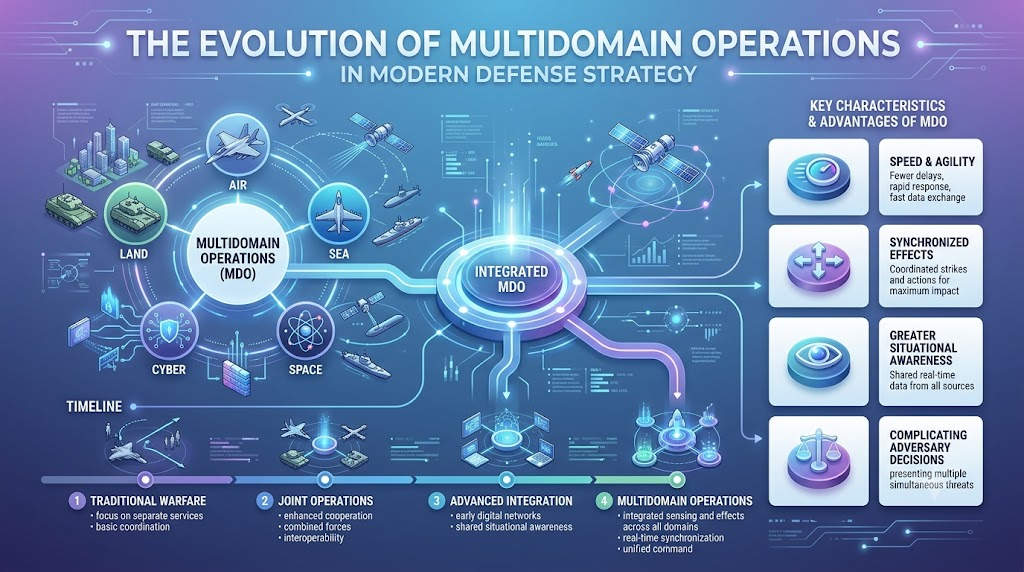
As security environments grow increasingly interconnected, defense analysts and military history students must look beyond traditional single-domain warfare. WarOpsXprovides structured educational resources to help researchers and students navigate these complex strategic concepts. Multidomain Operations (MDO) represents an analytical and operational framework designed to integrate capabilities across all operating domains to achieve strategic objectives. Rather than viewing land, maritime, air, space, and cyber domains as isolated spheres of activity, MDO emphasizes synchronized actions where capabilities in one domain create advantages or open opportunities in another. This article breaks down the foundational principles of multidomain strategy, examining its historical development, command and control architectures, technological drivers, logistics sustainment, and key analytical frameworks. Through neutral, evidence-based analysis, readers will gain a foundational understanding of how defense organizations evaluate and implement cross-domain operational concepts.
Understanding the Core Concept of Multidomain Operations
Multidomain Operations refers to the functional integration of capabilities across land, maritime, air, space, and cyberspace domains, along with the information environment. The primary purpose of MDO is to prevent operational isolation and present complex challenges to adversaries by acting simultaneously or sequentially across multiple operational arenas.
In traditional military theory, forces often operated in distinct domains with designated boundaries. Land forces focused on terrestrial geography, navies on maritime routes, and air forces on airspace control. While joint operations previously sought to coordinate these services, MDO expands this concept by treating all domains—including non-physical realms like cyber and space—as a single, continuously interacting system.
Key Terminology in Multidomain Strategy
- Domain: A distinct sphere of operational activity characterized by specific physical or non-physical properties (Land, Sea, Air, Space, Cyber).
- Cross-Domain Synergy: The complementary application of capabilities from one domain to create advantages in another.
- Interoperability: The technical and organizational ability of systems, units, or forces to exchange data and operate together effectively.
- Convergence: The rapid integration of capabilities across multiple domains in time and space to achieve a specific strategic or operational effect.
Understanding MDO requires distinguishing it from historic “combined arms” concepts. Combined arms primarily coordinated tactical elements on the battlefield, such as infantry, artillery, and armor. MDO operates at broader strategic and operational levels, integrating strategic communications, space-based navigation, cyber networks, and traditional combat forces to achieve cohesive organizational objectives.
Military Strategy and Cross-Domain Alignment
Strategic planning requires aligning organizational means with long-term security goals. Within defense studies, strategy operates above tactics and operations. Strategy determines why and where resources are allocated, while operational concepts like MDO define how those resources are organized and synchronized across domains.
Strategic Objectives vs. Operational Execution
Modern defense organizations face the challenge of resource allocation across disparate technological and physical environments. Investing in space-based sensor arrays or cybersecurity infrastructure requires balancing budgets traditionally reserved for ground vehicles or maritime vessels. Strategic decision-makers must weigh short-term readiness against long-term modernization.
Risk assessment in multidomain planning centers on friction and vulnerability. A capability in the air domain may rely entirely on cyber networks and satellite links in space. If an opponent disrupts the space or cyber layer, the air capability may lose effectiveness. Strategic planning must account for these interdependencies to ensure organizational resilience.
Command and Control Systems in Integrated Environments
Command and Control (C2) systems form the structural backbone of modern defense organizations. C2 encompasses the leadership structures, communications infrastructure, procedures, and data processing tools used by decision-makers to direct operations and maintain situational awareness.
The Evolution of Command Architectures
Historically, C2 systems were hierarchical and organized by service branches. Reports moved up a chain of command within the land or naval service before reaching higher joint headquarters. Modern C2 architectures focus on networked, flatter structures designed to share information rapidly across domains.
+-------------------------------------------------------------------+
|                   Integrated Multidomain C2 Node                  |
+-------------------------------------------------------------------+
                                  |
    +-----------------+-----------+-----------+-----------------+
    |                 |                       |                 |
+-------+         +-------+               +-------+         +-------+
| Land  |         | Sea   |               | Air   |         | Space/|
| Force |         | Fleet |               | Wing  |         | Cyber |
+-------+         +-------+               +-------+         +-------+
Modern integrated C2 nodes process data feeds from land sensors, naval vessels, aircraft, space satellites, and digital networks simultaneously, providing operational commanders with a comprehensive operational picture.
Decision Velocity and Information Management
A central goal of modern C2 development is increasing decision velocity—the speed at which an organization can process information, evaluate options, make decisions, and execute actions. However, increased data generation presents significant challenges. Information overload occurs when headquarters receive more data than analysts can digest. Effective C2 systems prioritize data filtering, verification, and clear communication channels to preserve decision quality.
Defense Technology as an Enabler of Integration
Technological advancements drive the feasibility of multidomain integration. Without modern computing, low-latency communication networks, and advanced sensors, cross-domain coordination would remain limited in scale and speed.
Core Technological Pillars
- Sensor Networks: Distributed arrays of radar, optical, and acoustic devices across land, sea, air, and space that continuously collect environmental and tracking data.
- Artificial Intelligence & Data Processing: Machine-learning algorithms used to filter raw data, identify patterns, and assist human decision-makers in synthesizing complex operational environments.
- Space-Based Systems: Satellites providing global positioning, timing, missile warning, weather tracking, and long-range communications.
- Cyber Architecture: Secure communications networks, data encryption mechanisms, and defensive systems designed to protect command infrastructure from digital intrusion.
While technology provides significant functional benefits, it introduces notable limitations. Complex systems increase maintenance burdens and create technological dependencies. Educational analysis of defense technology must weigh potential performance gains against system fragility, cost constraints, and ethical considerations surrounding automated decision-support tools.
Military Logistics and Sustainment Across Domains
Logistics represents the practical foundation of strategic capability. Without sustainment, fuel, maintenance, medical support, and transportation, organizational strategy cannot be realized. In a multidomain context, logistics extends far beyond moving supplies on land or sea.
Cross-Domain Supply Chains and Resilience
Multidomain logistics involves managing supply networks that cross physical and digital boundaries. A modern maintenance facility relies on global supply software, digital technical manuals, space-based tracking, and multi-modal transport (air, rail, sea, and road).
| Logistics Dimension | Primary Function | Multidomain Dependency | Key Operational Challenge |
| Physical Distribution | Transporting gear, fuel, and personnel | Requires air, sea, and land movement | Susceptibility to route disruption |
| Digital Maintenance | Software updates and diagnostic data | Dependent on cyber networks and space relay | Cyber intrusion and signal interference |
| Inventory Management | Tracking supply levels and readiness | Relies on automated databases and sensor tags | Data accuracy and system connectivity |
Logistics resilience requires maintaining alternative supply routes and manual fallback procedures if digital or satellite-dependent networks experience disruption.
Intelligence, Surveillance, and Reconnaissance (ISR)
Intelligence, Surveillance, and Reconnaissance (ISR) describes the systemic collection, processing, and dissemination of information regarding operational environments and relevant actors.
The ISR Process
- Collection: Sensors across domains collect signals, images, radar data, or human reports.
- Processing & Data Fusion: Raw data from disparate sources (e.g., satellite imagery combined with naval radar logs) is integrated into coherent formats.
- Analysis: Intelligence analysts evaluate processed data to assess patterns, intent, and environmental conditions.
- Dissemination: Insights are sent to commanders and operational units to support decision-making.
ISR systems struggle with uncertainty and deception. Raw data does not equal actionable intelligence. Defense studies researchers emphasize that data quality, source verification, and analytical rigor remain critical to avoiding intelligence failures.
Domain Characteristics Comparison
The following table compares the five primary operational domains across key structural criteria:
| Domain | Physical / Non-Physical | Key Characteristics | Strategic Advantage | Primary Vulnerability |
| Land | Physical | Human-populated, complex terrain, dense infrastructure | Direct control of territory and populations | Slow movement speed, complex terrain obstacles |
| Maritime | Physical | Vast geography, international waters, chokepoints | Global reach, heavy cargo transport capacity | Vulnerability at oceanic transit chokepoints |
| Air | Physical | High speed, physical freedom, temporary presence | Rapid deployment, wide sensor coverage | Fuel limitations, weather dependence |
| Space | Physical (Orbital) | Global coverage, lack of atmosphere, high cost | Global perspective, strategic communication relay | Predictable orbital paths, high replacement cost |
| Cyber | Non-Physical | Man-made, virtual, rapidly evolving, global reach | High-speed data exchange, low entry cost | Constant structural exposure to digital attack |
Historical and Hypothetical Examples
Historical Antecedent: AirLand Battle Doctrine (1980s)
During the late Cold War, defense theorists recognized that ground forces could not succeed in isolation without close coordination with air capabilities. The resulting “AirLand Battle” doctrine focused on synchronizing ground maneuver with deep air strikes to disrupt follow-on forces. While primarily limited to two physical domains (land and air), AirLand Battle established the conceptual framework for operational synchronization that evolved into modern Multidomain Operations.
Technology Transition Example: Integration of Space-Based Positioning
The implementation of the Global Positioning System (GPS) in the late 20th century transformed defense operations. Originally developed as a specialized satellite navigation system, space-based timing and location data became integrated into naval navigation, artillery precision, aircraft routing, logistics tracking, and search-and-rescue systems. This transition illustrates how a capability in the space domain fundamentally altered operational practices across land, sea, and air domains.
Hypothetical Scenario: Integrated Search and Disaster Response
Consider a hypothetical defense organization assisting in a major international maritime search-and-relief effort following a severe natural disaster:
- Space Domain: Satellites capture radar and optical imagery to map disrupted coastal lines and locate maritime debris fields.
- Cyber Domain: Network personnel establish secure data tunnels to share map data across sovereign relief agencies.
- Air Domain: Unmanned aerial vehicles fly localized sensor routes to verify clear sea channels.
- Maritime & Land Domains: Naval vessels and ground support teams use the shared data grid to navigate safely into damaged ports and distribute emergency supplies.
This hypothetical example illustrates cross-domain synergy in a non-combat environment, demonstrating how data sharing across domains enhances overall organizational effectiveness.
Strategic Analysis Framework
Students and researchers can apply this structured eight-step framework to evaluate multidomain concepts or defense case studies:
Step 1: Define the Strategic Objective
Identify the core policy, institutional, or security goal being pursued.
Step 2: Identify Participating Organizations and Actors
Determine which service branches, alliance partners, or civilian institutions are involved.
Step 3: Analyze Resources and Constraints
Evaluate available technology, hardware budgets, geographical factors, and legal boundaries.
Step 4: Examine Information and Decision-Making Structures
Assess how command structures process information and maintain situational awareness.
Step 5: Evaluate Logistics and Sustainment Readiness
Determine if supply networks can maintain operations across physical and digital lines.
Step 6: Review Technological Interoperability
Analyze whether data networks, radios, and software tools can communicate effectively across domains.
Step 7: Assess Risk, Vulnerability, and Uncertainty
Identify potential single points of failure, such as reliance on a single satellite constellation or software network.
Step 8: Contextualize Within History and Policy
Examine historical predecessors and broader legal, ethical, and political considerations.
Key Challenges and Limitations
Implementing multidomain strategy involves significant practical difficulties:
- Organizational Friction: Service branches often possess distinct organizational cultures, budgeting processes, and heritage identities, making seamless integration difficult.
- Cybersecurity Exposure: Interconnected networks mean a security breach in one low-level system can spread across broader organizational command links.
- Data Overload: The influx of continuous sensor streams can overwhelm human analysts, leading to delayed or flawed decision-making.
- Infrastructure Dependence: High-technology solutions depend on vulnerable ground stations, sea cables, and satellite arrays.
- Interoperability Standards: Allied nations and different domestic agencies often use non-compatible radios, software, and data formats, complicating joint efforts.
Common Misconceptions
- Misconception: Multidomain Operations is simply traditional Combined Arms with a new name.Correction: Combined arms focuses on tactical integration primarily within land and air domains. MDO encompasses strategic and operational synchronization across non-physical domains like cyber, space, and the information environment.
- Misconception: Advanced technology automatically guarantees multidomain success.Correction: Technology is an enabler, but organizational culture, doctrine, leadership, logistics, and realistic training determine overall organizational effectiveness.
- Misconception: Collecting more data always yields clearer decisions.Correction: Raw data without effective filtering, verification, and analysis creates noise, causing decision fatigue and confusion.
- Misconception: Multidomain strategy makes single-domain expertise obsolete.Correction: Effective cross-domain integration relies on deep expertise within individual domains. An integrated network is only as capable as its constituent land, sea, air, space, and cyber components.
10 Frequently Asked Questions (FAQs)
1. What is Multidomain Operations (MDO)?
Multidomain Operations is a defense framework focused on integrating capabilities across land, maritime, air, space, cyber, and information environments. Rather than operating in isolated domains, MDO synchronizes actions across multiple realms simultaneously to achieve strategic objectives and prevent operational isolation.
2. How does strategy differ from tactics in defense studies?
Strategy defines long-term national or organizational goals and allocates resources to achieve them. Tactics refers to the specific methods and maneuvers used by units during immediate engagements. Operations links the two, organizing tactical activities to fulfill strategic objectives.
3. Why are space and cyber considered operational domains?
Space and cyberspace are designated as domains because they represent distinct environments where operational capabilities function. Space provides global timing, navigation, and communications infrastructure, while cyberspace consists of the digital networks that store, transmit, and process essential organizational data.
4. What is Command and Control (C2)?
Command and Control encompasses the authority, leadership structures, technologies, and procedures used by leaders to organize forces, process information, and direct operations. Modern C2 systems focus on integration, secure communication, and rapid data sharing across service branches.
5. How does logistics support multidomain strategy?
Logistics provides the materials, fuel, equipment maintenance, transportation, and personnel care required to sustain operations. In a multidomain environment, logistics systems manage both physical movement across transport networks and digital data flows required for supply chain visibility.
6. What is the role of ISR in defense systems?
Intelligence, Surveillance, and Reconnaissance (ISR) gathers, processes, and analyzes information about operational environments. ISR integrates data from satellites, aerial vehicles, radar arrays, and digital monitoring to improve situational awareness and support strategic decision-making.
7. What is cross-domain synergy?
Cross-domain synergy occurs when a capability operated in one domain creates an operational advantage in a different domain. For example, using a space-based satellite to guide a maritime rescue vessel illustrates cross-domain synergy between space and maritime operations.
8. What are the primary challenges of implementing MDO?
Primary challenges include organizational resistance between service branches, high technical costs, information overload, cybersecurity vulnerabilities, and ensuring interoperability among allied forces using different software and communication systems.
9. How does military history inform modern defense studies?
Military history provides documented empirical evidence regarding organizational behavior, technological adoption, strategic decision-making, and logistics friction. Analyzing historical precedents helps researchers understand how institutions adapt to changing technological and strategic environments over time.
10. How can students use WarOpsX.com to study defense concepts?
Students can use WarOpsX.com to access structured, non-operational educational guides covering military history, defense technology, organizational structures, logistics principles, and strategic theory to build a rigorous foundational knowledge base in defense studies.
Conclusion
Understanding Multidomain Operations requires analyzing how modern defense organizations connect strategy, technology, command structures, and logistics across diverse physical and non-physical environments. As land, sea, air, space, and cyber domains become increasingly interconnected, educational analysis must look beyond simple hardware comparisons to evaluate decision-making, information management, and institutional adaptability. By examining historical precedents, theoretical frameworks, and practical constraints, researchers and students can develop a comprehensive perspective on modern defense systems. Educational platforms like WarOpsX.com provide structured, academic-focused resources to help learners explore these complex defense studies topics in a neutral, research-oriented environment. Continuing study in strategic history, organizational systems, and responsible policy analysis remains essential for understanding the future of global defense environments.