Introduction
Fat transfer surgery moves fat from one part of the body to another. It can add volume to areas such as the face, breasts, hands, hips, or buttocks. Some people also choose it to improve dents or uneven areas caused by injury or earlier surgery.
Many patients consider this procedure because it uses their own fat rather than a synthetic filler or implant. However, the body may absorb some of the transferred fat, and results can vary. Like other operations, fat transfer has risks and requires time for healing.
Understanding the process can help you prepare and make informed choices. The surgeon’s skills, your health, the treatment area, and the care you receive all matter. BESTCOSMETICHOSPITALS helps readers explore cosmetic care information and compare providers. Before choosing surgery, discuss your goals, likely results, costs, recovery, and possible complications with a qualified plastic surgeon.
What Is Fat Transfer Surgery?
Fat transfer surgery is a procedure in which a surgeon removes fat from one area of your body and places it in another. It is also called fat grafting, fat injection, or lipofilling.
The process usually has three main stages: fat removal, fat preparation, and fat injection. Fat may be taken from the abdomen, thighs, hips, or waist, depending on the treatment plan and the amount available.
Fat transfer differs from synthetic dermal fillers and implants. Fillers use manufactured substances to add volume, while implants are devices placed inside the body. Fat transfer uses your own tissue. However, this does not remove the risks linked to surgery, anesthesia, or healing.
Which Areas Can Be Treated With Fat Transfer?
Fat transfer can be used in several areas, but the best approach depends on your goals, health, and body shape.
- Face: Fat may be placed in the cheeks, selected areas under the eyes, or other areas with lost volume. Fat transfer for the face may also be considered for the lips, though results can vary.
- Breasts: In selected patients, fat may add some volume or improve shape. It may not provide the size change a patient wants and is not suitable for every breast concern.
- Buttocks and hips: Fat may improve contour or add volume. Gluteal fat grafting carries serious risks and requires strict safety measures.
- Hands: Fat may restore volume that has reduced with age or other changes.
- Contour irregularities: Fat may fill some dents caused by injury, previous surgery, or other conditions.
Each area has its own risks and treatment needs. A qualified plastic surgeon should explain whether the procedure is suitable for you and whether another option may better meet your goals.
Who May Be a Suitable Candidate?
A plastic surgeon will assess your health, donor fat, and treatment goals before recommending fat transfer. Being interested in the procedure does not automatically mean you are a suitable candidate.
The surgeon may consider:
- Overall health: Some medical conditions can raise the risks of anesthesia, surgery, or healing.
- Available donor fat: The surgeon needs enough suitable fat for the planned treatment.
- Stable body weight: Large weight changes can affect the donor area and the final shape.
- Smoking and nicotine use: Nicotine can reduce blood flow and slow healing. Ask your surgeon when to stop and how long to avoid it after surgery.
- Medicines and healing: The team needs to know about your medicines, allergies, past operations, and any history of healing problems.
- Realistic goals: Fat transfer may improve volume or contour, but it cannot promise perfect symmetry or a specific look.
Some people may benefit from non-surgical treatments. Others may be advised to delay surgery or avoid it due to health risks. Only a qualified clinician can assess your individual needs and decide whether the procedure is appropriate.
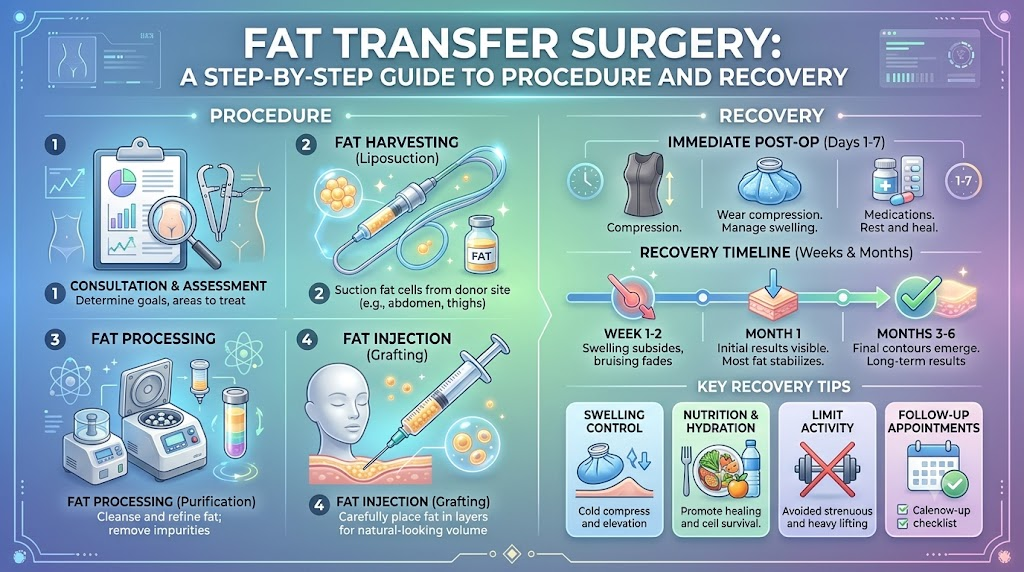
Fat Transfer Surgery Step by Step
The fat transfer procedure involves several stages. The exact method depends on the treatment area, the amount of fat needed, and your health.
Step 1 — Consultation and Medical Assessment
The first step is a detailed consultation. The surgeon reviews your medical history, current medicines, allergies, previous procedures, and treatment goals.
The surgeon examines both the donor area and the area that may receive fat. You should discuss the likely benefits, limits, risks, and other treatment options. This visit also helps the surgeon decide whether the procedure is suitable for you.
Step 2 — Planning and Preparation
If surgery is suitable, the surgeon plans where fat will be removed and where it will be placed. The team discusses anesthesia, expected results, costs, and recovery needs.
Tell the team about all medicines, vitamins, and supplements you take. Do not stop or change prescribed medicines without guidance from your treating clinician. Follow the instructions about food, drink, smoking, and nicotine before surgery.
Step 3 — Anesthesia
The procedure may use local anesthesia, sedation, or general anesthesia. Local anesthesia numbs a specific area. Sedation helps you feel calm or sleepy, while general anesthesia makes you unconscious during surgery.
The safest option depends on the procedure, your health, and the amount of treatment planned. The surgical and anesthesia team should explain the chosen method and how you will be monitored.
Step 4 — Fat Removal From the Donor Area
The surgeon collects fat using a liposuction technique. This usually involves small cuts in the skin and a thin tube called a cannula. Common donor areas include the abdomen, thighs, hips, and waist.
The amount collected depends on your treatment plan and the fat available. The surgeon aims to collect suitable fat while managing the shape of the donor area and limiting tissue injury.
Step 5 — Fat Processing and Purification
The collected fat may contain fluid, blood, and other material. The surgeon processes it to separate the fat intended for transfer from unwanted material.
The method depends on the surgeon’s technique and the procedure. Careful handling helps prepare the fat for injection, but it cannot ensure that all transferred fat will survive.
Step 6 — Fat Injection Into the Target Area
The surgeon places the prepared fat into the selected area in small amounts. Careful placement helps shape the treated area and supports the chance that the fat will develop a lasting blood supply.
The technique and safety needs vary by body area. Fat transfer to the buttocks needs special care because fat entering large blood vessels can cause a life-threatening fat embolism. Ask about current safety measures, including avoiding injection into the gluteal muscle and using real-time ultrasound guidance to monitor the cannula’s position.
Step 7 — Initial Recovery and Monitoring
After surgery, the team monitors your condition as you recover from anesthesia. Staff may check your breathing, pain, bleeding, and general health before discharge.
You will receive instructions for wound care, pain control, activity, and positioning. Some patients go home the same day, while others need more time under medical care. Arrange transport and support as advised by your team.
| Step | What Happens | Main Purpose |
|---|---|---|
| Consultation | The surgeon reviews health, goals, and treatment areas | Check suitability and plan care |
| Fat removal | Fat is collected from a donor area | Obtain fat for transfer |
| Fat processing | The collected fat is prepared for use | Separate usable fat from unwanted material |
| Fat injection | Fat is placed in the target area | Add volume or improve contour |
| Recovery monitoring | The team checks your condition and gives care instructions | Support safe early recovery |
How Long Does Fat Transfer Surgery Take?
The time needed depends on the treatment area, the amount of fat collected, and how many areas are treated. A procedure involving several areas may take longer than a smaller treatment.
Anesthesia and other procedures performed at the same time can also affect the total time. Ask your surgeon for an estimate based on your treatment plan. The actual time may differ from that estimate.
How to Prepare for Fat Transfer Surgery
Good preparation helps you understand the process and plan for recovery. Your surgical team should give you instructions based on your health and the procedure.
Before surgery:
- Complete the medical assessment and any tests requested.
- Share a full list of medicines, vitamins, and supplements.
- Follow instructions about eating, drinking, smoking, and nicotine.
- Arrange transport home and support during early recovery.
- Plan time away from work and strenuous activity.
- Ask who to contact if you have a problem after discharge.
Do not change prescribed medicines on your own. If you smoke or use nicotine, ask your surgeon when to stop and how long to avoid it after surgery. Follow the care team’s instructions, as preparation can differ between procedures.
Recovery After Fat Transfer Surgery
Healing takes place in both the area where fat was removed and the area where it was placed. Bruising, swelling, tenderness, and temporary numbness can occur. These effects often improve over time, but each person heals at a different pace.
Your team may advise dressings or compression garments for the donor area. Follow their instructions about how to use them and care for your incisions. Do not put creams or other products on healing wounds unless your team says they are safe.
Gentle movement may be encouraged, while some activities may need to wait. You may also receive special instructions about sleeping or sitting, especially after fat transfer to the buttocks. These instructions depend on the procedure and should be followed closely.
Return to work, exercise, and normal activities only when your care team says it is safe. Attend follow-up visits so the team can check healing and discuss concerns. Recovery after facial fat transfer may differ from recovery after breast or body fat transfer, so one person’s experience may not predict yours.
When Will You See the Final Results?
Early fullness may partly come from swelling. As swelling settles, the treated area may look different from how it appeared soon after surgery.
The body naturally absorbs some transferred fat. Fat that develops a lasting blood supply may remain for a long time, but the amount that survives varies from person to person. Changes in body weight can also affect the result.
It may take several months for the shape to settle. Some patients may need another session to reach their goals. Before surgery, ask your surgeon what results are realistic and when your progress will be assessed.
Benefits and Limitations of Fat Transfer Surgery
Fat transfer may improve volume or contour in selected areas. It uses the patient’s own tissue and may treat both a donor area and a receiving area. Some patients prefer this approach to an implant or synthetic filler.
However, the procedure has limits. There may not be enough donor fat for the planned change, and some transferred fat may not survive. The result may be uneven, or another session may be needed. Surgery also involves costs, recovery time, and possible complications.
| Topic | Potential Benefit or Limitation | What Patients Should Know |
|---|---|---|
| Natural tissue use | Uses the patient’s own fat | This does not remove the risks of surgery |
| Variable fat survival | Some transferred fat may remain long term | The amount that survives differs between people |
| Recovery needs | May improve volume or contour | Both donor and treated areas need care |
| Repeat sessions | Another session may help reach the goal | Extra treatment may increase cost and recovery time |
| Surgical risks | Can treat selected areas and contour concerns | Discuss risks specific to the treatment area |
Risks and Possible Complications
Fat transfer surgery has risks, even when performed by a qualified surgeon. Possible problems include infection, bleeding, bruising, swelling, pain, scarring, or changes in skin sensation.
Other complications may include uneven contours, differences between the two sides, fluid or blood collecting under the skin, firm areas, oil cysts, or fat necrosis. Fat necrosis happens when some fat cells die. Anesthesia can also cause complications, and surgery may raise the risk of blood clots.
A serious risk is fat embolism, which occurs when fat enters the bloodstream and blocks blood flow. This is a major safety concern with fat transfer to the buttocks. Ask your surgeon about their experience with gluteal fat grafting, the facility’s emergency plan, the injection method, and real-time ultrasound guidance.
The risks depend on the area treated, your health, and the technique used. Ask the surgeon to explain the main risks in your case and how the team works to reduce them.
Fat Transfer Surgery Cost and Hospital Selection
The cost of fat transfer surgery depends on the treatment area, the complexity of the procedure, and the services provided. An advertised fee may not cover every part of care.
Common cost factors include:
- The surgeon’s fees and the complexity of the procedure.
- Anesthesia and operating-room fees.
- Hospital or surgical facility charges.
- Medical tests and consultations.
- Medicines, dressings, and compression garments.
- Follow-up appointments and aftercare.
- Additional sessions or revision surgery, if needed.
Ask for a written, itemized estimate. Check what is included, what costs extra, and how unexpected treatment needs may affect the final bill. If you compare providers, look beyond price alone.
Check the surgeon’s qualifications and experience with your specific procedure. Confirm that the facility meets local licensing or accreditation rules, has suitable emergency arrangements, and provides a clear aftercare plan. No hospital or surgeon can guarantee a particular result.
When to Seek Medical Help After Surgery
Contact your surgical team promptly if you notice worsening redness, increasing pain or swelling, fever, unusual discharge, or bleeding that does not stop. These signs may need medical assessment.
Seek emergency medical care immediately for sudden shortness of breath, chest pain, fainting, severe confusion, or other signs of a serious emergency. These symptoms may indicate a dangerous complication. Do not wait for a routine follow-up visit.
Keep your discharge instructions and the surgical team’s contact details nearby. If you are unsure whether a symptom is serious, seek medical advice rather than trying to manage it alone.
Frequently Asked Questions About Fat Transfer Surgery
1. What is fat transfer surgery?
Fat transfer surgery moves fat from one part of the body to another to add volume or improve contour. It is also called fat grafting or lipofilling. The surgeon collects fat, prepares it, and injects it into the target area. Results vary, and some transferred fat may not survive.
2. How is fat transfer surgery performed?
The surgeon first reviews your health and treatment goals. During the procedure, fat is usually removed through liposuction, prepared to separate usable fat, and injected into the chosen area. Anesthesia and the exact method depend on the procedure. The medical team monitors you afterward and gives recovery instructions.
3. Which areas of the body can receive transferred fat?
Fat may be transferred to selected areas of the face, hands, breasts, buttocks, or hips. It can also help improve some contour irregularities. Each area has different treatment needs and risks. A qualified plastic surgeon can assess whether your chosen area is suitable and explain other options.
4. Is fat transfer surgery painful?
Anesthesia helps control pain during the procedure. After surgery, you may have soreness, swelling, bruising, or tenderness in both the donor and treated areas. The level of discomfort varies with the procedure and your health. Follow your surgeon’s pain-control instructions and ask before taking any additional medicine.
5. How long does recovery from fat transfer surgery take?
Recovery depends on the area treated, the amount of fat removed and transferred, and your general health. Swelling and bruising take time to settle, and some activities must be limited at first. Follow your surgeon’s advice about work, exercise, wound care, and positioning rather than relying on a fixed timeline.
6. How long do fat transfer results last?
Some transferred fat may remain for a long time if it develops a lasting blood supply. However, the body absorbs some of the fat, and the amount that remains differs between people. Weight changes can affect the result. Your surgeon can explain what to expect and when results may be assessed.
7. Does all transferred fat survive?
No. Some transferred fat is naturally absorbed by the body. The amount that survives depends on factors such as the treatment area, the technique used, and individual healing. No surgeon can promise that all the fat will remain. Some patients may need another session to reach their goals.
8. What are the main risks of fat transfer surgery?
Possible risks include infection, bleeding, scarring, uneven contours, fat necrosis, and complications from anesthesia. Blood clots and fat embolism are also concerns. Fat transfer to the buttocks has particular serious risks if fat enters blood vessels. Ask your surgeon how these risks apply to your procedure and how they are reduced.
9. How much does fat transfer surgery cost?
The cost depends on the treatment area, surgeon, anesthesia, facility, tests, and follow-up care. Additional sessions may increase the total expense. Ask for an itemized written estimate that explains included services and possible extra charges. Compare qualifications, safety arrangements, and aftercare as well as price.
10. How can I choose a qualified plastic surgeon for fat transfer surgery?
Check the surgeon’s recognized qualifications, registration, and experience with your specific procedure. Ask about the technique, risks, expected results, and emergency arrangements at the facility. Make sure you receive clear answers and a written cost estimate. Avoid choosing based only on advertising, online ratings, or promises of guaranteed results.
Conclusion
Fat transfer surgery may help add volume or improve contour, but it requires careful planning and a clear understanding of its limits. Learn about each stage, compare qualified surgeons and facilities, and ask about risks, costs, and aftercare. Your health, treatment area, and goals all affect which option may suit you. Discuss your questions with a qualified plastic surgeon before making a decision, and take time to understand the possible benefits and risks.