Introduction
In recent years, interest in subtle, minimally invasive cosmetic enhancements has grown significantly. Among facial aesthetic procedures, non-surgical rhinoplasty—often called liquid rhinoplasty or a non-surgical nose job—has emerged as a popular alternative for individuals seeking minor cosmetic adjustments to the shape or contour of their nose without undergoing conventional surgery.Selecting a qualified medical facility and an experienced practitioner is paramount for patient safety. The nasal region features a complex network of blood vessels, making practitioner qualifications, anatomical knowledge, and emergency preparedness essential evaluation criteria. Resources like BESTCOSMETICHOSPITALS help patients learn about cosmetic options, understand hospital capabilities, and evaluate key provider selection factors to make well-informed healthcare decisions.
What Is Non-Surgical Rhinoplasty?
Non-surgical rhinoplasty is an aesthetic medical procedure in which injectable dermal fillers are placed strategically beneath the skin of the nose to temporarily alter its external contour and appearance.Unlike surgical rhinoplasty, which can physically alter or remove bone and cartilage, liquid rhinoplasty works by adding volume. By strategically placing filler, a qualified medical professional can disguise certain contour irregularities, soften the appearance of a dorsal hump, or improve facial symmetry.As described by the American Society of Plastic Surgeons, non-surgical rhinoplasty is a filler-based approach capable of creating selected aesthetic adjustments without traditional surgical incisions. However, because it relies on volumetric augmentation, it cannot physically reduce the size of the nose or resolve internal structural breathing obstructions.
SURGICAL VS. LIQUID RHINOPLASTY (MECHANISM)
┌───────────────────────────┐         ┌───────────────────────────┐
│   SURGICAL RHINOPLASTY    │         │   LIQUID RHINOPLASTY      │
│ • Reshapes/removes bone   │   VS.   │ • Adds volumetric filler  │
│   and cartilage           │         │ • Camouflages irregularities│
│ • Reduces or restructures │         │ • Cannot reduce physical  │
│   overall size            │         │   nose volume             │
└───────────────────────────┘         └─────────────────────────┘
How Liquid Rhinoplasty Works
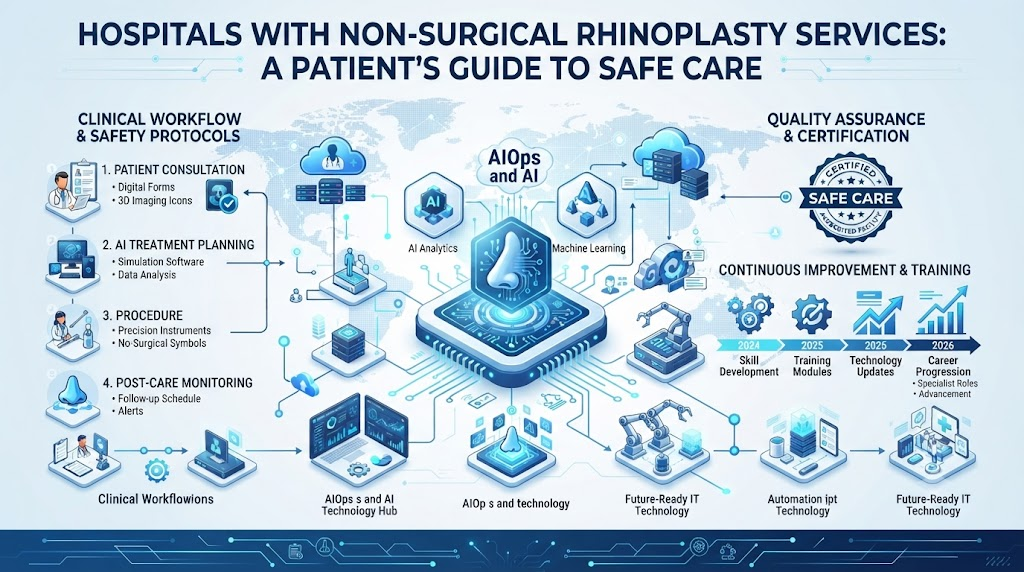
When performed in an accredited hospital or specialized cosmetic clinic, non-surgical rhinoplasty follows a structured clinical protocol focused on patient assessment, precise delivery, and safety.
1. Initial Medical Consultation
The process begins with a detailed evaluation. The healthcare provider discusses the patient’s aesthetic goals, evaluates facial proportions, reviews medical history, and confirms whether the patient has had previous nasal surgeries or facial filler treatments.
2. Anatomical Assessment
The provider evaluates the skin’s thickness, elasticity, existing nasal symmetry, and underlying vascular structure. If a patient has undergone prior surgical rhinoplasty, the altered blood supply requires heightened caution or may make liquid rhinoplasty unsuitable.
3. Treatment Planning
Based on the anatomical evaluation, the provider outlines a personalized treatment plan. This includes selecting an appropriate, regulated dermal filler (typically a hyaluronic acid gel) and identifying the exact injection sites needed to achieve realistic, subtle improvements.
4. Controlled Injection
After cleansing and topically numbing the area, the medical professional carefully injects small, precise amounts of filler into targeted anatomical layers of the nose, continually checking symmetry and vascular refill.
5. Post-Procedure Monitoring and Follow-Up
Following the injections, the treatment site is inspected for signs of normal tissue response. The patient receives specific aftercare instructions and guidance on recognizing warning signs that require immediate medical evaluation.
What Can Non-Surgical Rhinoplasty Potentially Improve?
Dermal fillers can refine selected aesthetic aspects of the nose by strategically building up adjacent areas:
- Softening a Dorsal Hump: Injecting filler directly above and below a bony hump creates the visual illusion of a straighter, smoother nasal bridge.
- Refining Nasal Asymmetry: Filling small depressions or uneven contours can balance minor structural asymmetries.
- Correcting Post-Surgical Depressions: Filling small defects or minor contour irregularities remaining after a previous surgical rhinoplasty.
- Raising the Nasal Bridge: Adding height and definition to a flat or low nasal bridge, a common preference in Asian or ethnic rhinoplasty refinement.
- Slight Tip Elevation: Placing filler near the base or tip of the nose (columella) can provide subtle support, giving the optical illusion of a slightly lifted tip.
What Non-Surgical Rhinoplasty Cannot Do
Understanding the physical limitations of dermal fillers prevents unrealistic expectations and guides patients toward surgical consultation when necessary.
Liquid rhinoplasty cannot:
- Physically Reduce Nose Size: Fillers add volume; they cannot make a large, wide, or bulbous nose physically smaller.
- Remove Bone or Cartilage: Large bony humps or wide nasal bones cannot be removed without surgical intervention.
- Refine a Bulbous Tip: Adding filler to a wide or thick-skinned nasal tip often adds bulk rather than definition.
- Correct Severe Structural Deviations: Twisted or severely crooked nasal structures require surgical reconstruction.
- Improve Internal Nasal Breathing: Functional issues, such as a deviated septum or enlarged turbinates, require surgical or otolaryngological management.
For patients seeking significant reduction or structural alteration, the American Society of Plastic Surgeons recommends discussing surgical options with a board-certified plastic surgeon.
Who May Be a Candidate?
Suitability for liquid rhinoplasty is determined during a clinical evaluation. Generally, candidates include:
- Adults seeking modest cosmetic changes rather than dramatic structural alteration.
- Individuals with minor dorsal humps, low nasal bridges, or small contour depressions.
- Patients who prefer temporary results without the downtime associated with surgery.
- Individuals with realistic expectations regarding what added volume can achieve.
- Patients with healthy facial tissue who have no contraindications, such as active skin infections or known allergies to filler components.
Benefits of Non-Surgical Rhinoplasty
When performed by a qualified medical professional, liquid rhinoplasty offers several notable advantages:
No Traditional Surgical Incisions
Because the procedure relies entirely on delicate needle or cannula injections, it involves no scalpel incisions, structural bone repositioning, or general anesthesia.
Minimal Downtime
Most patients resume normal daily activities shortly after the procedure. While mild swelling, redness, or localized tenderness can occur, recovery is considerably shorter than the weeks required following surgical rhinoplasty.
Reversibility and Gradual Breakdown
Most non-surgical rhinoplasties utilize Hyaluronic Acid (HA) fillers. According to the U.S. Food and Drug Administration (FDA), HA fillers are naturally broken down by the body over several months. Furthermore, if an unsatisfactory result or complication occurs, HA fillers can be rapidly dissolved using an injectable enzyme called hyaluronidase.
Immediate Visual Feedback
Results are visible immediately following injection, allowing the patient and provider to evaluate contour changes in real time during the consultation session.
Risks and Safety Considerations
Despite being non-surgical, liquid rhinoplasty is not risk-free. The nose is considered one of the most anatomically complex and high-risk areas of the face for dermal filler injections due to its intricate, interconnected blood supply.
POTENTIAL COMPLICATIONS SPECTRUM
┌──────────────────────────────┐        ┌──────────────────────────────┐
│   COMMON / MILD EFFECTS      │        │    SERIOUS / VASCULAR RISKS  │
│ • Temporary swelling         │   VS.  │ • Vascular Occlusion         │
│ • Localized redness          │        │ • Skin Necrosis (Tissue death)│
│ • Mild bruising / tenderness │        │ • Vision Impairment / Blindness│
└──────────────────────────────┘        └──────────────────────────────┘
Common, Mild Side Effects
- Transient swelling around the injection sites
- Localized bruising or skin redness
- Mild tenderness or discomfort for a few days post-treatment
Serious Medical Complications
The FDA warns that accidental injection of dermal filler into a blood vessel can cause severe, permanent medical complications:
- Vascular Occlusion: Occurs when filler enters or compresses an artery, blocking blood flow to surrounding facial tissues.
- Skin Necrosis: Severe tissue damage or cell death resulting from prolonged lack of blood supply, potentially leading to permanent scarring.
- Vision Impairment or Blindness: If filler material accidentally enters branches of the ophthalmic artery, it can travel backward and block blood flow to the retina, leading to irreversible vision loss.
- Infection and Granulomas: Delayed inflammatory reactions, bacterial infections, or firm nodule formation beneath the skin.
Because of these vascular risks, the American Society of Plastic Surgeons emphasizes that liquid rhinoplasty requires deep anatomical knowledge, precise injection technique, and immediate access to emergency complication protocols.
Warning Signs After Filler Treatment
Patients must know how to spot early signs of vascular complications. Seek urgent medical care immediately if you notice any of the following symptoms after receiving nasal fillers:
🚨 CRITICAL MEDICAL WARNING SIGNS (SEEK IMMEDIATE EMERGENCY CARE)
┌────────────────────────────────────────────────────────────────────────┐
│ 1. UNUSUAL OR SEVERE, WORSENING PAIN at or near the injection site     │
│ 2. SKIN BLANCHING (whitening) or dusky, bluish/mottled skin discoloration│
│ 3. SUDDEN VISION CHANGES, blurred vision, or eye discomfort             │
│ 4. SIGNS OF STROKE, such as facial drooping, weakness, or speech difficulty│
│ 5. RAPIDLY SPREADING REDNESS, warmth, or pus indicating infection      │
└────────────────────────────────────────────────────────────────────────┘
As highlighted by the FDA, prompt recognition and immediate administration of hyaluronidase (to dissolve the blocking filler) are crucial to restoring blood flow and preventing permanent tissue damage or vision loss.
Surgical vs. Non-Surgical Rhinoplasty
Understanding how these procedures compare helps patients select the option best suited to their anatomical goals:
| Feature | Non-Surgical Rhinoplasty (Liquid) | Surgical Rhinoplasty |
| Primary Method | Injectable dermal fillers (Hyaluronic Acid) | Operative surgery altering bone and cartilage |
| Surgical Incisions | None; performed via fine needles or cannulas | Open or closed surgical incisions |
| Volumetric Change | Adds volume to disguise irregularities | Can add, remove, or reshape tissue |
| Nose Size Reduction | Not possible (cannot make nose smaller) | Fully capable of physical size reduction |
| Structural Corrections | Limited; purely cosmetic surface refinement | Corrects deviated septums, bone, and airway issues |
| Downtime & Recovery | Minimal; mild swelling/bruising for 2–7 days | 1–2 weeks initial swelling/splinting; full resolution up to 1 year |
| Duration of Results | Temporary (typically 6 to 18 months) | Intended to be permanent |
| Reversibility | Reversible if using Hyaluronic Acid fillers | Requires revision surgery to modify |
| Primary Risk Factors | Vascular occlusion, tissue necrosis, vision risk | Anesthesia risks, surgical infection, structural dissatisfaction |
What Makes a Leading Hospital for Non-Surgical Rhinoplasty?
Because nasal filler injections carry inherent vascular risks, choosing a facility based on safety standards rather than marketing claims is essential.
1. Fully Licensed Medical Professionals
The FDA strongly recommends that dermal fillers be administered exclusively by licensed, board-certified healthcare professionals—such as plastic surgeons, dermatologists, or specialized facial aesthetic physicians—who have extensive training in facial anatomy and emergency complication management.
2. Specialized Nasal Anatomy Expertise
Practitioners must possess a comprehensive understanding of the nose’s intricate arterial network. Experienced injectors utilize specialized techniques, such as slow, low-pressure micro-injections or blunt-tipped micro-cannulas, to minimize vascular trauma.
3. Established Emergency Complication Protocols
High-quality medical centers maintain immediate, on-site access to high-concentration hyaluronidase, emergency medications, ultrasound guidance tools, and established transfer protocols with ophthalmologists and vascular specialists.
4. Quality-Assured, Regulated Products
Leading facilities use exclusively authentic, approved dermal fillers sourced directly from authorized medical distributors. They never use unverified, gray-market, or online-purchased products.
5. Comprehensive Consultation and Informed Consent
A reputable facility provides a thorough pre-treatment evaluation, openly discussing realistic aesthetic outcomes, physical limitations, potential complications, and alternative surgical choices before obtaining consent.
Questions to Ask Before Non-Surgical Rhinoplasty
During your consultation, ask these key questions to evaluate your provider’s experience and safety standards:
- What are your medical credentials and specific training in facial injectable procedures?
- How many non-surgical rhinoplasty procedures have you performed?
- Which specific dermal filler product do you plan to use, and is it approved for aesthetic facial use in this country?
- Based on my nasal anatomy, what cosmetic changes are realistically achievable?
- Would my aesthetic goals be better addressed through surgical rhinoplasty?
- How do you evaluate and map the vascular anatomy of the nose before injecting?
- What is your immediate protocol if a vascular occlusion or emergency complication occurs?
- Do you keep hyaluronidase stocked on-site in the treatment room?
- How long are my results expected to last, and what follow-up care is included?
- What total expenses are involved, including follow-up or emergency management if needed?
How to Compare Hospitals Offering Non-Surgical Rhinoplasty
Evaluating cosmetic facilities requires a structured framework focused on safety, quality, and clinical transparency:
                    HOSPITAL EVALUATION FRAMEWORK
                                  │
    ┌─────────────────────────────┼─────────────────────────────┐
    ▼                             ▼                             ▼
PROVIDER CREDENTIALS         CLINICAL SAFETY            PATIENT SUPPORT
 • Board Certification       • Emergency Protocols      • Transparent Pricing
 • Specialized Training      • Approved Products        • Follow-Up Care
 • Nasal Volume Experience   • On-site Hyaluronidase    • Realistic Consultations
- Provider Qualifications: Verify that injections are performed directly by qualified medical doctors rather than unsupervised non-medical personnel.
- Clinical Safety Standards: Ensure the facility operates within an accredited hospital or licensed clinical environment with strict sterilization protocols.
- Emergency Readiness: Confirm the immediate availability of complication reversal agents (hyaluronidase) and emergency medical equipment.
- Product Sourcing & Transparency: Check that the hospital uses recognized, regulatory-approved dermal fillers and provides product lot numbers to patients.
- Quality of Consultation: Choose providers who take time to evaluate your anatomy, discuss risks, and decline treatment if you are an unsuitable candidate.
- Surgical Capabilities: Facilities that offer both surgical and non-surgical rhinoplasty provide unbiased guidance on which approach best suits your goals.
- Patient Reviews & Case Safety: Look for patient feedback regarding medical professionalism, hygiene, communication, and post-procedure follow-up.
- Transparent Pricing: Ensure clear pricing without hidden fees or pressure to purchase excessive filler volume.
Preparing for the Consultation
To get the most out of your consultation, prepare the following details in advance:
- Complete Medical History: Disclose all underlying medical conditions, allergies, bleeding disorders, or autoimmune diseases.
- Previous Nasal Procedures: Disclose any past surgical rhinoplasties, nasal trauma, or prior facial filler injections. Prior surgery alters blood vessel pathways and significantly increases vascular risks.
- Current Medications List: Inform your provider about all prescription drugs, over-the-counter pain relievers, blood thinners (like aspirin or ibuprofen), and herbal supplements that may increase bruising risks.
- Clear Cosmetic Goals: Bring photos or describe the specific contour issues (such as a minor hump or low bridge) you hope to refine.
Recovery and Aftercare
Adhering to post-procedure instructions minimizes common side effects and protects your results:
- Apply Cool Compresses: Use a cool compress gently near (not directly pressing on) the area to manage mild swelling or localized bruising.
- Avoid Touching or Manipulating the Area: Refrain from rubbing, massaging, or pushing on the nose for at least 14 days post-treatment, as physical pressure can displace the filler.
- Avoid Heavy Eyewear: Refrain from wearing heavy glasses or sunglasses resting directly on the treated nasal bridge for the first two weeks if advised by your provider.
- Postpone Strenuous Activity: Avoid high-intensity exercise, saunas, hot tubs, and heavy alcohol consumption for 24 to 48 hours to minimize swelling and bleeding risks.
- Attend Scheduled Follow-Ups: Visit your provider for any scheduled checks to evaluate tissue integration and aesthetic symmetry.
Common Mistakes to Avoid
- Selecting Providers Based Solely on Price: Choosing cheap offers or discounted deals often leads to unqualified injectors, gray-market products, or inadequate safety standards.
- Purchasing Fillers Online: The FDA explicitly warns against purchasing dermal fillers online, as counterfeit or contaminated products can cause severe infections and permanent disfigurement.
- Assuming Non-Surgical Means Risk-Free: Treating liquid rhinoplasty as a casual beauty errand rather than an invasive medical procedure.
- Expecting Size Reduction: Believing fillers can shrink a large nose or remove bone structure.
- Withholding Surgery History: Concealing previous surgical rhinoplasties from your provider, which hides altered vascular anatomy and elevates complication risks.
- Ignoring Early Complication Signs: Dismissing unusual pain, skin whitening, or vision alterations instead of seeking immediate emergency care.
Myths vs Facts
| Myth | Fact |
| Myth: Non-surgical rhinoplasty is completely risk-free because it uses no scalpel. | Fact: Injecting fillers into the vascular anatomy of the nose carries serious risks, including tissue necrosis and vision impairment. |
| Myth: Liquid rhinoplasty can make a large nose appear smaller. | Fact: Dermal fillers add volume; they cannot physically reduce nasal size or remove bone and cartilage. |
| Myth: Anyone working in a spa or beauty salon can safely inject nose fillers. | Fact: Nasal filler injection requires specialized medical training, deep anatomical expertise, and immediate complication management capabilities. |
| Myth: Results from non-surgical rhinoplasty are permanent. | Fact: Most nasal fillers consist of hyaluronic acid, which gradually breaks down over 6 to 18 months. |
| Myth: More filler always produces a better, smoother aesthetic result. | Fact: Over-filling can cause an unnatural, widened appearance and increases pressure on delicate blood vessels. |
How BESTCOSMETICHOSPITALS Helps Patients
Navigating aesthetic healthcare options requires accurate, unbiased information. BestCosmeticHospitals.com offers educational resources to help readers evaluate cosmetic procedures and medical providers safely.
BESTCOSMETICHOSPITALS PLATFORM ROLE:
┌─────────────────────────┐     ┌─────────────────────────┐     ┌─────────────────────────┐
│  EDUCATE ON PROCEDURES  │ ──► │  EXPLAIN SAFETY & RISKS │ ──► │ COMPARE CARE FACILITIES │
│ Understand capabilities │     │ Learn warning signs,    │     │ Evaluate provider       │
│ and physical limits     │     │ safety & protocols      │     │ qualifications & care   │
└─────────────────────────┘     └─────────────────────────┘     └─────────────────────────┘
The platform supports patients by:
- Explaining Aesthetic Treatments: Providing clear descriptions of cosmetic options, procedural steps, and physical limitations.
- Promoting Clinical Safety Standards: Highlighting the importance of licensed medical providers, approved products, and complication protocols.
- Offering Objective Comparison Criteria: Supplying frameworks and checklists to help patients evaluate hospital standards, provider qualifications, and care quality.
- Empowering Patient Autonomy: Equipping readers with relevant questions to ensure productive, informed consultations with aesthetic specialists.
Frequently Asked Questions
1.What is non-surgical rhinoplasty?
Non-surgical rhinoplasty is an aesthetic medical procedure that uses injectable dermal fillers to temporarily alter the shape, contour, or visual symmetry of the nose without operative surgery.
2.What is liquid rhinoplasty?
Liquid rhinoplasty is simply another term for non-surgical rhinoplasty, referring to the use of liquid or gel-based injectable dermal fillers.
3.How does nose filler work?
Dermal filler (usually hyaluronic acid) is injected beneath the skin in precise locations to add subtle volume, camouflaging bumps, raising low bridges, or smoothing contour depressions.
4.How long does non-surgical rhinoplasty last?
Results typically last between 6 and 18 months, depending on the type of filler used, the exact injection site, and individual metabolic rates.
5.Can liquid rhinoplasty make the nose smaller?
No. Dermal fillers add volume. While strategic placement can make a nose look visually straighter, it cannot physically reduce the size or width of the nasal structure.
6.What can non-surgical rhinoplasty improve?
It can disguise small dorsal humps, raise a flat bridge, fill minor post-surgical depressions, refine subtle asymmetries, and provide a temporary optical lift to the nasal tip.
7.Is non-surgical rhinoplasty safe?
When performed by a highly qualified medical professional, it can be performed safely. However, because the nose has a complex blood supply, it carries serious risks that require strict safety protocols.
8.What are the main risks of nose filler?
Risks include common effects like swelling and bruising, as well as severe complications such as vascular occlusion, skin necrosis (tissue death), infection, and rare vision loss.
9.Can nose filler cause vision problems?
Yes. If filler is accidentally injected into a blood vessel connected to the ophthalmic artery, it can block blood flow to the retina, potentially causing vision impairment or blindness.
10.How do I choose a qualified provider?
Choose a licensed, board-certified physician (such as a plastic surgeon or dermatologist) with extensive experience in facial anatomy, nasal filler procedures, and emergency complication management.
Conclusion
Non-surgical rhinoplasty offers a versatile, minimally invasive option for individuals seeking minor, temporary cosmetic contour refinements without the downtime of traditional surgery. However, because the procedure relies on adding volume, it cannot replace surgical rhinoplasty for physical size reduction or structural correction.Because the nose contains complex vascular anatomy, selecting a qualified healthcare provider is paramount. Choosing a licensed medical professional operating in an accredited facility—with verified experience, approved products, and robust emergency protocols—ensures that safety remains the top priority.