Introduction
Navigating the legal landscape in India can often feel overwhelming. Whether you are an individual addressing a personal family matter, a startup founder drafting commercial contracts, an employee facing a workplace dispute, or a property buyer verifying land title documents, securing timely and accurate legal guidance is vital.The Indian judicial structure comprises diverse laws, specialized tribunals, and thousands of practicing advocates across various jurisdictions. Knowing how to locate, evaluate, and engage the right legal professional is often the single most critical factor in resolving a legal matter effectively.This comprehensive guide breaks down the core practice areas in Indian law, outlines the essential steps to search for legal representation, explains how modern digital discovery platforms streamline consultation, and highlights the best practices for managing your legal affairs.
Understanding the Legal Topic: The Indian Legal System
The Indian legal framework is primarily based on common law principles, codified statutes, and constitutional mandates. It governs every aspect of civic, commercial, and personal life. Legal matters generally fall under civil law, criminal law, corporate regulations, or specialized domains such as intellectual property, tax, and labor law.
                   ┌─────────────────────────────────────────┐
                   │          Supreme Court of India         │
                   └────────────────────┬────────────────────┘
                                        │
                   ┌────────────────────▼────────────────────┐
                   │         High Courts of States           │
                   └────────────────────┬────────────────────┘
                                        │
         ┌──────────────────────────────┴──────────────────────────────┐
         │                                                             │
┌────────▼────────┐                                           ┌────────▼────────┐
│ District Courts │                                           │   Tribunals &   │
│  (Civil/Crim.)  │                                           │ Special Courts  │
└─────────────────┘                                           └─────────────────┘
When faced with a legal challenge, understanding which specific law applies—and which forum holds jurisdiction—is the first step toward resolution. For instance:
- Civil law deals with disputes between private parties, such as property boundaries, contractual breaches, or family matters.
- Criminal law concerns offenses against the state or society, ranging from financial fraud to physical harm.
- Corporate law addresses business formation, regulatory compliance, mergers, and commercial agreements.
Because each area involves distinct procedural rules, statutory deadlines, and court hierarchies, working with an advocate who specializes in the specific domain is crucial.
Why Legal Guidance May Be Important
Navigating legal issues without professional assistance exposes individuals and businesses to significant risks. Legal statutes contain strict timelines (statutes of limitation), strict filing formats, and evidentiary requirements. A simple omission in a legal notice or an unverified clause in a property agreement can lead to prolonged court disputes, financial loss, or the loss of legal remedies.
Professional legal guidance helps you:
- Understand your rights and liabilities under relevant Indian statutes.
- Prevent disputes through proactive documentation and title verification.
- Ensure procedural compliance during court filings, bail applications, or police proceedings.
- Negotiate settlements effectively outside of court through mediation or arbitration.
By engaging a qualified legal professional early, you can often mitigate risks before they escalate into costly and time-consuming litigation.
Types of Lawyers and Practice Areas
Lawyers in India specialize in various practice areas to serve specific client needs. Understanding these categories allows you to select the appropriate legal counsel.
Criminal Lawyers
Criminal lawyers deal with matters involving the Indian Penal Code (IPC) / Bharatiya Nyaya Sanhita (BNS), the Code of Criminal Procedure (CrPC) / Bharatiya Nagarik Suraksha Sanhita (BNSS), and special penal statutes. They assist clients during police inquiries, handle First Information Reports (FIRs), represent parties in anticipatory and regular bail applications, and manage trial proceedings in Magistrate and Sessions Courts.
Family and Matrimonial Lawyers
Family lawyers handle disputes arising from personal laws governing marriage, divorce, child custody, alimony, maintenance, and adoption. Because family law in India varies depending on personal religious statutes (such as the Hindu Marriage Act, Special Marriage Act, or Muslim Personal Law), these legal professionals help navigate delicate personal disputes through formal court proceedings or court-annexed mediation.
Property and Real Estate Lawyers
Property lawyers assist with land disputes, title verification, sale agreements, partition suits, and tenant-landlord conflicts. Conducting a thorough title search and verifying property documentation before purchasing real estate is essential for preventing future title defects or illegal encumbrances.
Cybercrime Lawyers
With the rapid increase in digital banking, e-commerce, and online communication, cybercrime specialists manage cases under the Information Technology Act and provisions governing financial fraud, identity theft, unauthorized data access, cyberstalking, and online extortion. They frequently guide victims through filings with local police cyber cells and the National Cyber Crime Reporting Portal.
Corporate and Business Lawyers
Corporate legal professionals counsel startups, small businesses, and large enterprises on corporate governance, statutory compliances with the Ministry of Corporate Affairs (MCA), intellectual property registration, employment contracts, shareholder agreements, and commercial dispute resolution.
Practice Areas Comparison Table
| Practice Area | Primary Focus / Common Matters | Suitable For |
| Criminal Law | FIRs, Bail, Trials, White-Collar Crime, Appeals | Individuals facing criminal charges or victims of crime |
| Family Law | Divorce, Child Custody, Maintenance, Mutual Consent Separation | Spouses, parents, and family members in domestic disputes |
| Property Law | Title Verification, Sale Deeds, Partition Suits, RERA Disputes | Real estate buyers, sellers, landlords, tenants, and heirs |
| Corporate Law | Business Contracts, MCA Compliances, Startup Structuring | Entrepreneurs, startups, SMEs, and corporate entities |
| Cybercrime Law | Online Financial Fraud, Identity Theft, Data Breaches | Individuals and companies targeted by digital threats |
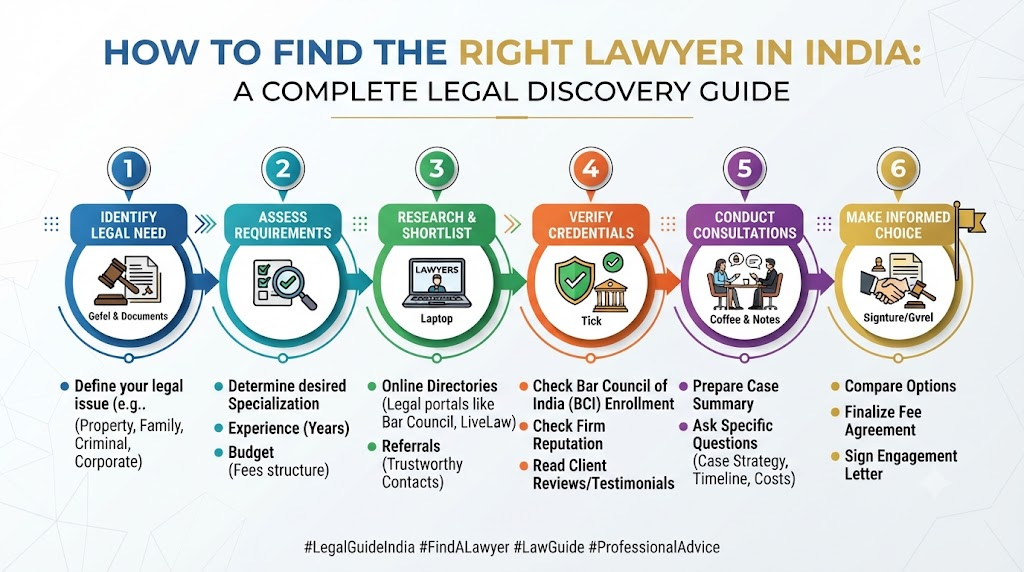
How to Find the Right Lawyer
Selecting the right legal advocate requires evaluating several critical factors rather than relying on location or cost alone:
- Domain Specialization: Ensure the advocate actively practices in the field relevant to your issue (e.g., engage a property specialist for land disputes, not a general practitioner).
- Court & Forum Experience: Laws and administrative customs vary across District Courts, High Courts, and specialized tribunals (such as NCLT, DRT, or Consumer Forums). Choose an advocate familiar with the specific forum handling your case.
- Professional Background: Verify membership with relevant State Bar Councils and review past experience with similar cases.
- Communication & Transparency: Your advocate should explain legal procedures, risks, and strategies clearly, without making unverified promises about outcomes.
- Fee Structure: Discuss professional fees, consultation charges, court fee allocations, and billing methods before formal engagement.
Lawyer Selection Criteria Comparison Table
| Factor | What to Check | Why It Matters |
| Specialization | Past case history in your specific legal domain | Ensures deep knowledge of domain-specific laws and precedents |
| Court Experience | Familiarity with the relevant local court or tribunal | Improves efficiency during procedural hearings and filings |
| Fee Transparency | Clear written schedule of consultation and representation fees | Prevents unexpected costs during long-term representation |
| Communication | Ability to explain complex legal terms in simple language | Helps you make informed legal decisions at every stage |
Online Lawyer Consultation and Digital Legal Discovery
Digital platforms have made legal consultation and information access far more transparent and efficient across India. Through structured online platforms, users can browse categorized lawyer profiles, evaluate practice areas, and book initial consultations remotely.
Benefits of Online Lawyer Consultation
- Accessibility: Connect with experienced advocates across different cities and High Courts without initial travel.
- Time Efficiency: Seek quick preliminary legal opinions on urgent matters, document reviews, or legal notices.
- Preparation: Organize digital copies of case files, timeline notes, and evidence before speaking with a professional.
┌─────────────────────────────────────────────────────────┐
│              Online Consultation Workflow               │
├─────────────────────────────────────────────────────────┤
│ 1. Search Advocate by Practice Area & Location           │
│ 2. Organize Digital Documents & Prepare Event Timeline   │
│ 3. Schedule & Complete Preliminary Consultation        │
│ 4. Receive Initial Assessment & Plan Next Steps         │
└─────────────────────────────────────────────────────────┘
When preparing for an online legal consultation:
- Draft a clear, chronological summary of events.
- Compile key documents (contracts, emails, legal notices, FIR copies, or property deeds) in PDF format.
- List specific questions regarding legal remedies, timeline estimates, and expected costs.
Consultation Methods Comparison Table
| Feature | Online Legal Consultation | In-Person Legal Consultation | Key Difference |
| Primary Use Case | Initial advice, document review, quick legal guidance | Detailed strategy, court preparation, signing originals | Online offers speed; In-person allows physical document handoff |
| Geographic Reach | Pan-India access to specialists across states | Limited to local advocates or nearby court districts | Online removes distance barriers for specialized legal advice |
| Document Sharing | Digital file sharing (PDFs, scans, emails) | Physical review of paper documents and files | Digital sharing requires organizing clear electronic copies |
| Cost & Time | Saves travel time and often lowers initial costs | Involves travel and potentially higher office session fees | Online consultations are generally more time-efficient |
When to Seek Professional Legal Help
While general awareness is helpful, certain legal situations demand immediate intervention by a qualified legal advocate:
- Receipt of a Legal Notice: Unanswered legal notices can lead to adverse court rulings or default proceedings.
- Criminal Inquiries or Summons: Being named in an FIR, receiving a police summons, or facing potential arrest requires immediate criminal legal representation.
- Real Estate Transactions: Signing property sale agreements or transferring land without title verification risks title fraud.
- Business Formations & Contracts: Launching a business, taking on investors, or signing major commercial agreements without legal review risks commercial liability.
- Matrimonial Breakdown: Issues involving legal separation, child custody, or property division require structured family law proceedings.
Costs and Consultation Considerations
Legal fees in India are not standardized by a single regulatory schedule and vary depending on several practical factors:
- Case Complexity: High-stakes corporate disputes or multi-party property trials require significantly more preparation and court appearances than simple legal notice drafts.
- Advocate Experience: Senior advocates with decades of specialized court practice command higher consultation and appearance fees.
- Jurisdiction and Court Level: Representation before State High Courts or the Supreme Court of India generally involves different fee structures than District Court appearances.
- Type of Engagement: Fees may be charged per consultation, as a fixed retainership, per court appearance, or as a flat rate for specific documentation (e.g., drafting a contract or title search report).
Always clarify fee terms, retainer agreements, and additional out-of-pocket expenses (court fees, drafting, stamping, and process costs) prior to formally engaging legal counsel.
Common Legal Mistakes to Avoid
Many individuals and business owners inadvertently complicate their legal position by making avoidable errors.
┌──────────────────────────────────────────────────────────┐
│              Avoid These Critical Errors                 │
├──────────────────────────────────────────────────────────┤
│ ❌ Delaying Legal Counsel Until Issues Escalate           │
│ ❌ Missing Statutory Limitation Deadlines                 │
│ ❌ Signing Documents Without Thorough Reading             │
│ ❌ Relying on Unverified Social Media Advice             │
│ ❌ Selecting Legal Representation Based Solely on Cost    │
└──────────────────────────────────────────────────────────┘
- Delaying Legal Counsel: Waiting until a summons is issued or a contract is breached severely limits available legal remedies.
- Missing Statutory Deadlines: Courts strictly enforce statutes of limitation. Missing a court filing deadline can permanently bar your claim.
- Signing Documents Unread: Never sign contracts, settlement deeds, or property agreements without fully understanding every clause.
- Relying on Generic Online Advice: Social media forums and generic articles cannot account for your specific factual context or local court rules.
- Choosing Based Solely on Lowest Cost: Selecting legal counsel based on low fees rather than domain expertise often leads to poor court representation and higher long-term costs.
Expert Tips for Managing Your Legal Affairs
Implementing structured habits can significantly improve how your legal matters are handled:
- Maintain an Organized Paper Trail: Keep chronological records of all communications, invoices, contracts, receipts, and court filings.
- Prepare a Written Event Timeline: When consulting an advocate, bring a bulleted summary of key events with exact dates and names.
- Be Completely Transparent with Your Lawyer: Full disclosure of all facts—both favorable and unfavorable—is necessary for your lawyer to build a strong legal strategy.
- Clarify the Scope of Work: Ensure you understand whether an advocate’s fee covers initial drafting, negotiation, court filings, or complete trial proceedings.
- Protect Confidentiality: Avoid discussing pending legal disputes, police inquiries, or court proceedings on public social media platforms.
Best Practices for Selecting and Working with an Advocate
To maintain a productive professional relationship with your legal counsel:
- Select for Specialization over Proximity: Prioritize an advocate’s experience in your specific issue area over physical office distance.
- Verify Qualifications: Confirm that the advocate is properly registered with a recognized State Bar Council.
- Keep Written Records: Confirm key instructions, fee agreements, and strategy decisions in writing or via email.
- Respect Legal Timelines: Provide requested documents, signatures, and evidence to your legal team well in advance of court filing deadlines.
- Consider Alternate Dispute Resolution (ADR): For civil, commercial, or family disputes, ask your lawyer whether mediation or arbitration could resolve the matter faster than traditional court litigation.
The Future of Legal Discovery in India
The legal sector in India is evolving rapidly through technology, digital court records, and online discovery platforms. Historically, finding a specialized legal advocate depended almost entirely on offline word-of-mouth recommendations, which made it difficult to compare practice areas, language preferences, or court experience.
Structured legal discovery platforms and digital directories are modernizing this process by providing transparent, searchable access to legal information and advocacy options across India. Combined with e-filing systems, virtual court hearings, and digital document verification, these platforms allow citizens and businesses to make informed, efficient choices when securing legal representation.
Why Choose WakilSahab
WakilSahab serves as a legal discovery and educational platform designed to bridge the gap between citizens seeking legal information and legal professionals across India.
Through its structured online directory and educational resources, WakilSahab simplifies the process of exploring legal services across key practice areas—including criminal law, family disputes, property title verifications, corporate compliance, and cybercrime matters. By organizing legal information and connecting users with advocates based on location, practice area, and court experience, WakilSahab helps individuals, startups, and enterprises navigate their legal options with confidence.
Frequently Asked Questions (FAQs)
1. How can I find a reliable lawyer near me in India?
To find a lawyer, identify your specific legal issue (e.g., criminal, family, or property law) and search for advocates specializing in that domain. You can use verified legal directories like WakilSahab, check State Bar Council registries, or seek recommendations. Always verify an advocate’s practice history, court experience, and professional background before engagement.
2. How do online lawyer consultations work in India?
An online lawyer consultation allows you to connect with an advocate remotely via phone or video call. You share digital copies of relevant legal documents beforehand, present your factual situation, and receive preliminary legal guidance on rights, remedies, and court procedures without needing to travel to an office.
3. What should I do if I receive a formal legal notice?
Do not ignore a legal notice. Review the notice carefully, note any response deadlines specified, and consult a qualified advocate immediately. Your lawyer will help gather relevant facts, evaluate the claims, and draft an appropriate written reply to protect your legal rights and prevent default court proceedings.
4. How are legal fees calculated by advocates in India?
Legal fees vary widely based on case complexity, advocate experience, court hierarchy, and practice area. Lawyers may charge fixed retainers, per-appearance fees, consultation hourly rates, or flat fees for document drafting. Always request a clear breakdown of professional fees and anticipated court expenses prior to engagement.
5. What is the difference between legal information and legal advice?
Legal information provides general legal facts, statutory definitions, court procedures, and options available under the law. Legal advice applies legal principles to an individual’s specific factual circumstances and recommends a precise course of action. Generic articles provide legal information; personalized strategy from a lawyer constitutes legal advice.
6. When should I hire a criminal lawyer near me?
You should consult a criminal lawyer immediately if you are named in an FIR, receive a police summons, face criminal investigation, or need to apply for anticipatory or regular bail. Early criminal representation ensures your constitutional rights are protected during police proceedings and inquiries.
7. How does a mutual consent divorce work under Indian law?
A mutual consent divorce occurs when both spouses agree to separate peacefully. Under statutes like the Hindu Marriage Act, both parties jointly file a petition addressing alimony, property division, and child custody. The court conducts hearings, observes a cooling-off period if required, and issues a final divorce decree.
8. Why is title verification important before buying property in India?
Title verification ensures that the seller holds clear, legal ownership of the property free from mortgages, pending court litigation, or illegal encumbrances. A property lawyer reviews past title deeds, encumbrance certificates, and revenue records to prevent land disputes and property fraud.
9. What steps should I take if I am a victim of cyber fraud?
If targeted by online fraud or identity theft, immediately notify your bank to block compromised accounts. Save evidence, including screenshots, transaction IDs, and communication logs. Report the incident to your local police cyber cell or file an online complaint at the National Cyber Crime Reporting Portal.
10. What does a corporate lawyer do for a startup or business?
A corporate lawyer guides businesses on company incorporation, Ministry of Corporate Affairs (MCA) compliances, shareholder agreements, employment contracts, vendor agreements, intellectual property protection, and commercial dispute resolution, ensuring the business operates in full compliance with Indian corporate laws.
11. Can I represent myself in an Indian court without a lawyer?
Yes, Section 32 of the Advocates Act allows individuals to argue their own cases (party-in-person) with court permission. However, because court procedures, evidentiary rules, and legal drafting are complex, hiring a qualified legal professional is strongly recommended to protect your interests.
12. What documents should I prepare before meeting a legal advocate?
Bring all relevant original documents or clear copies, including identity proofs, written agreements, emails, notices, police reports, or court papers. Prepare a chronological timeline of events with dates, times, and involved parties to ensure an efficient and focused initial consultation session.
13. How can I verify if an advocate is licensed to practice in India?
You can verify an advocate’s credentials by checking their enrollment card issued by the relevant State Bar Council. You can also verify their enrollment number through official Bar Council online portals or local Bar Association directories at the court where they practice.
14. Should I seek a second legal opinion on a complex legal matter?
Yes, seeking a second legal opinion is common in complex, high-stakes civil, criminal, or corporate disputes. A second opinion provides an independent perspective on legal strategy, potential risks, and settlement options, helping you make well-informed decisions.
15. How do digital lawyer discovery directories help legal consumers?
Digital lawyer directories organize legal professionals by location, practice domain, court experience, and language. This transparency helps individuals and businesses search for legal professionals, review domain specializations, and schedule consultations easily without relying solely on word-of-mouth.
Conclusion
Understanding your legal rights and identifying the appropriate legal counsel are essential steps when addressing legal matters in India. Whether you are dealing with property verification, corporate contracts, family disputes, or criminal proceedings, taking proactive steps and working with specialized legal professionals can help protect your interests and prevent costly court litigation. Modern digital legal discovery tools simplify this process, making legal information and advocate discovery transparent and accessible across the country.