Introduction
Data engineering teams often find themselves trapped in a reactive cycle. Pipelines break silently, dashboards display conflicting numbers, and downstream users discover missing records only after reports go public. Fixing these issues usually requires manual firefighting rather than systematic prevention.Traditional software development solved similar deployment and reliability problems years ago through DevOps. However, data environments face unique challenges, including complex schema changes, hidden pipeline dependencies, and continuous data drift.This is where understanding what is DataOps becomes essential for modern engineering organizations. DataOps is a collaborative and automated approach that improves the speed, quality, and reliability of data workflows. By combining automated testing, CI/CD, and robust monitoring, data teams can transition from reactive debugging to dependable, predictable delivery.
What Is DataOps?
At its core, DataOps brings agile methodologies, automation, and continuous improvement to data management and engineering. It unifies data engineers, data scientists, analytics engineers, and platform operators under a shared operational framework.Unlike standard software development, data applications depend on both application code and dynamic, ever-changing data assets. A pipeline might run successfully while quietly ingesting corrupted records or missing critical partitions. DataOps addresses this reality by treating data pipelines with the same engineering rigor applied to production software services.The practice integrates version control, automated testing, continuous integration, and continuous delivery (CI/CD) into data workflows. It also emphasizes observability, ensuring that teams detect anomalies, schema violations, and freshness delays before they impact business stakeholders.
Why Does DataOps Matter?
Data platforms grow complex rapidly. Organizations ingest data from dozens of SaaS APIs, transactional databases, and event streams, transforming them inside cloud data warehouses like Snowflake or BigQuery before serving BI reports and machine learning models.Without structured data operations, organizations encounter frequent pipeline failures and data corruption. Manual deployments introduce human error, and undocumented schema changes frequently break downstream analytics models.Implementing DataOps practices allows engineering teams to ship pipeline updates safely and reliably. Automated validation catches anomalies early, while CI/CD pipelines test code changes in isolated staging environments before promoting them to production. This reliability builds trust between technical teams and business stakeholders.
Core Components of DataOps
Modern data operations rely on several foundational pillars that work together to maintain pipeline health and data integrity.
Workflow Orchestration
Orchestration tools manage pipeline execution order, handle retries, and map dependencies across complex workflows. Instead of relying on brittle cron jobs, modern orchestrators like Apache Airflow, Prefect, or Dagster manage tasks dynamically and alert engineers immediately upon failure.
Data Transformation and Version Control
Modular transformation frameworks, particularly dbt, allow analytics and data engineers to write modular SQL with built-in version control. This ensures that every transformation step is tracked in Git, peer-reviewed via pull requests, and tested automatically.
Automated Data Quality and Testing
Data testing moves quality checks upstream. Instead of discovering bad data in production dashboards, teams write automated assertions for uniqueness, null counts, referential integrity, and freshness using tools like Great Expectations or native dbt tests.
Data Observability and Monitoring
Traditional software monitoring tracks CPU and memory usage, but data observability monitors data health. It tracks volume changes, schema evolution, distribution anomalies, and table freshness, giving engineers immediate visibility into data pipeline incidents.
| DataOps Area | Common Challenge | Useful Practice |
| Data Pipelines | Silent pipeline failures | Automated monitoring and retries |
| Data Quality | Corrupted records in production | Automated schema and assertion testing |
| CI/CD | Risky manual deployments | Git-based version control and automated staging promotion |
| Orchestration | Unmanaged task dependencies | Directed Acyclic Graph (DAG) orchestration |
| Observability | Hidden upstream data drift | Lineage tracking and anomaly detection |
The DataOps Lifecycle: From Source to Consumption
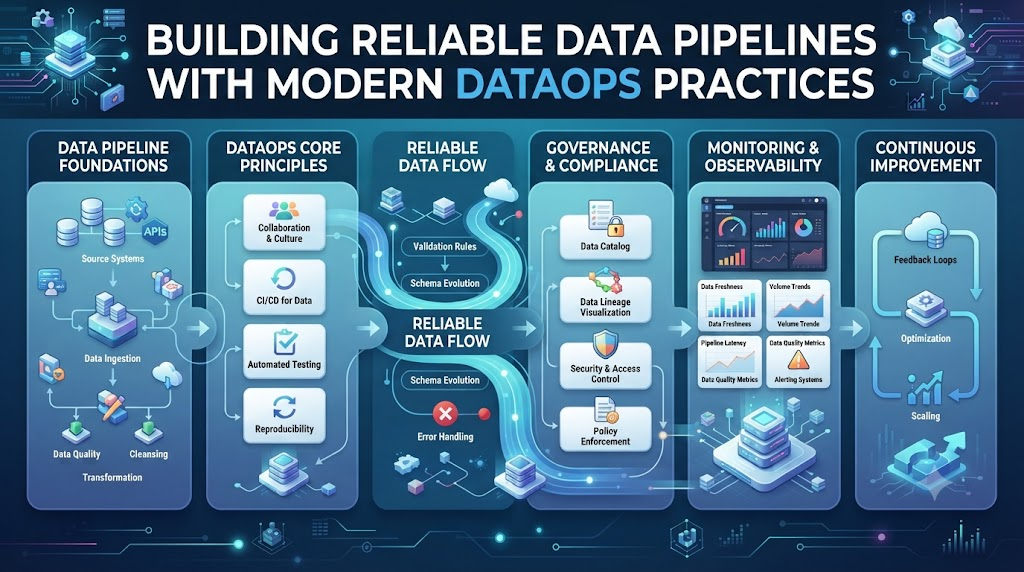
A robust DataOps architecture standardizes how data moves through an organization. The typical lifecycle follows a structured path from raw ingestion to end-user consumption.
Data Sources → Ingestion → Storage → Transformation → Quality Checks → Deployment → Monitoring → Consumption
- Ingestion: Raw data is pulled from external sources into a centralized cloud storage layer or data lakehouse.
- Transformation: Data is cleaned, modeled, and structured using version-controlled SQL or Python scripts.
- Quality Validation: Automated tests verify that transformed tables meet predefined schema and freshness rules.
- Deployment: CI/CD pipelines promote validated models and code changes into production environments.
- Monitoring: Observability tools track lineage and freshness continuously, alerting engineers to anomalies.
CI/CD for Data Pipelines
Continuous Integration and Continuous Delivery form the backbone of DataOps automation. In traditional software, CI/CD builds, tests, and deploys application code automatically. In data engineering, CI/CD must handle code and schema changes without disrupting historical data.
When a data engineer updates a transformation model, a CI pipeline spins up a temporary staging schema in the cloud data warehouse. It runs the new code against a subset of data, executes automated quality tests, and validates that no breaking changes occur.
Once approved, the continuous delivery process merges the code into production. This automated feedback loop reduces deployment anxiety and allows teams to ship pipeline updates multiple times a day.
Common Challenges in Data Operations
Building and maintaining a mature data operations practice presents distinct technical and organizational hurdles.
- Managing Schema Evolution: Upstream applications frequently alter database schemas without warning, breaking downstream ingestion pipelines and reporting models.
- Complex Pipeline Dependencies: As data graphs expand, identifying the downstream impact of an upstream failure becomes increasingly difficult without proper lineage mapping.
- Alert Fatigue: Poorly configured monitoring tools generate excessive alerts for minor threshold breaches, causing engineers to ignore critical warnings.
- Environment Parity: Maintaining consistency between local development environments, staging warehouses, and production infrastructure requires disciplined configuration management.
Best Practices for Implementation
Organizations looking to adopt DataOps successfully should focus on incremental improvements rather than a massive, disruptive overhaul.
- Treat Data Code as Software: Store all pipeline definitions, infrastructure configurations, and transformation models in version control systems like GitHub or GitLab.
- Test Early and Often: Implement data quality assertions as part of the build process, preventing invalid data from entering production tables.
- Establish Clear Ownership: Assign explicit ownership for every pipeline and dataset so teams know who to contact when an incident occurs.
- Invest in Observability: Use data lineage and monitoring tools to trace root causes quickly during pipeline failures.
- Promote Cross-Functional Collaboration: Break down silos between data engineers, analytics teams, and software developers to align data definitions and expectations.
The Role of DataOps Training and Certification
As organizations increasingly demand reliable data infrastructure, professionals with specialized operations skills are in high growth. Transitioning from traditional data engineering to modern operational practices requires structured learning paths.
Programs like those offered at DataOpsSchool.com help engineers master pipeline orchestration, CI/CD automation, and data observability. Earning a credential such as a Certified DataOps Engineer demonstrates structured proficiency in building resilient, automated data platforms. However, certification serves best when paired with hands-on project experience in real cloud environments.
Practical Tips / Key Takeaways
- Version control everything—pipeline code, transformation logic, and infrastructure configurations must live in Git repositories.
- Implement data quality tests directly inside your CI pipeline to catch breaking schema changes before they reach production.
- Choose modular orchestration tools that support clear task dependencies and dynamic retry mechanisms.
- Prioritize actionable alerting by monitoring data freshness and volume anomalies rather than raw server metrics alone.
- Adopt DataOps practices incrementally, starting with high-impact pipelines before scaling across the entire organization.
10 FAQs
1.What is DataOps?
DataOps is an automated, collaborative methodology that improves the design, testing, deployment, and monitoring of data pipelines and analytics workflows across an organization.
2.How is DataOps different from DevOps?
While DevOps focuses on traditional software applications and infrastructure, DataOps specifically addresses the unique challenges of data systems, including data quality, schema evolution, and pipeline dependencies.
3.Why are data quality tests important in DataOps?
Automated data quality tests catch corrupt records, missing values, and schema drift early, preventing downstream reporting errors and broken machine learning models.
4.What tools are commonly used in DataOps?
Common tools include Apache Airflow or Dagster for orchestration, dbt for transformations, Great Expectations or Soda for data quality testing, and GitHub Actions for CI/CD automation.
5.What does a DataOps Engineer do?
A DataOps Engineer builds, automates, and monitors reliable data pipelines, manages CI/CD workflows, and ensures high data availability and quality across cloud platforms.
6.What is included in DataOps training?
Training typically covers pipeline automation, workflow orchestration, version control, CI/CD for data, data testing, observability, and cloud platform operations.
7.How does CI/CD work in data engineering?
CI/CD for data automates the testing and deployment of pipeline and transformation code using isolated staging environments, ensuring smooth and safe production releases.
8.What is data observability?
Data observability is the practice of monitoring, tracking, and troubleshooting data health across pipelines by observing freshness, volume, distribution, and lineage.
9.How does DataOps consulting help organizations?
Consulting services help businesses modernize data platforms, automate messy pipelines, implement CI/CD, and resolve persistent data reliability and quality bottlenecks.
10.Do I need a certification to work in DataOps?
While not strictly mandatory, structured training and certification help validate your technical expertise in data automation, orchestration, and reliability engineering.
Conclusion
Modern organizations rely heavily on accurate, timely data to drive operational decisions and power machine learning models. Treating data pipelines as brittle scripts is no longer viable in fast-paced engineering environments.By embracing DataOps principles, teams can eliminate manual deployment bottlenecks, catch data quality issues early, and build resilient architectures that scale. Whether you are an experienced data engineer or exploring pathways through resources at DataOpsSchool.com, mastering these operational practices is essential for delivering dependable data products.